


Guided by Clinical Experience
At HSL LABS, we believe meaningful innovation begins with those who experience the realities of patient recovery every day. Physicians routinely observe the challenges, opportunities, and unmet needs that emerge throughout the recovery journey – from patient education and engagement, to protocol implementation, communication, and long-term outcomes. Their firsthand experience provides valuable insight into where recovery support can be strengthened and where new solutions may create meaningful improvements for both patients and practices.
Rather than developing programs, technologies, protocols, and products in isolation, HSL LABS incorporates physician perspective throughout the development process. By combining clinical observations with structured evaluation, research, implementation experience, and ongoing feedback, the Company ensures that its initiatives remain practical, relevant, and aligned with real-world healthcare environments. This physician-informed approach serves as an important foundation for organizational learning, continuous improvement, and the advancement of post-procedural recovery.
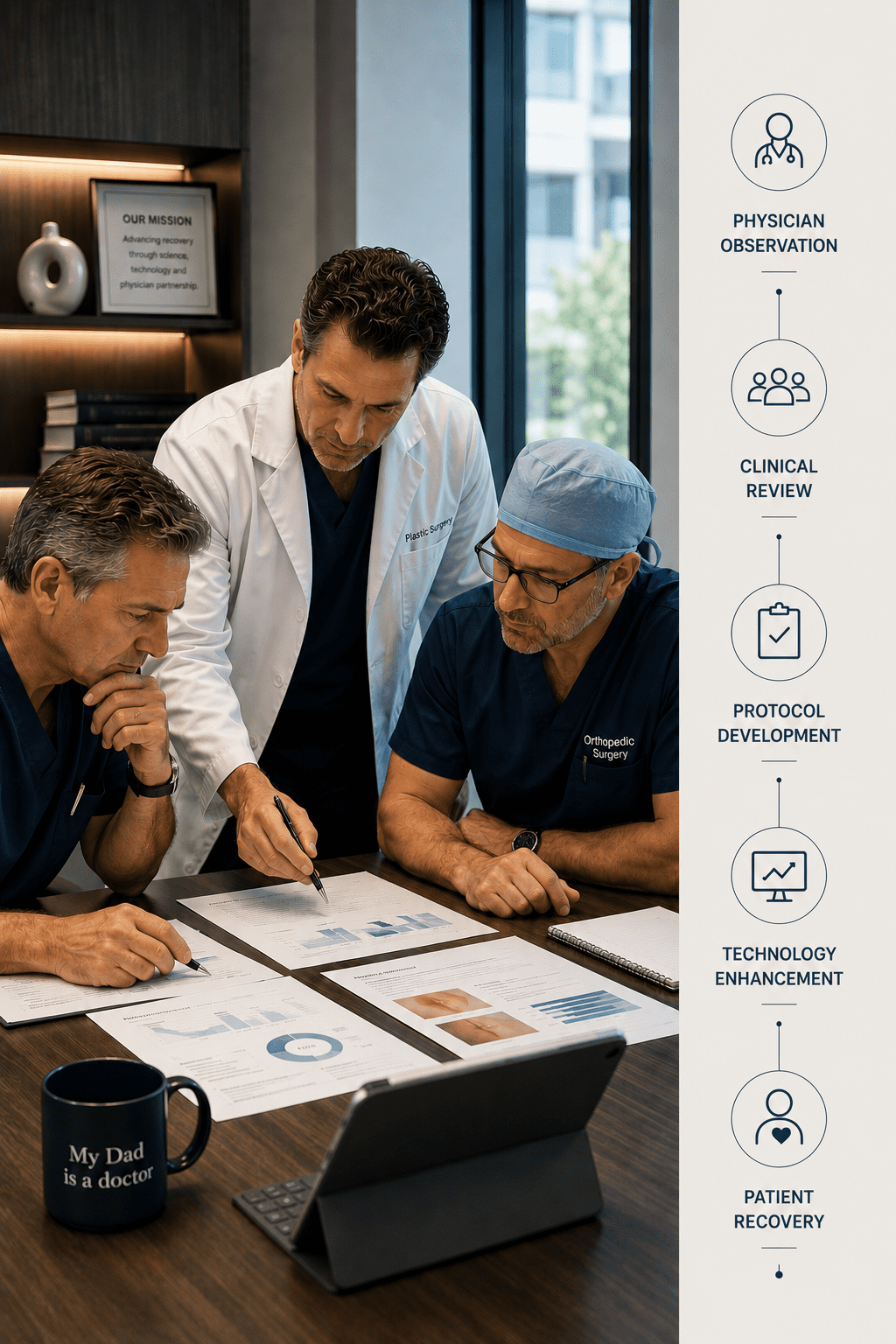
Guided by Clinical Experience
At HSL LABS, we believe meaningful innovation begins with those who experience the realities of patient recovery every day. Physicians routinely observe the challenges, opportunities, and unmet needs that emerge throughout the recovery journey – from patient education and engagement, to protocol implementation, communication, and long-term outcomes. Their firsthand experience provides valuable insight into where recovery support can be strengthened and where new solutions may create meaningful improvements for both patients and practices.
Rather than developing programs, technologies, protocols, and products in isolation, HSL LABS incorporates physician perspective throughout the development process. By combining clinical observations with structured evaluation, research, implementation experience, and ongoing feedback, the Company ensures that its initiatives remain practical, relevant, and aligned with real-world healthcare environments. This physician-informed approach serves as an important foundation for organizational learning, continuous improvement, and the advancement of post-procedural recovery.

PHYSICIAN-INFORMED DIRECTION
The direction of HSL LABS is shaped, in significant part, by the practical insights of physicians who routinely manage patients throughout the recovery process. Rather than relying exclusively upon internal development teams, market research, or theoretical models, the Company incorporates real-time physician observations, experiences, and recommendations into multiple aspects of organizational planning, program development, protocol refinement, technology design, educational initiatives, and product evaluation.
This approach reflects a straightforward reality: Practicing physicians encounter recovery-related challenges, patient concerns, implementation barriers, and unmet clinical needs on a daily basis. They observe where patients struggle, where recovery support may be insufficient, where communication gaps arise, and where opportunities may exist to improve recovery experiences and long-term outcomes. HSL LABS regards these observations as a most valuable source of developmental intelligence for decisionmaking.
Many Company initiatives begin with physician-identified needs. These may involve recurring recovery concerns, procedural-specific challenges, opportunities for improved patient engagement, workflow inefficiencies within clinical practices, educational deficiencies, or the absence of products designed to address particular aspects of the recovery experience. Rather than beginning with an idealized product and then searching for a market, HSL LABS begins its process by evaluating issues identified by physicians and then determining whether those issues may warrant the development of new programs, protocols, technologies, educational resources, or products.
The Company has established formal mechanisms through which physician input is routinely introduced, evaluated, and acted upon. One of the most important of these mechanisms is the Internal Executive Briefing (IEB) process. Through this structured review framework, physician observations, recommendations, developmental concepts, protocol modifications, product ideas, technology enhancements, and strategic opportunities are presented for evaluation by organizational leadership and relevant advisory participants. This process provides a disciplined pathway through which ideas may be examined, refined, prioritized, and ultimately incorporated into Company initiatives where appropriate.
Physician-informed direction also plays a central role in protocol development. Recovery protocols must operate effectively within real-world clinical environments and reflect the practical realities of patient care. Participating physicians provide valuable perspective regarding procedural variability, recovery timelines, patient compliance considerations, communication needs, implementation feasibility, and recovery-phase requirements. These insights help ensure that protocols consistently remain practical, adaptable, and aligned with contemporary clinical practice rather than existing solely as theoretical frameworks.
Technology development similarly benefits from active physician participation. Through ongoing discussions and review processes, physicians provide input regarding workflow integration, documentation requirements, patient communication systems, recovery monitoring capabilities, dashboard functionality, reporting needs, and other operational considerations. These perspectives continue to contribute to the ongoing evolution of PhysicianOS™, the Physician Dashboard, Patient Portal, and related technological infrastructure.
Educational initiatives represent another area in which physician-informed direction influences organizational priorities. Physicians frequently identify recurring patient misconceptions, informational deficiencies, communication challenges, and opportunities for improved educational support. Such observations help guide the development of educational materials, patient resources, training initiatives, professional development programs, and other informational assets designed to improve understanding and engagement. High-quality, accessible patient education materials are integral to the processes of patient protocol acceptance and adherence.
Product development within HSL LABS is also heavily influenced by physician observations. Potential opportunities frequently emerge from real-world clinical experiences involving post-surgical recovery, scar management, peri-procedural preparation, swelling and bruising concerns, minimally invasive procedure aftercare, compression support, patient adherence, and other recovery-related challenges. Physician input helps inform the identification, prioritization, evaluation, and refinement of product concepts before they enter broader development pathways.
Importantly, physician-informed direction is not limited to the introduction of new ideas. Existing programs, protocols, technologies, and products remain subject to ongoing review and refinement through physician feedback. As implementation experience accumulates and new observations emerge, physicians contribute insight regarding what is working effectively, what may require modification, and where additional opportunities for improvement may exist. This creates a continuous feedback cycle that supports long-term organizational learning and iterative development and improvement.
The Company further benefits from physician participation through its broader advisory framework, including committee review activities, peer evaluation processes, and collaborative discussions involving multiple specialties and geographic regions. This structure helps ensure that developmental initiatives are informed by a diversity of perspectives rather than by isolated viewpoints or limited experiences.
Ultimately, physician-informed direction serves as one of the principal mechanisms through which HSL LABS seeks to maintain relevance, practicality, and responsiveness within the healthcare environments it serves. By systematically incorporating physician observations into organizational decision-making, the Company is able to ground its programs, protocols, technologies, educational initiatives, and products in the realities of clinical practice while maintaining an ongoing awareness of emerging needs, challenges, and opportunities within the evolving landscape of post-procedural recovery.