

TECHNOLOGY
Technology serves as a foundational component of the HSL LABS operational framework, supporting the integration of programs, protocols, communications, documentation, patient engagement, workflow management, and organizational oversight within a unified environment. The Company utilizes technology not as a standalone objective, but as a practical tool for enhancing consistency, efficiency, accessibility, and informed decision-making across its initiatives.
As recovery programs and clinical support systems become increasingly sophisticated, the ability to organize information, facilitate communication, manage workflows, and maintain continuity assumes growing importance. HSL LABS develops and deploys technology solutions designed to support these functions while helping to streamline administrative processes and improve coordination among participating stakeholders.
The Company’s technology infrastructure is intended to facilitate structured implementation, support ongoing refinement initiatives, preserve institutional knowledge, and enable scalable growth without compromising operational standards. Through the thoughtful application of modern software architecture, workflow automation, data management capabilities, and secure digital systems, HSL LABS seeks to create a reliable technological foundation for its expanding recovery ecosystem.
As healthcare technologies continue to evolve, the Company remains committed to exploring new opportunities to enhance functionality, improve user experiences, strengthen operational capabilities, and support the long-term advancement of recovery-focused innovation.
TECHNOLOGY
Technology serves as a foundational component of the HSL LABS operational framework, supporting the integration of programs, protocols, communications, documentation, patient engagement, workflow management, and organizational oversight within a unified environment. The Company utilizes technology not as a standalone objective, but as a practical tool for enhancing consistency, efficiency, accessibility, and informed decision-making across its initiatives.
As recovery programs and clinical support systems become increasingly sophisticated, the ability to organize information, facilitate communication, manage workflows, and maintain continuity assumes growing importance. HSL LABS develops and deploys technology solutions designed to support these functions while helping to streamline administrative processes and improve coordination among participating stakeholders.
The Company’s technology infrastructure is intended to facilitate structured implementation, support ongoing refinement initiatives, preserve institutional knowledge, and enable scalable growth without compromising operational standards. Through the thoughtful application of modern software architecture, workflow automation, data management capabilities, and secure digital systems, HSL LABS seeks to create a reliable technological foundation for its expanding recovery ecosystem.
As healthcare technologies continue to evolve, the Company remains committed to exploring new opportunities to enhance functionality, improve user experiences, strengthen operational capabilities, and support the long-term advancement of recovery-focused innovation.
Technology Built Around Recovery
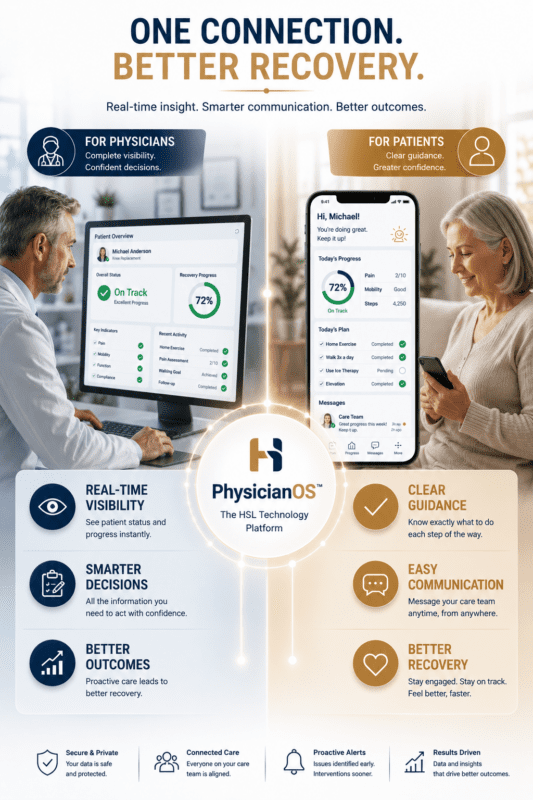
Most healthcare technology is designed to support scheduling, billing, documentation, and administrative workflows. While these functions are important, recovery often extends far beyond the procedure itself, requiring ongoing coordination, education, communication, visibility, and patient engagement over weeks and months. HSL LABS believes that recovery is not a single event, but a process that unfolds over time, creating the need for technology specifically designed to support the recovery journey and the many activities that occur throughout it.
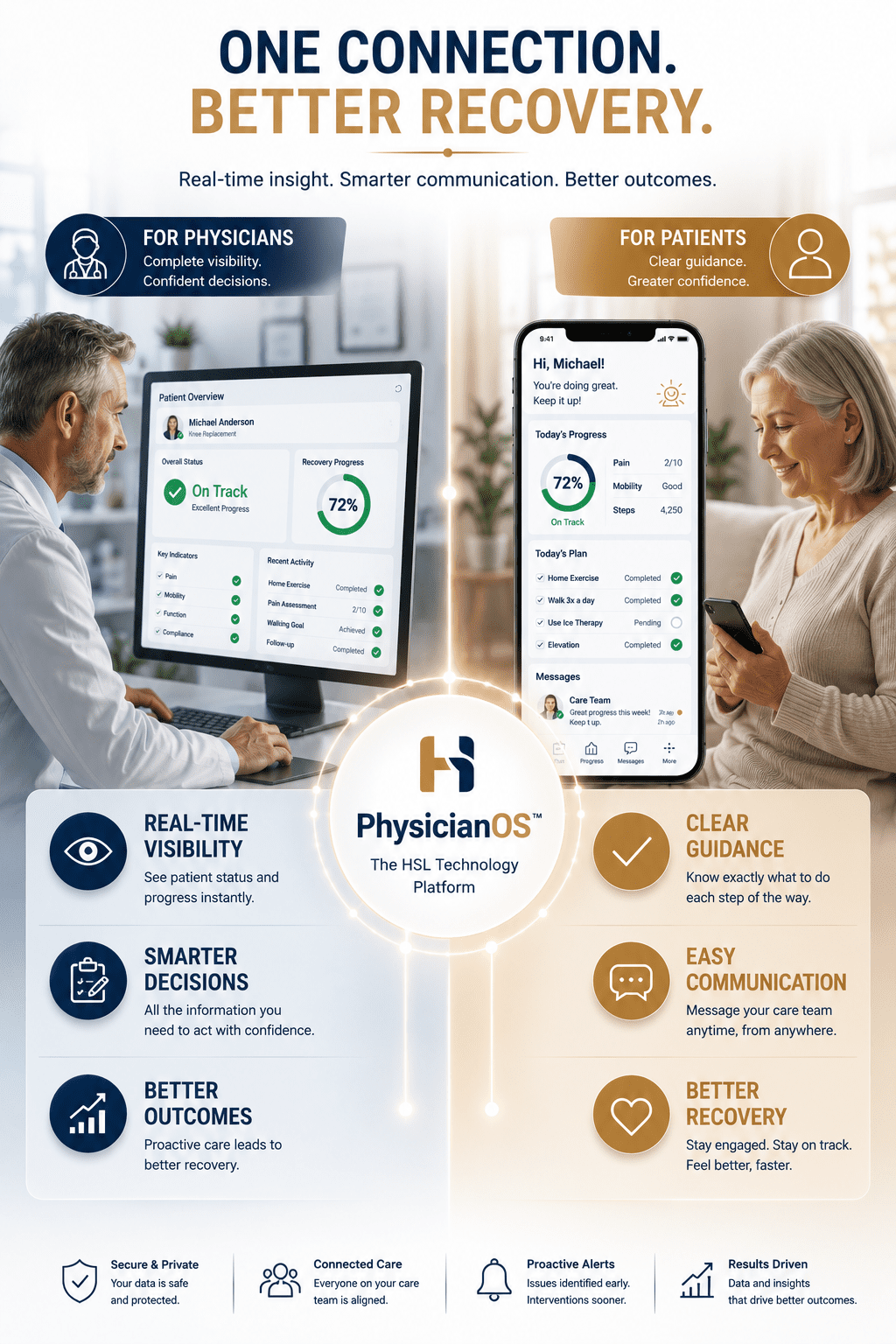
The HSL LABS technology ecosystem was developed to help physicians, practices, and patients navigate recovery in a more structured, organized, and connected manner. Through recovery-focused operational tools, educational resources, patient engagement systems, reporting capabilities, communication frameworks, and physician visibility features, the platform is designed to support consistency, accountability, and informed decision-making throughout the recovery experience. At the center of this ecosystem is PhysicianOS™, the clinical operating system that helps coordinate and manage recovery-related activities before, during, and after procedural care.
Technology Built Around Recovery
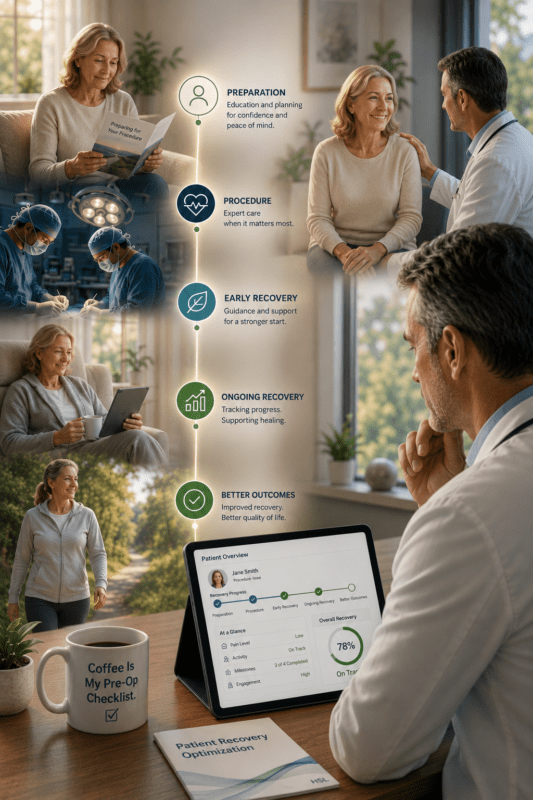
Most healthcare technology is designed to support scheduling, billing, documentation, and administrative workflows. While these functions are important, recovery often extends far beyond the procedure itself, requiring ongoing coordination, education, communication, visibility, and patient engagement over weeks and months. HSL LABS believes that recovery is not a single event, but a process that unfolds over time, creating the need for technology specifically designed to support the recovery journey and the many activities that occur throughout it.
The HSL LABS technology ecosystem was developed to help physicians, practices, and patients navigate recovery in a more structured, organized, and connected manner. Through recovery-focused operational tools, educational resources, patient engagement systems, reporting capabilities, communication frameworks, and physician visibility features, the platform is designed to support consistency, accountability, and informed decision-making throughout the recovery experience. At the center of this ecosystem is PhysicianOS™, the clinical operating system that helps coordinate and manage recovery-related activities before, during, and after procedural care.
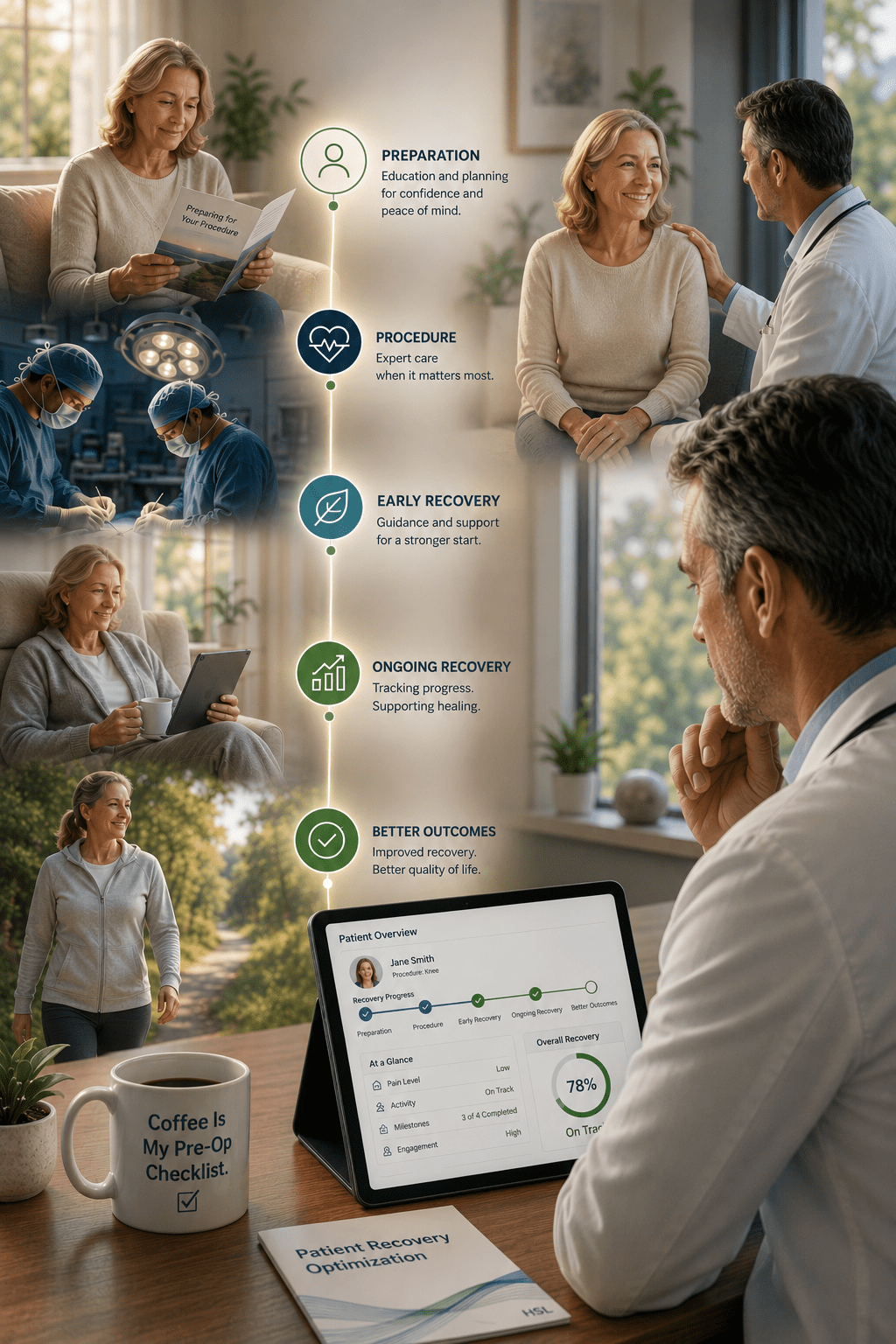
PhysicianOS™ CLINICAL OPERATING SYSTEM
PhysicianOS™ is the unique proprietary clinical operating system developed by HSL LABS to support the administration, coordination, documentation, communication, and management of its recovery-focused programs, protocols, technologies, educational initiatives, and physician participation activities. Designed specifically for physician-guided procedural environments, the platform serves as the central operational infrastructure through which many organizational functions are organized and managed.
The development of PhysicianOS™ arose from the recognition that recovery-focused initiatives involve a substantial volume of information, documentation, communications, workflows, educational resources, protocol materials, reporting activities, and physician interactions. Managing these functions through disconnected systems can create inefficiencies, duplication of effort, version-control challenges, communication gaps, and administrative burdens. PhysicianOS™ was designed to address these issues through a unified and purpose-built operating environment.
At its core, PhysicianOS™ functions as a centralized platform through which participating physicians and authorized personnel may access program resources, protocol documentation, educational materials, training resources, operational guidance, administrative tools, reporting systems, and other approved content relevant to their participation in HSL LABS initiatives.
One of the platform’s principal responsibilities is protocol administration. Physicians and designated staff members may access current protocol versions, implementation guidance, procedural-specific materials, recovery-phase resources, revision histories, supporting documentation, and related information through a structured and centrally managed environment. This helps promote consistency while ensuring that users have access to current and approved materials.
PhysicianOS™ also supports communication and information distribution throughout the HSL LABS ecosystem. Organizational announcements, protocol updates, educational releases, committee communications, advisory notifications, implementation guidance, and other important information may be disseminated through the platform in a controlled and documented manner. This helps reduce fragmentation and ensures that participants receive information through a common communications channel.
The platform serves an important role within the Company’s governance framework. Materials associated with Internal Executive Briefings, Committee Review activities, Clinical Advisory Council initiatives, peer review processes, policy development efforts, and other organizational functions may be managed through PhysicianOS™. This capability supports documentation integrity, workflow continuity, accountability, and institutional recordkeeping.
Another significant function of the system involves operational coordination. Participating practices may utilize PhysicianOS™ to access implementation resources, administrative tools, support materials, educational content, reporting requirements, and program-management information. The objective is to simplify participation while reducing administrative complexity for physicians and their staff.
The platform is also intended to support organizational learning activities. Information generated through approved reporting initiatives, Designated Clinical Research and Data Facility participation, implementation observations, protocol evaluations, educational assessments, technology reviews, and other approved activities may be organized within the system to support review, analysis, and future decision-making. In this respect, PhysicianOS™ serves not only as an operational platform but also as a repository of institutional knowledge.
Technology development within PhysicianOS™ is guided by practical implementation requirements rather than theoretical software objectives. Enhancements are evaluated based upon physician feedback, workflow observations, operational experiences, organizational needs, and emerging opportunities identified through the Company’s governance and review processes. This approach helps ensure that platform evolution remains aligned with the realities of clinical practice and organizational operations.
Privacy, security, access control, and information governance are important considerations within the design and administration of PhysicianOS™. The system is intended to support responsible information management through role-based access controls, administrative oversight, documentation standards, audit capabilities, and other safeguards appropriate to the platform’s operational objectives.
As HSL LABS continues to expand, PhysicianOS™ is expected to serve as an increasingly important component of the Company’s technological infrastructure. Future capabilities may include enhanced workflow management tools, expanded reporting resources, educational delivery systems, communication features, data-management capabilities, and additional functionality designed to support physicians, participating practices, advisory participants, and organizational leadership.
Ultimately, PhysicianOS™ is more than a software application. It is the operational framework through which many of the Company’s programs, protocols, communications, governance activities, educational initiatives, and physician participation efforts are coordinated. By bringing these functions together within a unified environment, the platform helps support consistency, accountability, efficiency, and long-term organizational growth across the HSL LABS ecosystem.
Recovery Visibility & Practice Oversight
Managing recovery often requires physicians and staff to coordinate information across patient communications, recovery activities, educational engagement, follow-up requirements, and operational workflows. As recovery progresses over days, weeks, and months, maintaining visibility into patient status and practice activities can become increasingly complex. The Physician Dashboard was designed to provide a centralized view of recovery-related information, helping practices maintain greater awareness of patient progress, participation, and recovery-support activities throughout the recovery journey.
By bringing recovery monitoring, patient engagement oversight, operational reporting, protocol management, communications, and practice-level insights into a single environment, the Physician Dashboard helps support more informed decision-making and improved workflow efficiency. The goal is not simply to provide access to information, but to help physicians and their teams identify opportunities for patient support, maintain greater visibility throughout recovery, and deliver a more organized, consistent, and connected recovery experience for both patients and practice staff.
Recovery Visibility & Practice Oversight
Managing recovery often requires physicians and staff to coordinate information across patient communications, recovery activities, educational engagement, follow-up requirements, and operational workflows. As recovery progresses over days, weeks, and months, maintaining visibility into patient status and practice activities can become increasingly complex. The Physician Dashboard was designed to provide a centralized view of recovery-related information, helping practices maintain greater awareness of patient progress, participation, and recovery-support activities throughout the recovery journey.
By bringing recovery monitoring, patient engagement oversight, operational reporting, protocol management, communications, and practice-level insights into a single environment, the Physician Dashboard helps support more informed decision-making and improved workflow efficiency. The goal is not simply to provide access to information, but to help physicians and their teams identify opportunities for patient support, maintain greater visibility throughout recovery, and deliver a more organized, consistent, and connected recovery experience for both patients and practice staff.
PHYSICIAN DASHBOARD
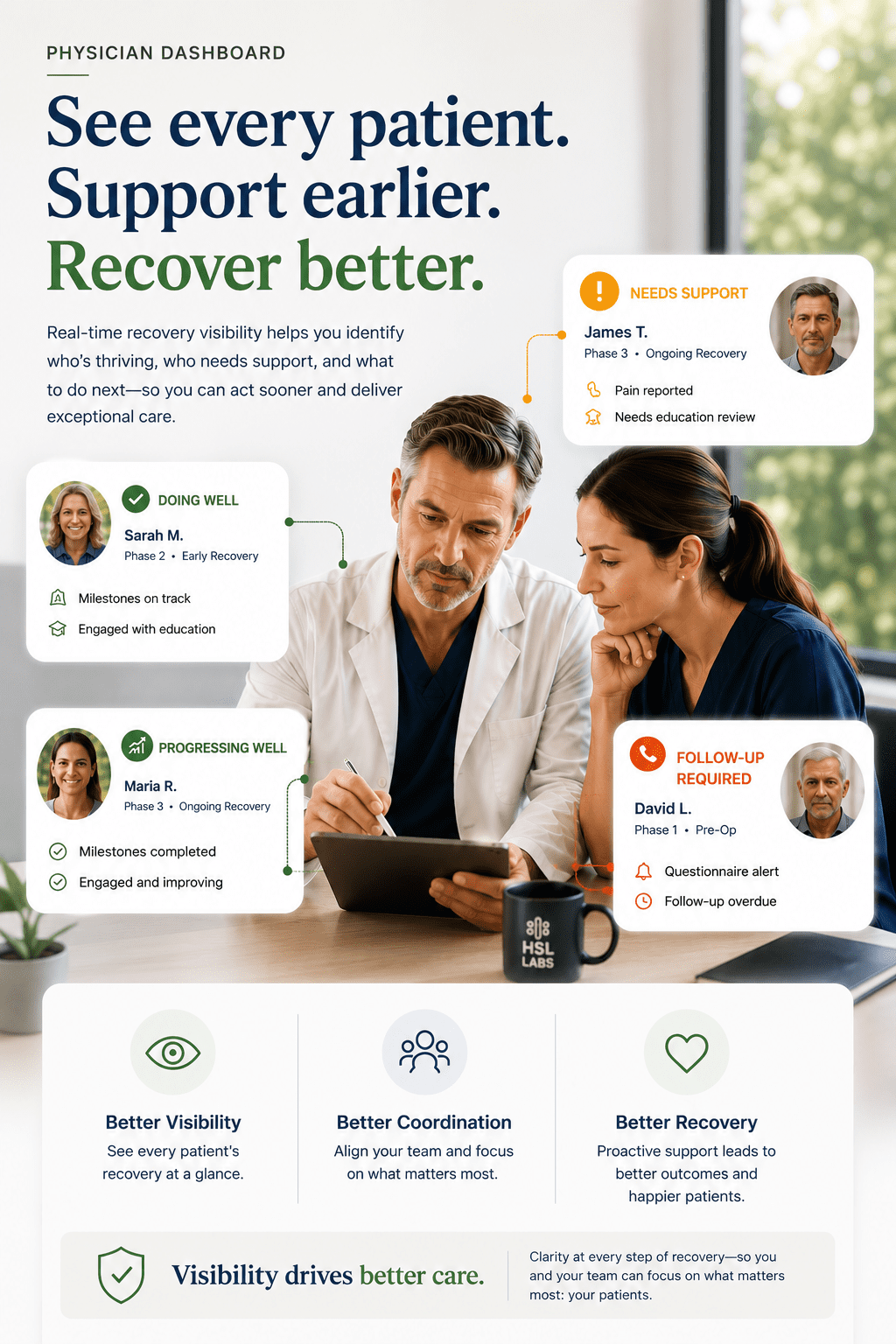
The Physician Dashboard serves as the primary operational interface through which participating physicians and authorized practice personnel interact with PhysicianOS™. Designed specifically for procedural practices participating in HSL LABS programs and initiatives, the dashboard provides centralized access to patient recovery information, protocol management tools, reporting resources, educational materials, communications, practice analytics, and administrative functions within a single integrated environment.
The dashboard was developed to address a common challenge within modern healthcare operations: the fragmentation of information across multiple systems, documents, communications channels, and administrative processes. By consolidating relevant recovery-related information and operational resources into a unified interface, the Physician Dashboard seeks to improve visibility, coordination, efficiency, and decision-making throughout the patient recovery lifecycle.
One of the dashboard’s primary functions is recovery monitoring. Participating physicians and authorized staff members may access information regarding enrolled patients, recovery-phase status, protocol participation, educational engagement, milestone completion, reporting activity, and other approved recovery-related indicators. This capability allows practices to maintain a more organized view of recovery activities while facilitating appropriate follow-up and patient support efforts.
The dashboard also supports protocol administration and implementation management. Physicians and staff may review protocol assignments, recovery-phase transitions, implementation guidance, protocol revisions, procedural-specific recommendations, educational materials, and related documentation. This helps ensure that practices are working from current information while reducing administrative complexity associated with protocol management.
Patient engagement oversight represents another important component of the system. The dashboard may provide visibility into patient participation activities, educational resource utilization, communication interactions, reporting compliance, follow-up requirements, and other engagement metrics. These tools help practices identify opportunities for additional patient support while encouraging continuity throughout the recovery process.
In addition to patient-specific functions, the dashboard provides practice-level operational reporting capabilities. Participating practices may access information regarding program utilization, enrollment activity, protocol implementation trends, reporting completion rates, patient participation metrics, educational engagement statistics, workflow performance indicators, and other operational measures relevant to practice participation within HSL LABS initiatives.
The Physician Dashboard is also intended to support quality management and performance evaluation activities. Practices may review implementation patterns, identify recurring operational challenges, evaluate recovery-support workflows, monitor participation consistency, and assess various aspects of program utilization. These capabilities assist physicians and staff in maintaining awareness of operational performance while identifying opportunities for improvement.
Communication management is integrated throughout the dashboard environment. Physicians and designated personnel may receive organizational announcements, protocol updates, Clinical Advisory Council communications, educational releases, technology notifications, implementation guidance, and other relevant information through a centralized communications framework. This helps reduce reliance upon fragmented communication channels while ensuring that important information remains accessible and documented.
The dashboard additionally serves as an access point for administrative and governance-related functions. Authorized users may review Internal Executive Briefing materials, committee communications, peer review activities, policy updates, training resources, compliance documentation, and other organizational information relevant to their roles and responsibilities. These capabilities help support transparency, accountability, and informed participation throughout the HSL LABS ecosystem.
A significant advantage of the Physician Dashboard is its ability to aggregate information from multiple operational activities into a single management environment. Rather than requiring physicians and staff to navigate separate systems for patient engagement, protocol management, reporting, communications, education, and administrative functions, the dashboard provides a consolidated view of relevant information and resources. This integration supports more efficient workflow management and reduces administrative burden within participating practices.
The dashboard is also designed to support longitudinal analysis and practice-level trend evaluation. Over time, participating physicians may be able to review historical participation data, recovery-support activities, educational utilization patterns, reporting trends, operational performance metrics, and other aggregated information that may assist in evaluating practice engagement and implementation effectiveness.
As PhysicianOS™ continues to evolve, the Physician Dashboard is expected to expand through the addition of enhanced reporting tools, workflow management capabilities, predictive analytics, communication resources, patient engagement features, and other functionality designed to support participating physicians and their practices. Future development priorities will continue to be informed by physician feedback, operational experience, technology evaluations, and recommendations emerging through the Company’s governance and review processes.
Ultimately, the Physician Dashboard functions as the operational command center for participating practices. By integrating recovery management, protocol administration, patient engagement oversight, reporting capabilities, communications, analytics, and administrative resources into a single environment, the dashboard helps physicians and their teams manage participation activities more efficiently while supporting informed decision-making throughout the recovery process.
Recovery Guidance Every Step Of The Way
Recovery often extends far beyond the day of a procedure. Patients may receive instructions, educational materials, reminders, product recommendations, follow-up information, and recovery guidance from multiple sources throughout the recovery process. As recovery progresses, important information can become difficult to locate, timelines may become unclear, and patients may be uncertain about what actions should be taken next. The Patient Portal was designed to provide a single, centralized destination where patients can access the information, resources, and support tools associated with their recovery journey.
The platform helps organize recovery information according to the patient’s current stage of recovery, providing access to educational content, recovery resources, reminders, milestone tracking, reporting activities, and program materials when they are most relevant. By delivering information in a structured and organized manner, the portal helps reduce confusion, improve understanding, and create a more predictable recovery experience for patients navigating the weeks and months following a procedure.
Beyond providing access to information, the Patient Portal is intended to encourage engagement and participation throughout recovery. Progress tracking, recovery timelines, educational assignments, reminders, communications, and recovery-support resources help patients remain connected to their recovery plan while supporting physician-directed recommendations and approved program activities. The result is a more organized, informed, and confident recovery experience that helps patients better understand where they are today, what comes next, and how to navigate recovery with greater clarity and confidence.
Recovery Guidance Every Step Of The Way
Recovery often extends far beyond the day of a procedure. Patients may receive instructions, educational materials, reminders, product recommendations, follow-up information, and recovery guidance from multiple sources throughout the recovery process. As recovery progresses, important information can become difficult to locate, timelines may become unclear, and patients may be uncertain about what actions should be taken next. The Patient Portal was designed to provide a single, centralized destination where patients can access the information, resources, and support tools associated with their recovery journey.
The platform helps organize recovery information according to the patient’s current stage of recovery, providing access to educational content, recovery resources, reminders, milestone tracking, reporting activities, and program materials when they are most relevant. By delivering information in a structured and organized manner, the portal helps reduce confusion, improve understanding, and create a more predictable recovery experience for patients navigating the weeks and months following a procedure.
Beyond providing access to information, the Patient Portal is intended to encourage engagement and participation throughout recovery. Progress tracking, recovery timelines, educational assignments, reminders, communications, and recovery-support resources help patients remain connected to their recovery plan while supporting physician-directed recommendations and approved program activities. The result is a more organized, informed, and confident recovery experience that helps patients better understand where they are today, what comes next, and how to navigate recovery with greater clarity and confidence.

PATIENT PORTAL
The Patient Portal serves as the primary patient-facing component of the PhysicianOS™ ecosystem. Designed to provide convenient access to recovery-related resources, educational materials, communications, reporting tools, and program information, the portal functions as a centralized environment through which participating patients may engage with approved HSL LABS recovery initiatives throughout the post-procedural experience.
The portal was developed in response to a common challenge faced by recovering patients: important information is often distributed across multiple documents, emails, printed materials, websites, instructions, and conversations. As a result, patients may struggle to locate information when needed, misunderstand recovery expectations, overlook educational resources, or fail to complete recommended recovery-related activities. The Patient Portal seeks to address these challenges by consolidating relevant information within a single, easily accessible platform.
One of the portal’s primary functions is the delivery of recovery-phase-specific information. As patients progress through different stages of recovery, they may be provided access to educational resources, guidance materials, instructional content, recovery reminders, and other information appropriate to their current stage of participation. This phased approach helps ensure that information is delivered when it is most relevant rather than overwhelming patients with large volumes of material at the outset of the recovery process.
The portal also serves as a centralized repository for educational resources. Patients may access recovery guides, instructional materials, frequently asked questions, video content, program documents, procedural-specific information, and other approved educational assets intended to support understanding and informed participation throughout recovery.
Communication support represents another important function of the platform. The Patient Portal may provide access to announcements, educational updates, recovery reminders, scheduled notifications, program communications, and other information distributed through approved communication channels. This capability helps maintain continuity while reducing the likelihood that important information will be overlooked.
Patients may also utilize the portal to complete approved reporting activities associated with their participation in HSL LABS programs. Depending upon the nature of a particular initiative, reporting functions may include recovery status updates, milestone confirmations, educational completion acknowledgments, participation tracking, questionnaire responses, observational reporting, and other activities designed to support program administration and recovery monitoring.
The portal is designed to assist patients in understanding their recovery progression. Through visual timelines, milestone tracking tools, recovery calendars, phase indicators, and related features, patients may view their current stage of participation and better understand upcoming recovery activities, educational resources, and recommended actions. These tools help create a more organized and predictable recovery experience.
Program participation management is another key capability. Patients may review enrollment information, program materials, participation requirements, recovery schedules, educational assignments, and other resources associated with their involvement in HSL LABS initiatives. By providing centralized access to these materials, the portal helps reduce confusion and improve overall participation consistency.
The platform may also support the distribution of procedural-specific resources tailored to the patient’s treatment category. Recovery information relevant to facial procedures, breast procedures, body-contouring procedures, reconstructive interventions, minimally invasive treatments, and other approved categories may be organized and delivered according to the needs of individual participants. This allows educational and support resources to remain relevant to the patient’s specific recovery experience.
Another important objective of the portal is to encourage patient accountability and engagement. Participation reminders, milestone notifications, educational assignments, reporting requests, and recovery-related prompts help patients remain actively involved in the recovery process while supporting adherence to physician-directed recommendations and approved program activities.
The Patient Portal is additionally intended to improve continuity between patients and participating practices. By creating a centralized environment for information exchange, educational delivery, reporting activities, and program participation, the portal helps support more consistent communication throughout the recovery journey.
Privacy, security, and information protection remain important considerations in the design and operation of the platform. Access controls, authentication procedures, administrative safeguards, and approved information-management practices are incorporated to support responsible handling of patient-related information and maintain appropriate standards of confidentiality.
As HSL LABS continues to expand its technological capabilities, future Patient Portal enhancements may include additional educational resources, expanded reporting tools, personalized recovery pathways, advanced communication features, interactive recovery-support content, and other functionality intended to improve the patient experience.
Ultimately, the Patient Portal serves as the patient’s central point of access to the HSL LABS recovery ecosystem. By bringing together recovery information, educational resources, reporting tools, communications, participation activities, and progress-tracking capabilities within a single environment, the platform helps patients navigate recovery with greater clarity, organization, and confidence.
Building the Infrastructure for Continuous Learning and Improvement
Technology within HSL LABS is designed to support more than today’s operational needs. As participation expands across physicians, practices, educational initiatives, recovery programs, and organizational activities, the underlying infrastructure is intended to evolve alongside it. Future development efforts are focused on creating a flexible foundation capable of supporting long-term growth, organizational learning, and increasingly sophisticated recovery-support capabilities.
As information, implementation experience, and physician participation accumulate over time, new opportunities emerge to better understand recovery processes, protocol utilization, educational effectiveness, operational performance, and organizational trends. Future reporting, analytics, and intelligence capabilities are intended to help transform these observations into meaningful insights that support informed decision-making while maintaining physician oversight and professional judgment.
Looking forward, HSL LABS is focused on building an integrated technology ecosystem that connects physician dashboards, patient engagement tools, educational resources, governance systems, administrative workflows, and future intelligence capabilities into a unified platform. The objective is not simply to add software features, but to create an infrastructure that supports recovery-focused care, operational excellence, organizational collaboration, and continuous improvement across the entire HSL LABS ecosystem.

Building the Infrastructure for Continuous Learning and Improvement
Technology within HSL LABS is designed to support more than today’s operational needs. As participation expands across physicians, practices, educational initiatives, recovery programs, and organizational activities, the underlying infrastructure is intended to evolve alongside it. Future development efforts are focused on creating a flexible foundation capable of supporting long-term growth, organizational learning, and increasingly sophisticated recovery-support capabilities.
As information, implementation experience, and physician participation accumulate over time, new opportunities emerge to better understand recovery processes, protocol utilization, educational effectiveness, operational performance, and organizational trends. Future reporting, analytics, and intelligence capabilities are intended to help transform these observations into meaningful insights that support informed decision-making while maintaining physician oversight and professional judgment.
Looking forward, HSL LABS is focused on building an integrated technology ecosystem that connects physician dashboards, patient engagement tools, educational resources, governance systems, administrative workflows, and future intelligence capabilities into a unified platform. The objective is not simply to add software features, but to create an infrastructure that supports recovery-focused care, operational excellence, organizational collaboration, and continuous improvement across the entire HSL LABS ecosystem.
LOOKING TO THE FUTURE
Technology within HSL LABS is not viewed as a static collection of software tools, but as an evolving infrastructure intended to support physicians, patients, participating practices, educational initiatives, recovery programs, protocol administration, organizational governance, and long-term organizational learning. As the Company continues to expand its activities, PhysicianOS™ and its associated technologies are expected to evolve accordingly.
One area of anticipated development involves enhanced recovery intelligence capabilities. As participating practices contribute observations, implementation experiences, protocol utilization information, educational assessments, and other approved data through organizational systems, opportunities may emerge to identify patterns, trends, and operational relationships that are not readily apparent through isolated observations. Future technology initiatives may assist physicians and organizational leadership in better understanding these relationships and applying them to future decision-making activities.
Expanded reporting and analytics capabilities are also expected to represent an important area of development. Future dashboard environments may provide participating physicians, practices, administrators, and authorized personnel with increasingly sophisticated reporting tools capable of supporting operational analysis, program evaluation, protocol monitoring, educational utilization assessments, recovery-support evaluations, and organizational planning activities.
The Company additionally anticipates the continued expansion of longitudinal information-management capabilities. As organizational knowledge accumulates over time, future systems may facilitate more comprehensive tracking of implementation experiences, protocol evolution, educational effectiveness, technology utilization patterns, operational performance indicators, and other information relevant to the ongoing refinement of Company initiatives.
Artificial intelligence and advanced analytical technologies may also play an increasingly important role within future development efforts. Subject to appropriate governance, privacy safeguards, and organizational review processes, such technologies may assist with information organization, pattern recognition, reporting activities, workflow management, administrative support functions, educational delivery, and other operational applications. HSL LABS views these technologies as tools that may enhance human decision-making rather than replace professional judgment.
Future development efforts may also focus on deeper integration among the various components of the PhysicianOS™ ecosystem. Enhanced coordination among physician dashboards, patient portals, reporting systems, educational platforms, governance processes, and administrative functions may further streamline participation while improving information accessibility and operational efficiency throughout participating practices.
The Company also expects to expand technology resources supporting physician participation and organizational collaboration. Future capabilities may facilitate more efficient interactions among advisory participants, committee members, peer reviewers, executive leadership, participating practices, and other authorized stakeholders. Such enhancements may help strengthen communication pathways and support more effective organizational decision-making.
As participation within the Designated Clinical Research and Data Facility Program expands, additional opportunities may emerge to enhance information-management capabilities associated with observational reporting, implementation assessments, protocol evaluations, educational reviews, and other approved organizational learning activities. Future technology initiatives may help support these activities through improved collection, organization, review, and reporting processes.
Scalability remains another important consideration. The technology infrastructure being developed by HSL LABS is intended to support future growth in participating practices, physician involvement, educational initiatives, governance activities, program offerings, protocol categories, and organizational capabilities. Future enhancements will therefore continue to emphasize flexibility, reliability, interoperability, and operational sustainability.
Importantly, future technology development will continue to be guided by physician participation, implementation experience, organizational needs, and practical operating realities. Through the Internal Executive Briefing System, Clinical Advisory Council activities, Committee Review processes, peer review mechanisms, and ongoing physician feedback, HSL LABS seeks to ensure that future technological evolution remains aligned with the needs of the healthcare professionals and practices it serves.
Looking ahead, the Company’s objective is not simply to develop additional software features. Rather, it is to continue building an increasingly sophisticated technological infrastructure capable of supporting recovery-focused care, physician participation, organizational learning, operational excellence, and informed decision-making across the entire HSL LABS ecosystem.