

Recovery Guidance Every Step Of The Way
Recovery often extends far beyond the day of a procedure. Patients may receive instructions, educational materials, reminders, product recommendations, follow-up information, and recovery guidance from multiple sources throughout the recovery process. As recovery progresses, important information can become difficult to locate, timelines may become unclear, and patients may be uncertain about what actions should be taken next. The Patient Portal was designed to provide a single, centralized destination where patients can access the information, resources, and support tools associated with their recovery journey.
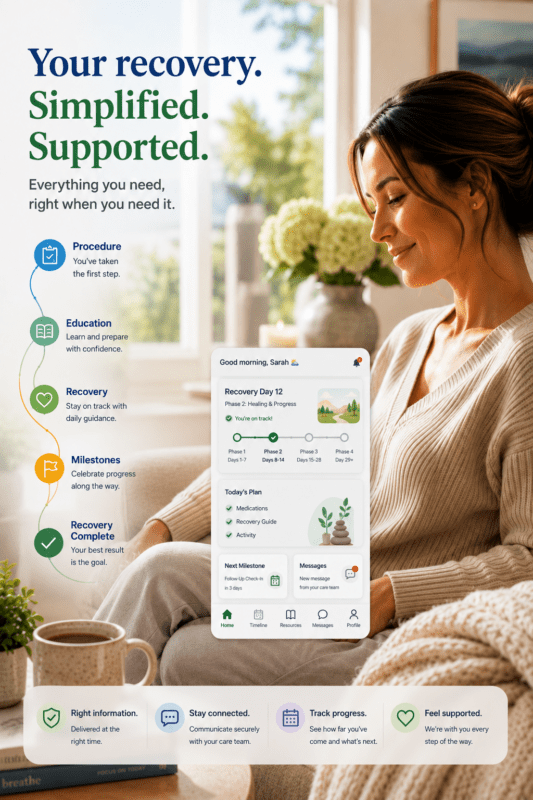
The platform helps organize recovery information according to the patient’s current stage of recovery, providing access to educational content, recovery resources, reminders, milestone tracking, reporting activities, and program materials when they are most relevant. By delivering information in a structured and organized manner, the portal helps reduce confusion, improve understanding, and create a more predictable recovery experience for patients navigating the weeks and months following a procedure.
Beyond providing access to information, the Patient Portal is intended to encourage engagement and participation throughout recovery. Progress tracking, recovery timelines, educational assignments, reminders, communications, and recovery-support resources help patients remain connected to their recovery plan while supporting physician-directed recommendations and approved program activities. The result is a more organized, informed, and confident recovery experience that helps patients better understand where they are today, what comes next, and how to navigate recovery with greater clarity and confidence.
Recovery Guidance Every Step Of The Way
Recovery often extends far beyond the day of a procedure. Patients may receive instructions, educational materials, reminders, product recommendations, follow-up information, and recovery guidance from multiple sources throughout the recovery process. As recovery progresses, important information can become difficult to locate, timelines may become unclear, and patients may be uncertain about what actions should be taken next. The Patient Portal was designed to provide a single, centralized destination where patients can access the information, resources, and support tools associated with their recovery journey.
The platform helps organize recovery information according to the patient’s current stage of recovery, providing access to educational content, recovery resources, reminders, milestone tracking, reporting activities, and program materials when they are most relevant. By delivering information in a structured and organized manner, the portal helps reduce confusion, improve understanding, and create a more predictable recovery experience for patients navigating the weeks and months following a procedure.
Beyond providing access to information, the Patient Portal is intended to encourage engagement and participation throughout recovery. Progress tracking, recovery timelines, educational assignments, reminders, communications, and recovery-support resources help patients remain connected to their recovery plan while supporting physician-directed recommendations and approved program activities. The result is a more organized, informed, and confident recovery experience that helps patients better understand where they are today, what comes next, and how to navigate recovery with greater clarity and confidence.

PATIENT PORTAL
The Patient Portal serves as the primary patient-facing component of the PhysicianOS™ ecosystem. Designed to provide convenient access to recovery-related resources, educational materials, communications, reporting tools, and program information, the portal functions as a centralized environment through which participating patients may engage with approved HSL LABS recovery initiatives throughout the post-procedural experience.
The portal was developed in response to a common challenge faced by recovering patients: important information is often distributed across multiple documents, emails, printed materials, websites, instructions, and conversations. As a result, patients may struggle to locate information when needed, misunderstand recovery expectations, overlook educational resources, or fail to complete recommended recovery-related activities. The Patient Portal seeks to address these challenges by consolidating relevant information within a single, easily accessible platform.
One of the portal’s primary functions is the delivery of recovery-phase-specific information. As patients progress through different stages of recovery, they may be provided access to educational resources, guidance materials, instructional content, recovery reminders, and other information appropriate to their current stage of participation. This phased approach helps ensure that information is delivered when it is most relevant rather than overwhelming patients with large volumes of material at the outset of the recovery process.
The portal also serves as a centralized repository for educational resources. Patients may access recovery guides, instructional materials, frequently asked questions, video content, program documents, procedural-specific information, and other approved educational assets intended to support understanding and informed participation throughout recovery.
Communication support represents another important function of the platform. The Patient Portal may provide access to announcements, educational updates, recovery reminders, scheduled notifications, program communications, and other information distributed through approved communication channels. This capability helps maintain continuity while reducing the likelihood that important information will be overlooked.
Patients may also utilize the portal to complete approved reporting activities associated with their participation in HSL LABS programs. Depending upon the nature of a particular initiative, reporting functions may include recovery status updates, milestone confirmations, educational completion acknowledgments, participation tracking, questionnaire responses, observational reporting, and other activities designed to support program administration and recovery monitoring.
The portal is designed to assist patients in understanding their recovery progression. Through visual timelines, milestone tracking tools, recovery calendars, phase indicators, and related features, patients may view their current stage of participation and better understand upcoming recovery activities, educational resources, and recommended actions. These tools help create a more organized and predictable recovery experience.
Program participation management is another key capability. Patients may review enrollment information, program materials, participation requirements, recovery schedules, educational assignments, and other resources associated with their involvement in HSL LABS initiatives. By providing centralized access to these materials, the portal helps reduce confusion and improve overall participation consistency.
The platform may also support the distribution of procedural-specific resources tailored to the patient’s treatment category. Recovery information relevant to facial procedures, breast procedures, body-contouring procedures, reconstructive interventions, minimally invasive treatments, and other approved categories may be organized and delivered according to the needs of individual participants. This allows educational and support resources to remain relevant to the patient’s specific recovery experience.
Another important objective of the portal is to encourage patient accountability and engagement. Participation reminders, milestone notifications, educational assignments, reporting requests, and recovery-related prompts help patients remain actively involved in the recovery process while supporting adherence to physician-directed recommendations and approved program activities.
The Patient Portal is additionally intended to improve continuity between patients and participating practices. By creating a centralized environment for information exchange, educational delivery, reporting activities, and program participation, the portal helps support more consistent communication throughout the recovery journey.
Privacy, security, and information protection remain important considerations in the design and operation of the platform. Access controls, authentication procedures, administrative safeguards, and approved information-management practices are incorporated to support responsible handling of patient-related information and maintain appropriate standards of confidentiality.
As HSL LABS continues to expand its technological capabilities, future Patient Portal enhancements may include additional educational resources, expanded reporting tools, personalized recovery pathways, advanced communication features, interactive recovery-support content, and other functionality intended to improve the patient experience.
Ultimately, the Patient Portal serves as the patient’s central point of access to the HSL LABS recovery ecosystem. By bringing together recovery information, educational resources, reporting tools, communications, participation activities, and progress-tracking capabilities within a single environment, the platform helps patients navigate recovery with greater clarity, organization, and confidence.