

STANDARDS
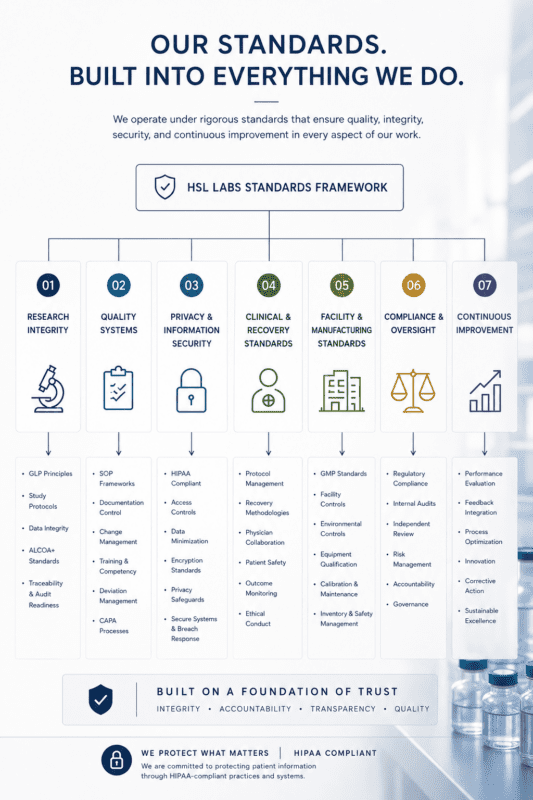
HSL LABS is committed to maintaining high standards of professionalism, integrity, accountability, and operational excellence across all aspects of its activities. The Company recognizes that meaningful innovation and sustainable growth depend not only upon new ideas and technological advancement, but also upon the consistent application of sound governance, responsible practices, and disciplined oversight.
The organization seeks to promote a culture in which quality, transparency, ethical conduct, and continuous improvement serve as guiding principles for decision-making and organizational development. These standards influence the manner in which programs are developed, technologies are implemented, relationships are established, information is managed, and organizational objectives are pursued.
As a company operating within healthcare-adjacent environments, HSL LABS places particular importance on maintaining appropriate safeguards, respecting privacy interests, supporting responsible information management practices, and fostering confidence among physicians, patients, collaborators, and other stakeholders. The Company views trust as an essential organizational asset and strives to preserve that trust through consistency, accountability, and adherence to clearly defined standards.
Through ongoing evaluation, oversight, and refinement of its policies, procedures, and operational frameworks, HSL LABS seeks to uphold an environment that supports responsible innovation, organizational credibility, and long-term excellence in service of its broader mission and objectives.
STANDARDS
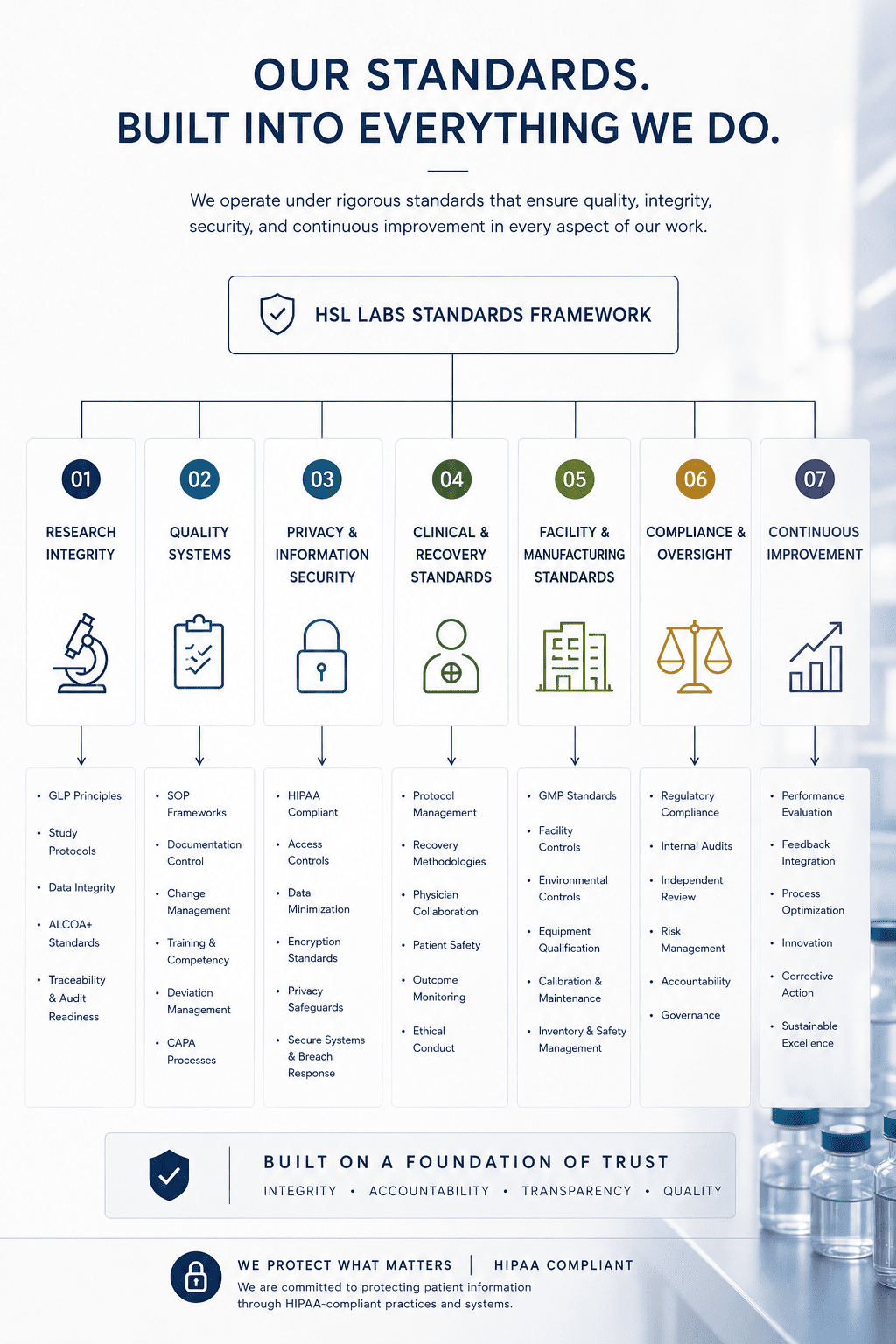
HSL LABS is committed to maintaining high standards of professionalism, integrity, accountability, and operational excellence across all aspects of its activities. The Company recognizes that meaningful innovation and sustainable growth depend not only upon new ideas and technological advancement, but also upon the consistent application of sound governance, responsible practices, and disciplined oversight.
The organization seeks to promote a culture in which quality, transparency, ethical conduct, and continuous improvement serve as guiding principles for decision-making and organizational development. These standards influence the manner in which programs are developed, technologies are implemented, relationships are established, information is managed, and organizational objectives are pursued.
As a company operating within healthcare-adjacent environments, HSL LABS places particular importance on maintaining appropriate safeguards, respecting privacy interests, supporting responsible information management practices, and fostering confidence among physicians, patients, collaborators, and other stakeholders. The Company views trust as an essential organizational asset and strives to preserve that trust through consistency, accountability, and adherence to clearly defined standards.
Through ongoing evaluation, oversight, and refinement of its policies, procedures, and operational frameworks, HSL LABS seeks to uphold an environment that supports responsible innovation, organizational credibility, and long-term excellence in service of its broader mission and objectives.
Guided by Principle
At HSL LABS, we believe that meaningful innovation begins with responsibility. While our organization is focused on advancing recovery through physician collaboration, products, protocols, education, and technology, we recognize that long-term success depends upon maintaining high standards of integrity, professionalism, and accountability. Every initiative we undertake is evaluated not only for its potential impact, but also for its ability to deliver practical value while aligning with the principles that guide our organization.
Our approach is grounded in respect for both physician independence and patient-centered care. We recognize that healthcare decisions belong to licensed medical professionals exercising their own clinical judgment and expertise. HSL LABS seeks to support these physician-directed environments through recovery-focused resources, educational initiatives, implementation frameworks, and innovative solutions designed to enhance understanding, engagement, and operational effectiveness while respecting the unique needs of every patient and practice.
As the organization continues to evolve, we remain committed to transparency, scientific integrity, continuous improvement, and responsible innovation. We believe trust is earned through consistent actions, thoughtful decision-making, and a willingness to learn from experience. These principles influence how we develop programs, evaluate opportunities, collaborate with physicians, and pursue our broader mission of advancing recovery knowledge, improving patient experiences, and supporting better outcomes across the recovery continuum.
Guided by Principle
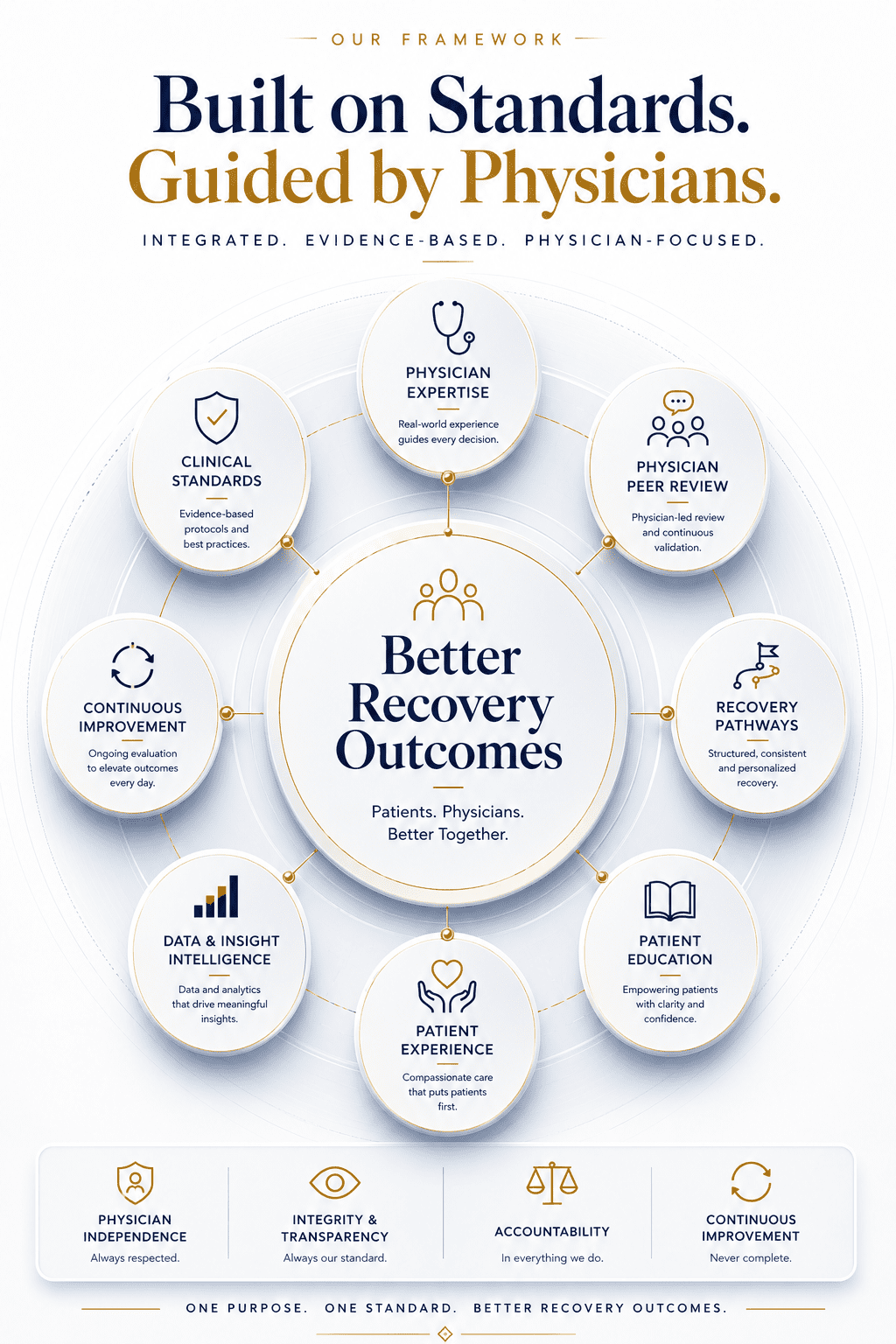
At HSL LABS, we believe that meaningful innovation begins with responsibility. While our organization is focused on advancing recovery through physician collaboration, products, protocols, education, and technology, we recognize that long-term success depends upon maintaining high standards of integrity, professionalism, and accountability. Every initiative we undertake is evaluated not only for its potential impact, but also for its ability to deliver practical value while aligning with the principles that guide our organization.
Our approach is grounded in respect for both physician independence and patient-centered care. We recognize that healthcare decisions belong to licensed medical professionals exercising their own clinical judgment and expertise. HSL LABS seeks to support these physician-directed environments through recovery-focused resources, educational initiatives, implementation frameworks, and innovative solutions designed to enhance understanding, engagement, and operational effectiveness while respecting the unique needs of every patient and practice.
As the organization continues to evolve, we remain committed to transparency, scientific integrity, continuous improvement, and responsible innovation. We believe trust is earned through consistent actions, thoughtful decision-making, and a willingness to learn from experience. These principles influence how we develop programs, evaluate opportunities, collaborate with physicians, and pursue our broader mission of advancing recovery knowledge, improving patient experiences, and supporting better outcomes across the recovery continuum.
EXCELLENCE IN ETHICS AND PRACTICE
HSL LABS believes that long-term organizational success depends not only upon innovation, operational effectiveness, and technological capability, but also upon the consistent application of sound ethical principles and responsible professional conduct. For this reason, excellence in ethics and practice serves as a foundational element of the Company’s governance framework and organizational culture.
The Company is committed to conducting its activities with honesty, integrity, transparency, accountability, and respect for the physicians, patients, participating practices, advisors, employees, contractors, and other stakeholders with whom it interacts. These principles help guide decision-making across all aspects of organizational activity, including program development, protocol administration, technology initiatives, educational efforts, research activities, product development, communications, and business operations.
A central principle of the HSL LABS approach is respect for physician independence. The Company recognizes that patient care decisions belong exclusively to licensed healthcare professionals exercising their own clinical judgment. Programs, protocols, technologies, educational materials, and products developed by HSL LABS are intended to support physician-directed care environments and are not designed to replace professional judgment, clinical decision-making, or individualized patient assessment.
The Company similarly recognizes the importance of patient autonomy and informed participation. Educational resources, communications, and recovery-support initiatives are intended to promote understanding and engagement while respecting the rights, dignity, privacy, and individual circumstances of each patient. HSL LABS supports clear communication, responsible information sharing, and the appropriate use of educational resources to assist patients in understanding their recovery experience.
Scientific integrity represents another important organizational principle. The Company seeks to evaluate ideas, observations, technologies, methodologies, and developmental opportunities based upon evidence, practical experience, physician input, and disciplined review processes rather than assumptions, trends, unsupported claims, or commercial pressures alone. Organizational decisions are expected to reflect thoughtful evaluation, responsible analysis, and a willingness to revise assumptions when new information warrants reconsideration.
The Company also places significant importance on transparency and accountability. Programs, protocols, technologies, educational initiatives, governance processes, and organizational activities are intended to operate within clearly defined structures that support responsible oversight and informed decision-making. Internal Executive Briefings, Committee Review activities, Clinical Advisory Council participation, peer review processes, and other governance mechanisms contribute to this objective by providing opportunities for evaluation, discussion, challenge, and continuous improvement.
Responsible innovation is another important component of the HSL LABS philosophy. The Company recognizes that innovation carries both opportunity and responsibility. New initiatives should not only seek to address unmet needs and improve outcomes, but should also be evaluated for practicality, safety, implementation feasibility, ethical considerations, and alignment with organizational objectives. The Company therefore seeks to balance creativity with discipline and ambition with accountability.
Professionalism is expected throughout all levels of organizational activity. Participants are encouraged to engage in constructive dialogue, respectful collaboration, objective evaluation, and responsible stewardship of organizational resources. Differences of opinion are viewed as valuable components of the decision-making process when expressed in a professional and productive manner.
The Company further believes that trust must be earned and continually maintained. Trust cannot be established through statements alone; it is developed through consistent conduct, responsible decision-making, transparency, accountability, and adherence to established principles over time. Accordingly, HSL LABS seeks to foster an environment in which ethical considerations are integrated into daily operations rather than treated as isolated compliance requirements.
As the organization continues to evolve, the principles described herein will continue to inform the development of programs, protocols, technologies, educational initiatives, operational systems, governance activities, and products throughout the HSL LABS ecosystem. While specific initiatives may change over time, the Company’s commitment to ethical conduct, professional responsibility, scientific integrity, physician independence, patient respect, and organizational accountability remains constant.
Excellence in ethics and practice is therefore not viewed as a separate organizational objective. It is a standard that informs how all organizational objectives are pursued.
Quality Through Process, Oversight, and Continuous Improvement
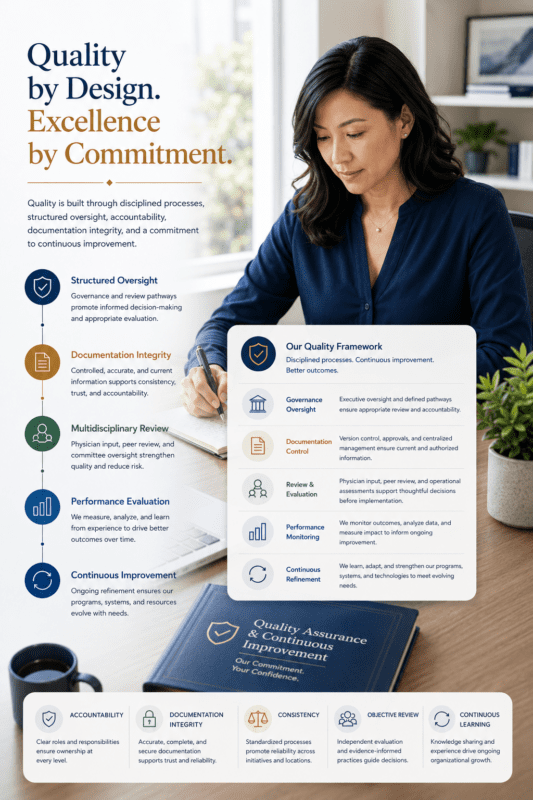
Quality is not achieved through a single review, final approval, or isolated checkpoint. It is built through disciplined processes, structured oversight, accountability, documentation integrity, and a commitment to continuous improvement. At HSL LABS, quality principles are integrated throughout the organization to help ensure that programs, protocols, technologies, educational initiatives, operational systems, and products are developed, evaluated, and refined through a thoughtful and consistent framework.
The Company’s quality philosophy begins with the belief that meaningful outcomes require structure. New initiatives are expected to progress through defined review pathways that may include physician input, executive evaluation, committee review, peer review activities, operational assessments, and ongoing governance oversight. These processes are designed to promote informed decision-making, reduce reliance on informal practices, and help ensure that important initiatives receive appropriate evaluation before implementation.
Quality assurance is viewed as an ongoing organizational responsibility rather than a final step in development. Through documentation controls, performance evaluation, multidisciplinary review, continuous learning, and structured improvement processes, HSL LABS seeks to create an environment where quality is continuously monitored, measured, and strengthened. This commitment supports operational consistency, promotes accountability, and helps ensure that the standards expected by physicians, participating practices, patients, and organizational leadership remain at the center of every initiative.
Quality Through Process, Oversight, and Continuous Improvement
Quality is not achieved through a single review, final approval, or isolated checkpoint. It is built through disciplined processes, structured oversight, accountability, documentation integrity, and a commitment to continuous improvement. At HSL LABS, quality principles are integrated throughout the organization to help ensure that programs, protocols, technologies, educational initiatives, operational systems, and products are developed, evaluated, and refined through a thoughtful and consistent framework.
The Company’s quality philosophy begins with the belief that meaningful outcomes require structure. New initiatives are expected to progress through defined review pathways that may include physician input, executive evaluation, committee review, peer review activities, operational assessments, and ongoing governance oversight. These processes are designed to promote informed decision-making, reduce reliance on informal practices, and help ensure that important initiatives receive appropriate evaluation before implementation.
Quality assurance is viewed as an ongoing organizational responsibility rather than a final step in development. Through documentation controls, performance evaluation, multidisciplinary review, continuous learning, and structured improvement processes, HSL LABS seeks to create an environment where quality is continuously monitored, measured, and strengthened. This commitment supports operational consistency, promotes accountability, and helps ensure that the standards expected by physicians, participating practices, patients, and organizational leadership remain at the center of every initiative.
QUALITY CONTROL AND ASSURANCE
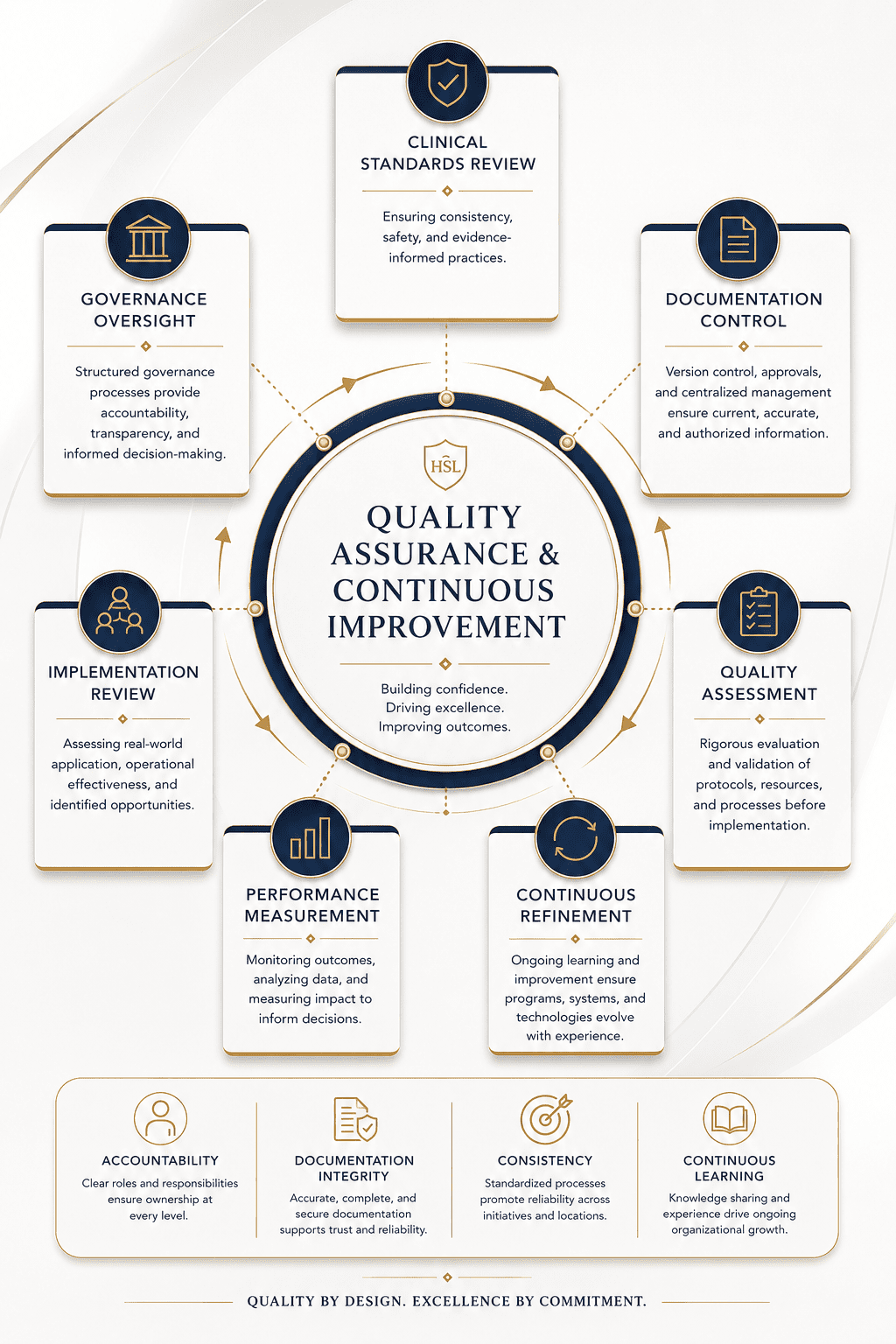
HSL LABS recognizes that quality is not achieved through isolated reviews or periodic inspections. Rather, quality is the product of disciplined processes, consistent oversight, structured evaluation, documentation integrity, accountability, and continuous refinement. For this reason, quality control and assurance principles are integrated throughout the Company’s programs, protocols, technologies, educational initiatives, governance activities, operational systems, and product-development efforts.
The Company’s approach to quality begins with process design. New initiatives are expected to progress through defined review pathways that may include physician input, Internal Executive Briefings, Committee Review activities, peer review evaluations, Clinical Advisory Council participation, operational assessments, and executive oversight. These mechanisms are intended to promote thoughtful evaluation before implementation and to reduce reliance upon informal or ad hoc decision-making.
Documentation control represents an important component of the quality framework. Protocols, educational resources, operational procedures, policy documents, implementation materials, technology specifications, reporting methodologies, and related organizational assets are expected to be managed through structured review, approval, revision, and version-control processes. These practices help promote consistency while ensuring that participants have access to current and authorized information.
Quality assurance activities also extend to protocol governance. Recovery methodologies, implementation procedures, educational resources, and related program components may be periodically evaluated to determine whether modifications, clarifications, updates, or enhancements are warranted. Such evaluations may be informed by physician observations, implementation experiences, organizational learning activities, committee recommendations, peer review findings, and other approved review mechanisms.
Technology systems are similarly subject to quality-oriented evaluation processes. PhysicianOS™, physician dashboards, patient portals, reporting systems, communication tools, and related infrastructure may undergo ongoing review to identify opportunities for enhanced functionality, improved usability, greater operational efficiency, and stronger alignment with physician and practice needs. Feedback from participating users serves as an important source of information in these efforts.
Educational initiatives also fall within the Company’s quality framework. Patient-facing materials, physician resources, training programs, implementation guidance, communication assets, and informational content may be reviewed for accuracy, clarity, consistency, relevance, and alignment with organizational objectives. This process helps ensure that educational resources remain useful, understandable, and responsive to evolving needs.
The Company places particular emphasis on continuous improvement. Quality assurance is not viewed as a final checkpoint occurring after development activities have concluded. Rather, it functions as an ongoing process through which programs, protocols, technologies, educational initiatives, operational systems, and products are periodically evaluated and refined based upon experience, observations, performance assessments, and emerging opportunities.
Organizational accountability represents another important element of the quality framework. Structured governance processes help establish responsibility for review activities, approvals, recommendations, modifications, and implementation decisions. By maintaining documented pathways for evaluation and oversight, the Company seeks to promote transparency, consistency, and informed decision-making throughout the organization.
The Internal Executive Briefing System plays a particularly important role within quality assurance activities. Through the IEB process, observations, recommendations, implementation concerns, technology enhancements, educational improvements, protocol modifications, and operational issues may be introduced for structured review and evaluation. This process helps ensure that quality-related observations are captured, documented, and considered within the broader organizational decision-making framework.
Committee Review and peer review activities provide additional layers of quality oversight. These mechanisms create opportunities for multidisciplinary evaluation, independent assessment, constructive challenge, and detailed examination of proposed initiatives and existing organizational activities. By encouraging review from multiple perspectives, the Company seeks to identify weaknesses, inconsistencies, implementation challenges, and opportunities for improvement before they become larger organizational issues.
The Company also recognizes the importance of measurement. Reporting systems, implementation observations, participation metrics, educational utilization data, technology performance indicators, and other operational information may contribute to the evaluation of organizational effectiveness and support future quality-improvement initiatives. These activities help transform quality assurance from a subjective objective into a measurable organizational function.
Ultimately, quality control and assurance at HSL LABS are intended to support a culture of disciplined execution, responsible oversight, continuous learning, and operational excellence. Through structured review processes, governance mechanisms, documentation controls, performance evaluation activities, and ongoing refinement efforts, the Company seeks to ensure that its programs, protocols, technologies, educational initiatives, operational systems, and products continue to reflect the standards expected by physicians, participating practices, patients, and organizational leadership.
Relationships Built on Shared Standards
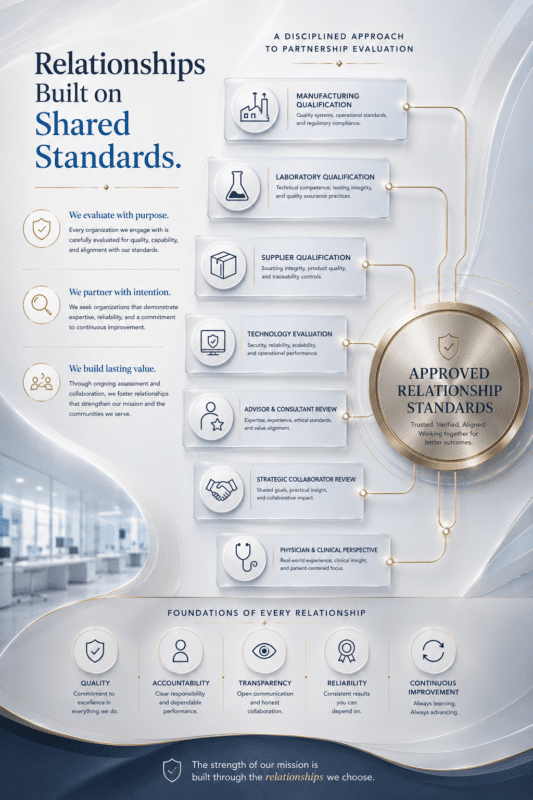
Success is rarely built in isolation. The quality, integrity, and effectiveness of any organization are influenced not only by its own standards, but also by the standards of the manufacturers, laboratories, suppliers, technology providers, advisors, consultants, and strategic partners with whom it chooses to work. At HSL LABS, we believe that meaningful progress requires collaboration with organizations and professionals who share a commitment to quality, accountability, operational excellence, and continuous improvement. The relationships we establish help shape the strength, consistency, and reliability of the broader ecosystem that supports our mission.
Our approach to partnership is guided by thoughtful evaluation and long-term alignment. Whether assessing manufacturing capabilities, laboratory expertise, technology infrastructure, supplier qualifications, or professional advisory relationships, we seek partners who demonstrate proven experience, disciplined processes, strong quality systems, ethical conduct, and a commitment to delivering consistent results. These evaluations are designed to help ensure that the organizations supporting our initiatives contribute positively to the standards we expect across every area of the Company.
Equally important, we view partnership evaluation as an ongoing process rather than a one-time decision. Performance, responsiveness, transparency, reliability, quality outcomes, and evolving organizational needs all play a role in how relationships develop over time. We believe trust is earned through consistent execution, and that strong organizations are built through strong relationships. By maintaining disciplined standards for the selection and assessment of external partners, HSL LABS seeks to foster an ecosystem capable of supporting long-term quality, integrity, physician participation, operational excellence, and recovery-focused innovation.
Relationships Built on Shared Standards
Success is rarely built in isolation. The quality, integrity, and effectiveness of any organization are influenced not only by its own standards, but also by the standards of the manufacturers, laboratories, suppliers, technology providers, advisors, consultants, and strategic partners with whom it chooses to work. At HSL LABS, we believe that meaningful progress requires collaboration with organizations and professionals who share a commitment to quality, accountability, operational excellence, and continuous improvement. The relationships we establish help shape the strength, consistency, and reliability of the broader ecosystem that supports our mission.
Our approach to partnership is guided by thoughtful evaluation and long-term alignment. Whether assessing manufacturing capabilities, laboratory expertise, technology infrastructure, supplier qualifications, or professional advisory relationships, we seek partners who demonstrate proven experience, disciplined processes, strong quality systems, ethical conduct, and a commitment to delivering consistent results. These evaluations are designed to help ensure that the organizations supporting our initiatives contribute positively to the standards we expect across every area of the Company.
Equally important, we view partnership evaluation as an ongoing process rather than a one-time decision. Performance, responsiveness, transparency, reliability, quality outcomes, and evolving organizational needs all play a role in how relationships develop over time. We believe trust is earned through consistent execution, and that strong organizations are built through strong relationships. By maintaining disciplined standards for the selection and assessment of external partners, HSL LABS seeks to foster an ecosystem capable of supporting long-term quality, integrity, physician participation, operational excellence, and recovery-focused innovation.
THE COMPANY WE KEEP
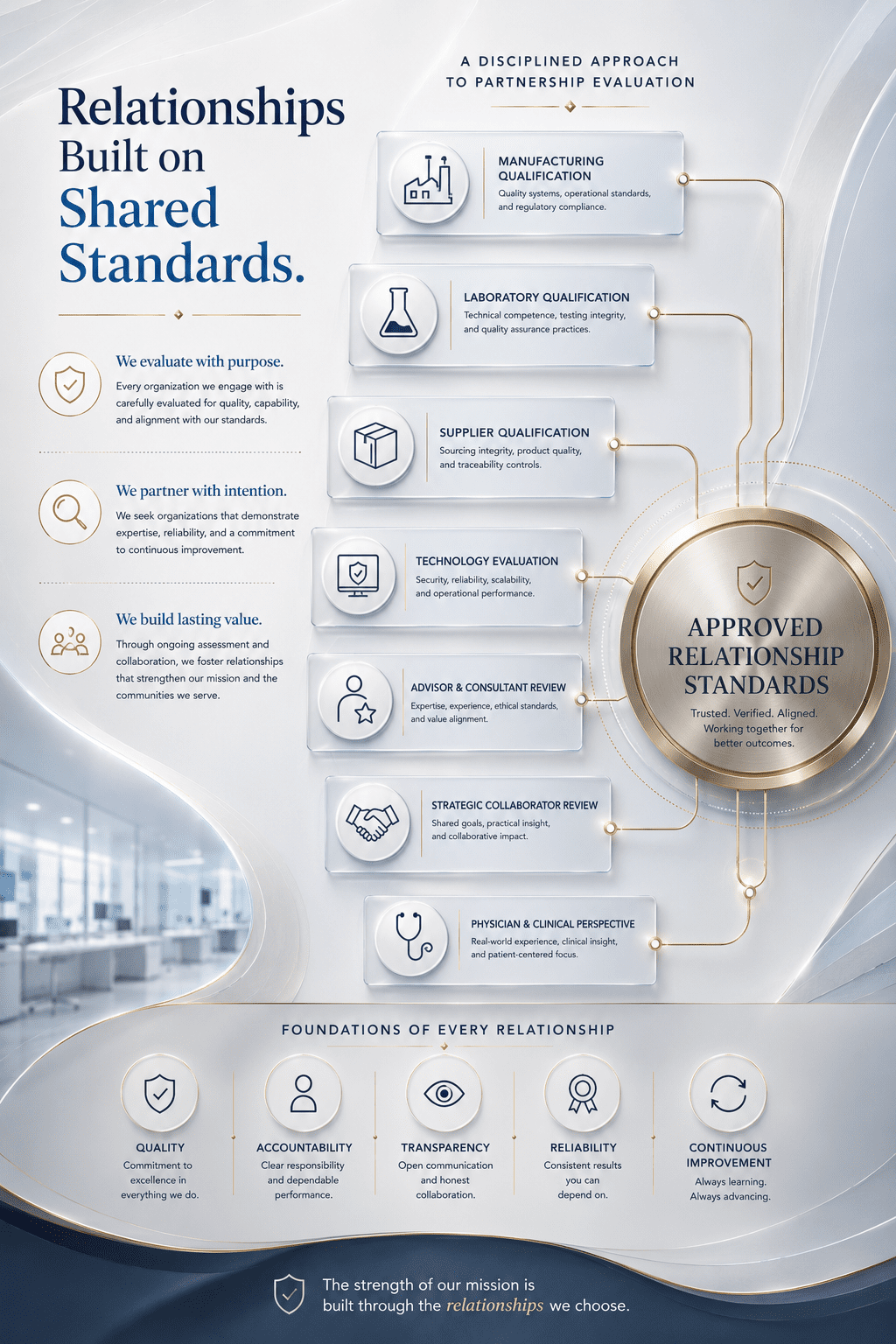
HSL LABS recognizes that organizational quality is influenced not only by its own internal standards, but also by the standards maintained by the organizations, professionals, manufacturers, laboratories, suppliers, consultants, technology providers, and strategic partners with whom it chooses to work. For this reason, the Company places significant emphasis on the selection, evaluation, and ongoing assessment of external relationships that support its programs, protocols, technologies, educational initiatives, operational systems, and products.
The Company’s approach is guided by a straightforward principle: organizations committed to quality should seek to associate with other organizations that demonstrate similar commitments to quality, accountability, professionalism, regulatory awareness, and operational excellence. Accordingly, HSL LABS evaluates prospective relationships based upon factors that may include qualifications, experience, reputation, technical capabilities, quality systems, regulatory history, operational performance, and alignment with organizational objectives.
Within the manufacturing environment, the Company seeks to work with organizations that maintain rigorous quality-control processes and established operational standards. Depending upon the nature of a particular relationship, relevant considerations may include Current Good Manufacturing Practices (cGMP), facility registration status, quality-management systems, manufacturing controls, documentation procedures, testing protocols, traceability practices, and related operational safeguards.
Laboratory partners play an equally important role within the broader quality framework. HSL LABS values relationships with qualified analytical laboratories capable of supporting identity testing, purity assessments, potency verification, microbiological evaluations, contaminant screening, stability assessments, and other quality-related activities appropriate to the products and initiatives under evaluation. Independent third-party laboratory testing may provide an additional layer of verification and accountability within selected development and quality-review processes.
The Company also recognizes the importance of supplier qualification. Raw material providers, ingredient suppliers, packaging vendors, technology providers, service organizations, and other contributors may be evaluated based upon quality standards, sourcing practices, operational capabilities, reliability, documentation controls, regulatory awareness, and demonstrated performance. These evaluations help support consistency throughout the broader development and implementation process.
Industry-recognized certifications and standards may also contribute to the evaluation of prospective relationships. Depending upon the nature of a particular organization, such considerations may include compliance with ISO standards, NSF certification programs, quality-management frameworks, facility audits, operational certifications, and other recognized indicators of organizational discipline and performance. While certifications alone do not determine suitability, they may provide useful information regarding an organization’s commitment to established standards and continuous improvement.
Technology providers are similarly evaluated with attention to reliability, security, scalability, operational integrity, information-management practices, and alignment with the Company’s broader technology objectives. As PhysicianOS™, physician dashboards, patient portals, reporting systems, and other technology initiatives continue to evolve, the selection of capable technology partners remains an important organizational consideration.
Professional advisors, consultants, subject matter experts, physicians, educators, and strategic collaborators also contribute to the Company’s broader ecosystem. HSL LABS seeks relationships with individuals and organizations that demonstrate professional competence, ethical conduct, practical experience, and a commitment to thoughtful collaboration. These relationships help strengthen organizational decision-making and support the development of initiatives that are both practical and sustainable.
Importantly, the evaluation of external relationships does not conclude once a partnership has been established. Ongoing assessment, performance review, operational feedback, quality observations, compliance considerations, and evolving organizational needs may all influence the continuation, modification, expansion, or termination of particular relationships. This continuous-review philosophy helps ensure that external partnerships remain aligned with Company expectations and strategic objectives.
The Company further recognizes that trust is built through performance rather than representations alone. Certifications, registrations, audits, testing programs, quality systems, and professional credentials all contribute useful information, but they are only part of a broader evaluation process. Long-term reliability, responsiveness, transparency, accountability, and demonstrated commitment to quality remain equally important considerations.
Ultimately, The Company We Keep reflects an important organizational belief: the strength of any enterprise is influenced by the strength of the relationships that support it. By maintaining disciplined standards for the selection and evaluation of manufacturers, laboratories, suppliers, technology providers, advisors, consultants, and strategic partners, HSL LABS seeks to build an ecosystem capable of supporting its long-term commitment to quality, integrity, physician participation, operational excellence, and recovery-focused innovation.
Protecting Information. Preserving Trust.
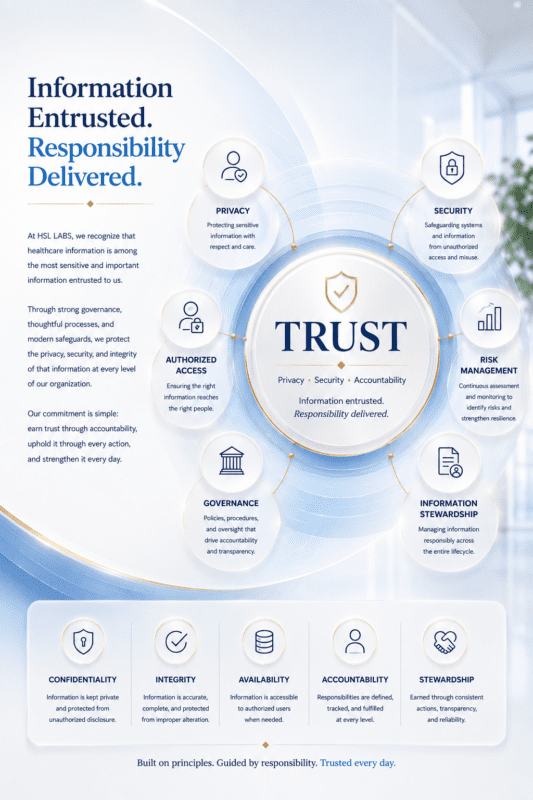
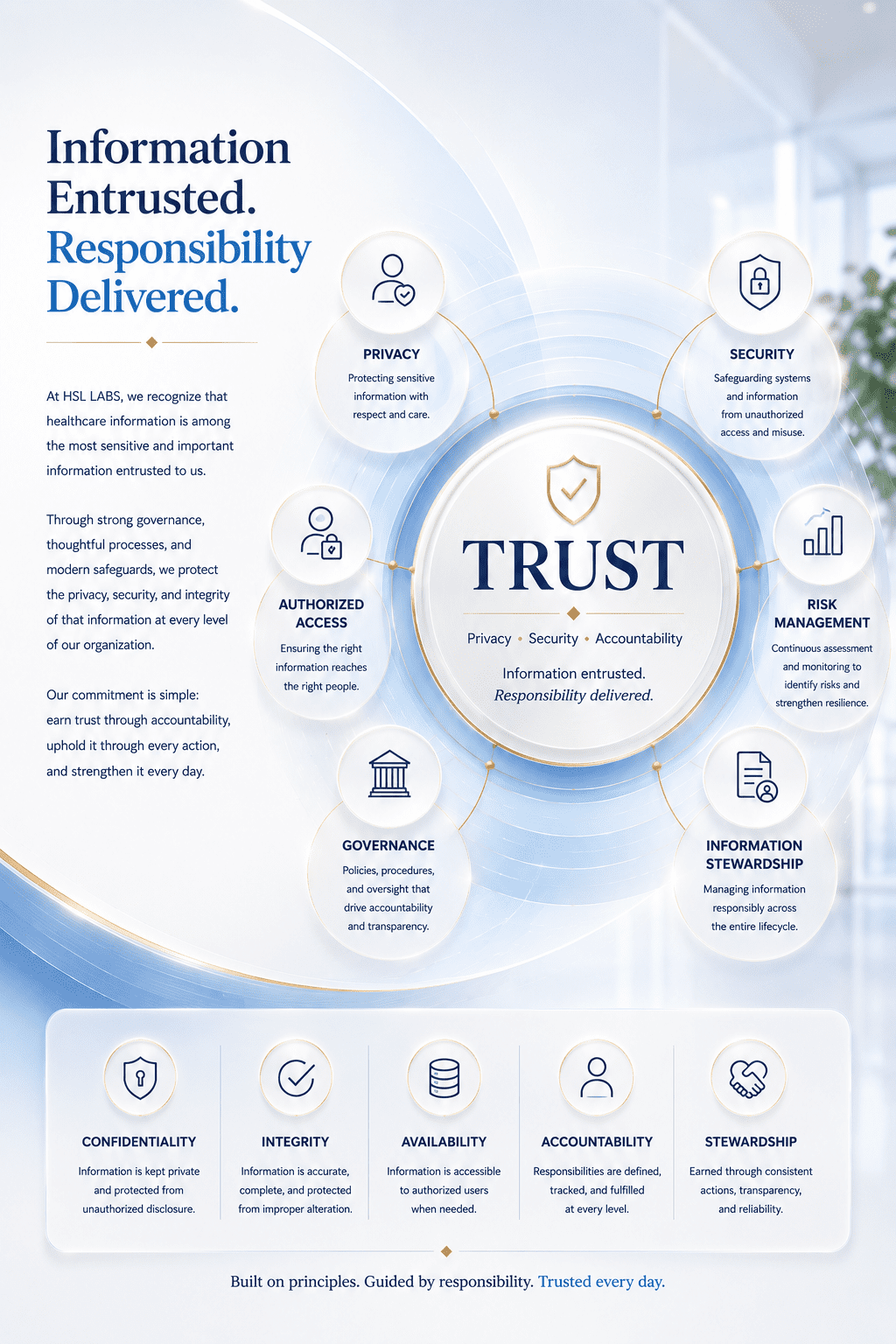
The responsible management of healthcare-related information requires more than technology alone. It requires a comprehensive framework of policies, procedures, safeguards, oversight, and accountability designed to protect the confidentiality, integrity, and availability of sensitive information. At HSL LABS, privacy, security, and information stewardship are viewed as essential organizational responsibilities that support the trust placed in the Company by physicians, participating practices, patients, and other stakeholders. As technologies, programs, reporting systems, and operational infrastructures continue to evolve, information protection remains an important consideration throughout the organization.
Our approach recognizes that effective compliance is achieved through the integration of administrative, physical, and technical safeguards working together. Access controls, authentication requirements, role-based permissions, audit capabilities, documentation management, workforce responsibilities, risk-management activities, and ongoing oversight all contribute to a broader framework designed to support responsible information management. These measures help establish clear expectations regarding how healthcare-related information is accessed, managed, protected, and utilized within approved operational environments.
Privacy and security are not static objectives. Regulatory requirements, cybersecurity risks, healthcare technologies, and operational practices continue to evolve over time, requiring continuous assessment and improvement. Through governance processes, contractual protections, information-security practices, workforce awareness, and ongoing evaluation of systems and procedures, HSL LABS seeks to support compliance with applicable privacy and security requirements while maintaining a strong commitment to responsible information stewardship and organizational accountability.
Protecting Information. Preserving Trust.
The responsible management of healthcare-related information requires more than technology alone. It requires a comprehensive framework of policies, procedures, safeguards, oversight, and accountability designed to protect the confidentiality, integrity, and availability of sensitive information. At HSL LABS, privacy, security, and information stewardship are viewed as essential organizational responsibilities that support the trust placed in the Company by physicians, participating practices, patients, and other stakeholders. As technologies, programs, reporting systems, and operational infrastructures continue to evolve, information protection remains an important consideration throughout the organization.
Our approach recognizes that effective compliance is achieved through the integration of administrative, physical, and technical safeguards working together. Access controls, authentication requirements, role-based permissions, audit capabilities, documentation management, workforce responsibilities, risk-management activities, and ongoing oversight all contribute to a broader framework designed to support responsible information management. These measures help establish clear expectations regarding how healthcare-related information is accessed, managed, protected, and utilized within approved operational environments.
Privacy and security are not static objectives. Regulatory requirements, cybersecurity risks, healthcare technologies, and operational practices continue to evolve over time, requiring continuous assessment and improvement. Through governance processes, contractual protections, information-security practices, workforce awareness, and ongoing evaluation of systems and procedures, HSL LABS seeks to support compliance with applicable privacy and security requirements while maintaining a strong commitment to responsible information stewardship and organizational accountability.
HIPAA AND HITECH COMPLIANCE
HSL LABS recognizes the importance of privacy, security, and responsible information stewardship within healthcare-related environments. As the Company develops technologies, programs, reporting systems, educational initiatives, physician-participation frameworks, and operational infrastructures that may interact with healthcare organizations and healthcare information, it remains committed to supporting compliance with applicable privacy and security requirements established under federal law.
Particular attention is directed toward the requirements and principles associated with the Health Insurance Portability and Accountability Act of 1996 (HIPAA) and the Health Information Technology for Economic and Clinical Health Act (HITECH). Together, these statutes provide important legal and operational frameworks governing the protection, use, disclosure, transmission, storage, and management of Protected Health Information (PHI) and related healthcare data.
The Company recognizes that HIPAA compliance extends beyond technology alone. Effective compliance requires the integration of administrative safeguards, physical safeguards, technical safeguards, workforce training, documentation controls, risk-management activities, access-management procedures, incident-response protocols, and ongoing oversight. Accordingly, HSL LABS seeks to incorporate these considerations into relevant operational, technological, and organizational activities.
Where appropriate and applicable, organizational policies and procedures may address issues relating to information access, user authentication, role-based permissions, audit controls, information integrity, transmission security, documentation management, workforce responsibilities, and the responsible handling of healthcare-related information. These measures are intended to support the confidentiality, integrity, and availability of information entrusted to approved systems and authorized participants.
The Company also recognizes the importance of contractual compliance frameworks. In circumstances where organizational activities involve interactions with healthcare providers, participating physician practices, surgical facilities, or other healthcare organizations, Business Associate Agreements (BAAs) and related contractual arrangements may be utilized to establish responsibilities regarding the management and protection of Protected Health Information. Such agreements help define permitted uses, disclosure limitations, security obligations, breach-notification requirements, and other compliance-related responsibilities.
HITECH introduced additional requirements and expectations relating to healthcare information security, breach notification, electronic information management, accountability, and enforcement. HSL LABS recognizes the importance of these provisions and seeks to incorporate appropriate awareness of HITECH requirements into relevant organizational planning, technology development, information-management activities, and operational procedures.
Within technology environments such as PhysicianOS™, the Physician Dashboard, the Patient Portal, reporting systems, and related infrastructure, information-security considerations are integrated into system administration and operational design. Access controls, authentication requirements, audit capabilities, permission structures, activity monitoring, and other administrative and technical measures may be utilized to support responsible information management and reduce the risk of unauthorized access, disclosure, alteration, or misuse.
The Company additionally recognizes the importance of risk assessment and continuous evaluation. Healthcare privacy and security requirements continue to evolve as technologies, regulatory expectations, cybersecurity threats, and operational environments change over time. Accordingly, HSL LABS periodically reviews relevant policies, procedures, contractual frameworks, operational practices, and technology controls to identify opportunities for enhancement and to maintain alignment with applicable requirements and recognized best practices.
Participation in Designated Clinical Research and Data Facility activities, physician-engagement initiatives, reporting programs, educational systems, and related organizational activities may involve additional privacy and information-governance considerations. In such circumstances, information-management practices may incorporate de-identification, anonymization, aggregation, minimum-necessary-use principles, access restrictions, documentation controls, and other safeguards designed to support responsible information stewardship.
Compliance responsibilities also extend to organizational culture and workforce conduct. Employees, contractors, consultants, advisors, participating practices, and authorized users of Company systems are expected to respect applicable privacy obligations, information-security requirements, confidentiality standards, and organizational policies governing the use and protection of healthcare-related information.
Ultimately, HSL LABS views HIPAA and HITECH compliance not merely as legal requirements, but as important components of organizational responsibility. Through the implementation of appropriate safeguards, governance processes, contractual protections, operational controls, and technology-management practices, the Company seeks to support the privacy, security, and responsible stewardship of healthcare-related information while maintaining the trust of physicians, participating practices, patients, and other stakeholders.
Privacy as an Organizational Responsibility
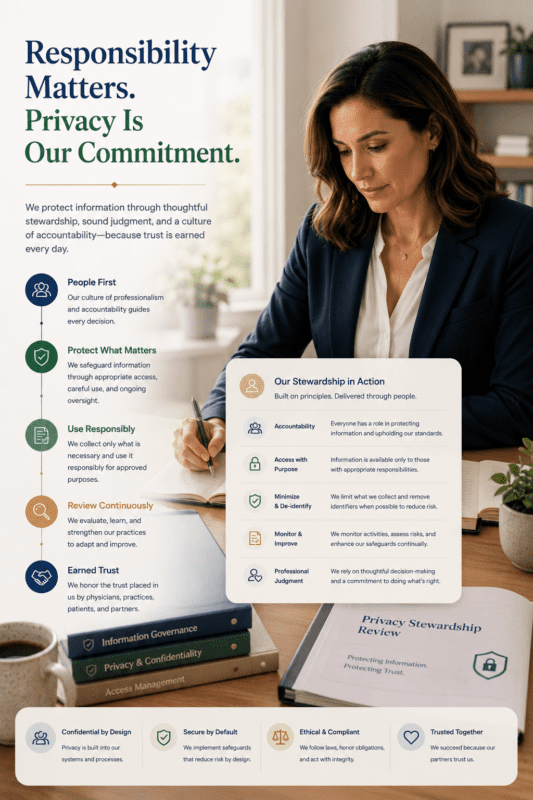
Protecting information requires more than technology alone. It requires a culture of responsibility supported by governance, oversight, operational discipline, and a commitment to responsible information stewardship. At HSL LABS, privacy is viewed as an important organizational obligation that extends across technologies, programs, reporting systems, physician-participation initiatives, and operational infrastructures. The Company recognizes that maintaining trust depends upon the responsible management, protection, and use of information throughout every stage of the information lifecycle.
Our approach emphasizes thoughtful information management through principles such as data minimization, access control, de-identification, accountability, and ongoing oversight. Wherever practical and appropriate, information collection, utilization, retention, and distribution are evaluated to help ensure that information is used responsibly and only for approved organizational purposes. These practices are intended to support operational effectiveness while reducing unnecessary exposure and strengthening overall privacy protections.
Privacy protection is also viewed as an ongoing process of evaluation and improvement. Technologies evolve, organizational activities expand, cybersecurity risks change, and information-management expectations continue to develop. Through governance procedures, workforce awareness, confidentiality standards, information-security practices, third-party evaluations, and continuous review of operational controls, HSL LABS seeks to foster an environment where information is protected appropriately, utilized responsibly, and managed in a manner consistent with the trust placed in the organization by physicians, participating practices, patients, and other stakeholders.
Privacy as an Organizational Responsibility
Protecting information requires more than technology alone. It requires a culture of responsibility supported by governance, oversight, operational discipline, and a commitment to responsible information stewardship. At HSL LABS, privacy is viewed as an important organizational obligation that extends across technologies, programs, reporting systems, physician-participation initiatives, and operational infrastructures. The Company recognizes that maintaining trust depends upon the responsible management, protection, and use of information throughout every stage of the information lifecycle.
Our approach emphasizes thoughtful information management through principles such as data minimization, access control, de-identification, accountability, and ongoing oversight. Wherever practical and appropriate, information collection, utilization, retention, and distribution are evaluated to help ensure that information is used responsibly and only for approved organizational purposes. These practices are intended to support operational effectiveness while reducing unnecessary exposure and strengthening overall privacy protections.
Privacy protection is also viewed as an ongoing process of evaluation and improvement. Technologies evolve, organizational activities expand, cybersecurity risks change, and information-management expectations continue to develop. Through governance procedures, workforce awareness, confidentiality standards, information-security practices, third-party evaluations, and continuous review of operational controls, HSL LABS seeks to foster an environment where information is protected appropriately, utilized responsibly, and managed in a manner consistent with the trust placed in the organization by physicians, participating practices, patients, and other stakeholders.
PRIVACY AND PROTECTIONS
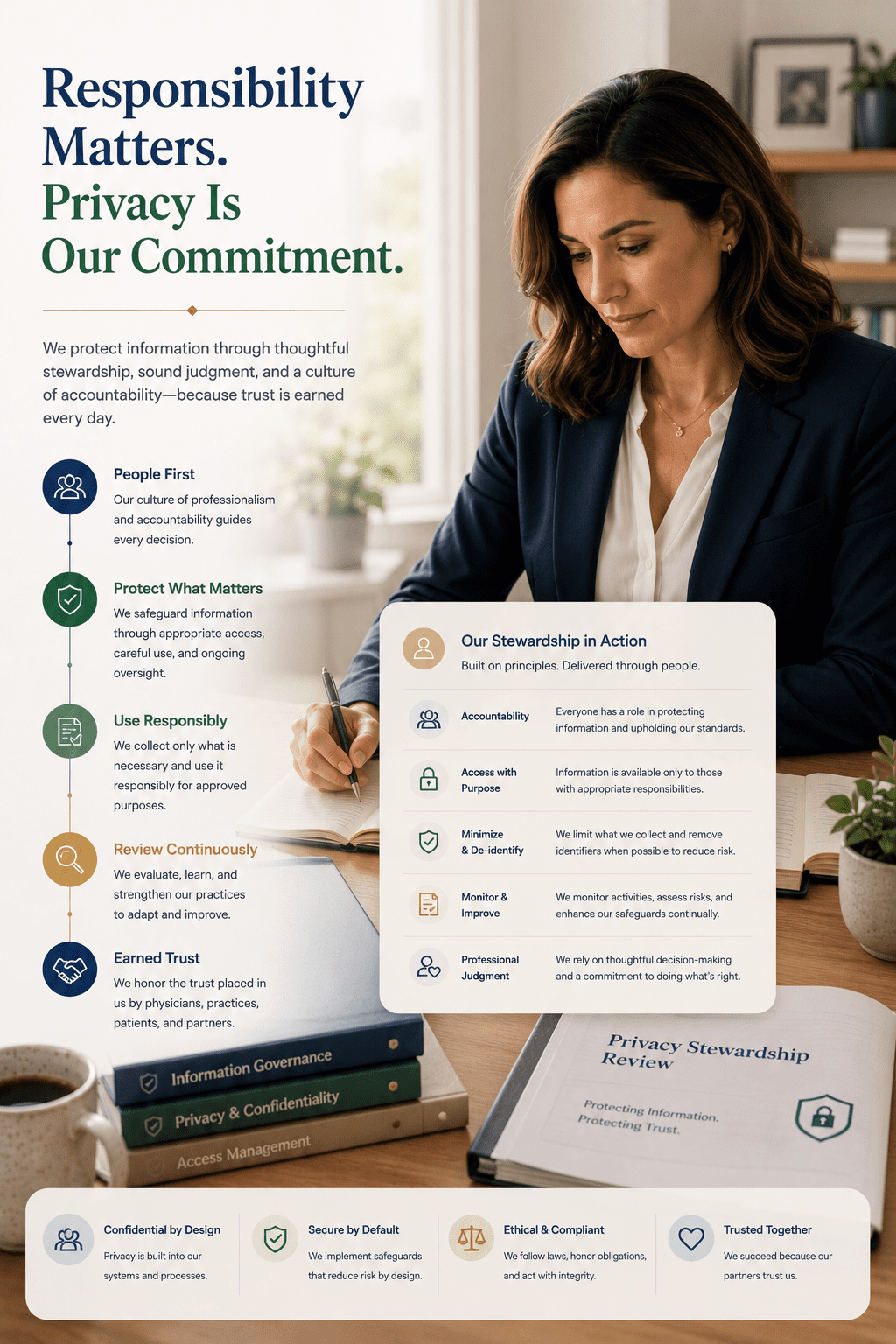
The responsible protection of information represents an important organizational priority within HSL LABS. As the Company develops technologies, physician-participation programs, reporting systems, educational initiatives, operational infrastructures, and recovery-support resources, it recognizes that privacy protection and information stewardship are essential to maintaining trust, supporting organizational integrity, and promoting responsible operations.
The Company approaches privacy as a continuous organizational responsibility rather than a single technology function or regulatory requirement. Effective privacy protection requires coordinated administrative controls, operational procedures, governance mechanisms, workforce awareness, technology safeguards, and ongoing oversight throughout the information lifecycle.
A fundamental principle of the HSL LABS privacy framework is data minimization. Whenever practical and appropriate, the Company seeks to limit the collection, utilization, retention, and distribution of information to that which is reasonably necessary to support approved organizational purposes. This approach helps reduce unnecessary exposure while supporting responsible information management practices.
The Company also recognizes the importance of de-identification and anonymization methodologies. Depending upon the nature of a particular activity, information may be subjected to processes designed to remove, obscure, aggregate, pseudonymize, or otherwise limit the presence of personally identifiable information and Protected Health Information. These techniques help support organizational learning, reporting activities, operational evaluations, and analytical initiatives while reducing privacy risks.
Access management represents another important component of the Company’s privacy framework. Information access may be governed through role-based permissions, user authentication requirements, administrative controls, authorization protocols, and documented access-management procedures. These measures are intended to help ensure that information is available only to individuals with appropriate responsibilities and approved access privileges.
The Company additionally emphasizes information governance throughout its technology environments. PhysicianOS™, Physician Dashboards, Patient Portals, reporting systems, communication platforms, and related infrastructure may incorporate administrative safeguards, audit capabilities, activity logging, access-monitoring functions, documentation controls, and other mechanisms intended to support responsible information stewardship and accountability.
Cybersecurity awareness forms an important part of the broader privacy strategy. HSL LABS recognizes that privacy protection and information security are closely interconnected. Accordingly, the Company seeks to incorporate appropriate safeguards relating to system security, access protection, authentication management, monitoring activities, data integrity, and operational resilience throughout relevant technology environments and organizational processes.
Privacy considerations also extend to the Designated Clinical Research and Data Facility Program and other information-contribution activities. Information generated through participating surgical practices may be subject to established governance procedures designed to support confidentiality, appropriate use, de-identification, aggregation, controlled access, and responsible organizational utilization. These measures help ensure that valuable observations and operational information may contribute to organizational learning while maintaining appropriate privacy protections.
Third-party relationships are similarly evaluated through the lens of privacy and information protection. Technology providers, consultants, service organizations, participating practices, laboratories, vendors, and other external parties may be expected to maintain standards consistent with applicable contractual obligations, confidentiality requirements, security expectations, and information-management responsibilities.
The Company further recognizes that privacy protection requires continuous vigilance. Technologies evolve, organizational activities expand, cybersecurity threats change, and information-management practices continue to develop. As a result, privacy policies, operational procedures, governance controls, contractual protections, and technology safeguards may be reviewed periodically to identify opportunities for enhancement and ongoing improvement.
Importantly, privacy protection is not solely a technology issue. It is a matter of organizational culture. Employees, advisors, contractors, participating physicians, practice personnel, and authorized users of Company systems are expected to exercise professional judgment, maintain confidentiality, respect information-access limitations, and support responsible stewardship of information entrusted to the HSL LABS ecosystem.
Ultimately, HSL LABS views privacy as a responsibility that extends beyond compliance requirements and technical safeguards alone. Through data minimization, de-identification practices, access controls, information-governance procedures, cybersecurity awareness, confidentiality standards, and ongoing oversight, the Company seeks to create an environment in which information may be utilized responsibly, protected appropriately, and managed in a manner consistent with the trust placed in it by physicians, participating practices, patients, and other stakeholders.