

Supporting Practices Beyond Implementation
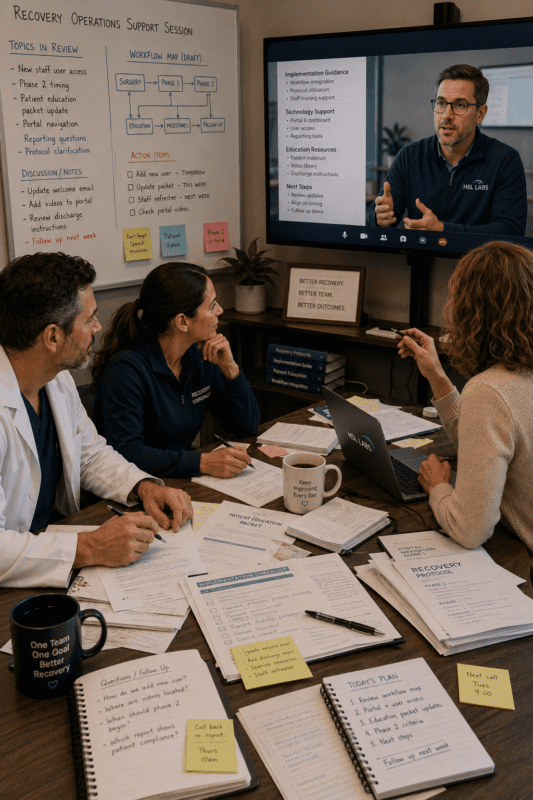
Successful implementation does not end when training is completed or a program is launched. As recovery-focused initiatives become integrated into everyday clinical operations, practices often encounter new questions, evolving workflow considerations, technology-related needs, and opportunities for continuous improvement. Long-term success therefore depends not only upon preparation, but also upon access to practical resources and ongoing support that help maintain momentum after implementation begins.
HSL LABS views support as an ongoing partnership rather than a one-time service. Participating practices may require assistance with operational workflows, technology utilization, protocol deployment, patient-engagement activities, reporting processes, educational resources, and other implementation-related matters that arise throughout the recovery-support lifecycle. Providing responsive guidance and practical assistance helps practices address challenges efficiently while maintaining consistency with established recovery objectives.
For this reason, HSL LABS maintains a broader support framework designed to assist physicians and their teams as programs mature and organizational capabilities evolve. By providing access to implementation guidance, operational resources, technology support, problem-resolution assistance, and continuing engagement opportunities, HSL LABS seeks to help participating practices strengthen operational performance, improve implementation consistency, enhance patient experiences, and support sustained recovery-focused excellence.
Supporting Practices Beyond Implementation
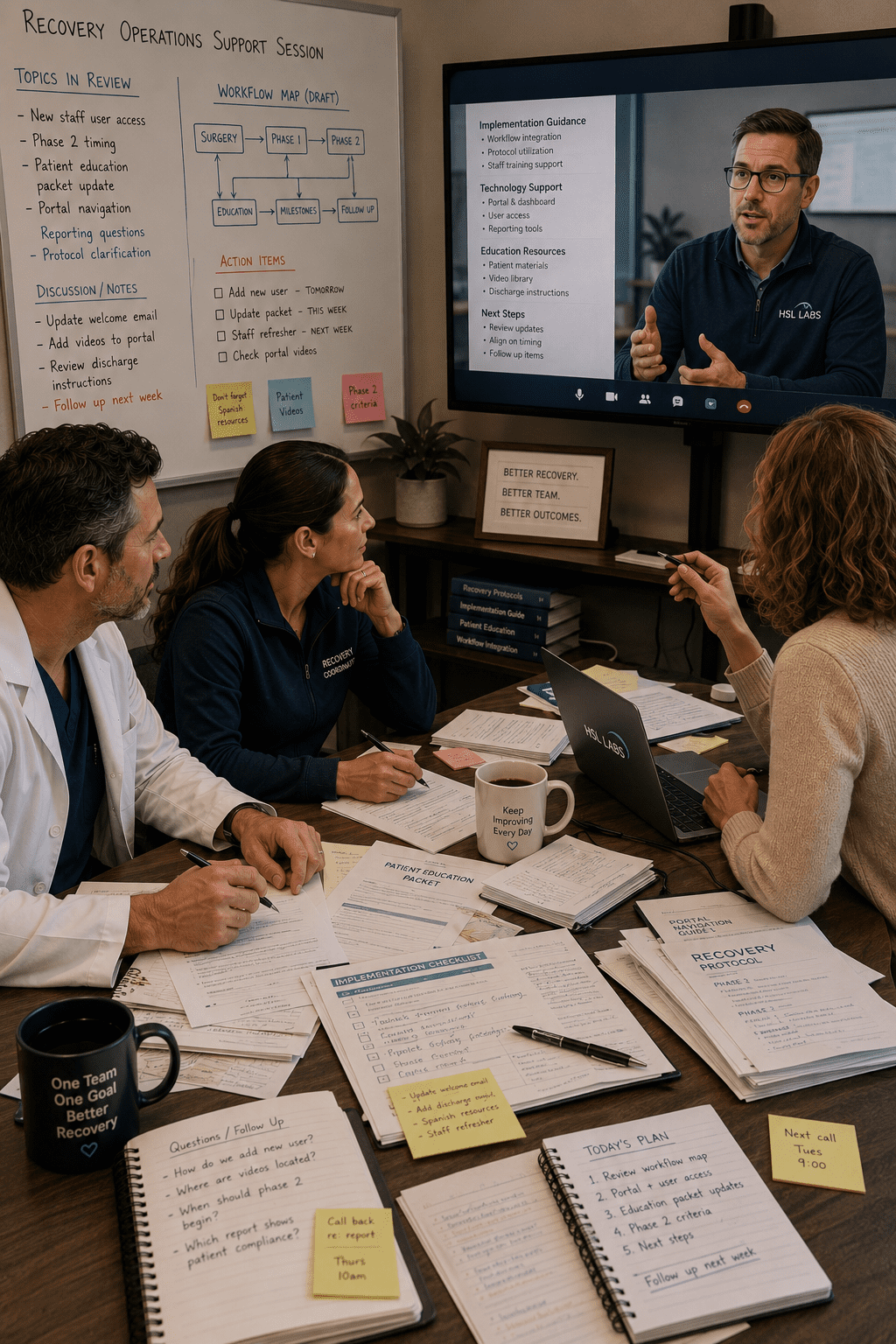
Successful implementation does not end when training is completed or a program is launched. As recovery-focused initiatives become integrated into everyday clinical operations, practices often encounter new questions, evolving workflow considerations, technology-related needs, and opportunities for continuous improvement. Long-term success therefore depends not only upon preparation, but also upon access to practical resources and ongoing support that help maintain momentum after implementation begins.
HSL LABS views support as an ongoing partnership rather than a one-time service. Participating practices may require assistance with operational workflows, technology utilization, protocol deployment, patient-engagement activities, reporting processes, educational resources, and other implementation-related matters that arise throughout the recovery-support lifecycle. Providing responsive guidance and practical assistance helps practices address challenges efficiently while maintaining consistency with established recovery objectives.
For this reason, HSL LABS maintains a broader support framework designed to assist physicians and their teams as programs mature and organizational capabilities evolve. By providing access to implementation guidance, operational resources, technology support, problem-resolution assistance, and continuing engagement opportunities, HSL LABS seeks to help participating practices strengthen operational performance, improve implementation consistency, enhance patient experiences, and support sustained recovery-focused excellence.
SUPPORT SERVICES
HSL LABS recognizes that successful implementation requires more than training alone. Even the most knowledgeable physicians and well-prepared staff members may encounter operational questions, technology issues, workflow challenges, implementation obstacles, and evolving practice needs as recovery-focused initiatives become integrated into everyday clinical operations. For this reason, ongoing support services represent an important component of the Company’s physician and practice engagement framework.
The purpose of HSL LABS support services is to assist participating practices in maintaining effective implementation, maximizing operational efficiency, resolving challenges promptly, and ensuring that programs, protocols, technologies, and educational resources continue to function as intended within real-world clinical environments.
Implementation support represents one of the primary service areas. As practices incorporate recovery-focused programs into existing workflows, questions may arise regarding operational procedures, protocol sequencing, patient participation activities, documentation expectations, reporting requirements, educational delivery schedules, and related implementation matters. Support resources are intended to help practices address these issues efficiently while maintaining consistency with established program objectives.
Technology support is another important component of the service framework. Participating physicians and authorized staff members may require assistance relating to PhysicianOS™, Physician Dashboards, Patient Portals, reporting systems, communication tools, user-access management, account administration, system navigation, feature utilization, workflow configuration, and other technology-related functions. Ongoing support helps practices utilize available technologies effectively while minimizing operational disruptions.
The Company also recognizes that practices frequently differ in size, specialty focus, staffing structure, procedural volume, and operational workflows. Accordingly, support services may include guidance relating to workflow integration, implementation adaptation, process optimization, resource utilization, and other practical considerations that influence successful participation within individual practice environments.
Protocol-support services may assist participating practices in navigating procedural-specific implementation questions, recovery-phase management considerations, educational-resource deployment, milestone monitoring activities, communication pathways, and other operational matters associated with protocol utilization. These services help promote consistency while supporting appropriate adaptation to the realities of individual practice operations.
Support services may also facilitate communication between participating practices and various organizational resources within the HSL LABS ecosystem. Practices may seek clarification regarding educational materials, technology updates, reporting initiatives, governance activities, certification programs, designation opportunities, or other organizational initiatives. Support personnel help ensure that practices have access to accurate information and appropriate resources when needed.
As organizational capabilities continue to expand, support services may additionally assist with the implementation of new technologies, protocol updates, educational enhancements, reporting initiatives, system upgrades, and other operational developments. This ongoing support helps participating practices remain current with evolving resources while reducing implementation burdens associated with organizational growth.
The Company further recognizes the importance of responsiveness. Timely assistance can often prevent relatively minor issues from becoming larger operational challenges. Accordingly, support services are intended to provide practical guidance, problem resolution, resource access, and implementation assistance in a manner that promotes continuity and minimizes disruption to patient-care operations.
Observations and feedback generated through support-service interactions also contribute to broader organizational learning activities. Recurring questions, implementation challenges, workflow issues, technology concerns, and operational observations may provide valuable information that helps inform future technology enhancements, educational initiatives, protocol refinements, training resources, and quality-improvement efforts. In this respect, support services contribute not only to individual practice success but also to the continued evolution of the HSL LABS ecosystem.
Importantly, support services are designed to complement, not replace, physician judgment and practice autonomy. The objective is to provide participating practices with practical resources, operational assistance, and responsive guidance while respecting the independence of physicians and the unique characteristics of individual clinical environments.
Ultimately, support services represent an ongoing commitment to participating practices. By providing operational assistance, technology support, implementation guidance, problem-resolution resources, and continuing engagement throughout the recovery-support lifecycle, HSL LABS seeks to help physicians and their teams achieve successful implementation while maintaining a high standard of patient service, operational effectiveness, and recovery-focused care.