

Turning Knowledge Into Action
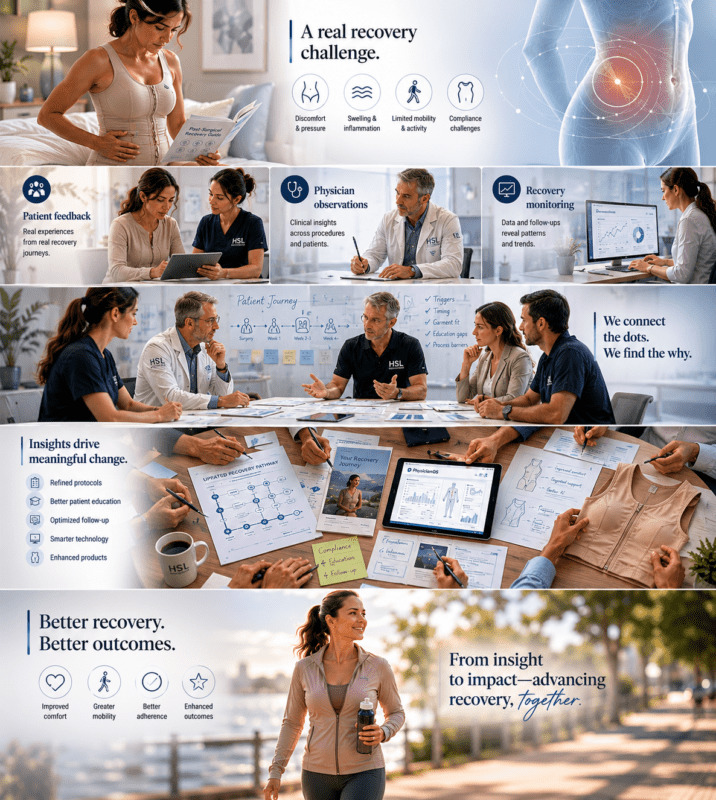
Information alone does not create improvement. The value of any observation, study, implementation experience, or recovery-related finding ultimately depends upon the ability to identify meaningful patterns, develop a deeper understanding of what those patterns may indicate, and apply those lessons in a practical manner. HSL LABS continually evaluates information derived from recovery-focused initiatives, physician observations, implementation experiences, technology-supported monitoring, educational activities, governance reviews, and other organizational learning processes to better understand the factors that influence recovery support, program effectiveness, patient engagement, and implementation success.
The insights generated through this process help inform future decisions across the HSL LABS ecosystem. Findings may contribute to refinements involving recovery protocols, educational resources, operational workflows, technology development, implementation methodologies, and product innovation. As new information becomes available and organizational experience expands, previously accepted assumptions may be reassessed, refined, or replaced. Through the continuous evaluation of observations, experiences, and emerging trends, HSL LABS seeks to transform information into understanding and understanding into meaningful action that supports ongoing improvement throughout its recovery-focused initiatives.
Turning Knowledge Into Action
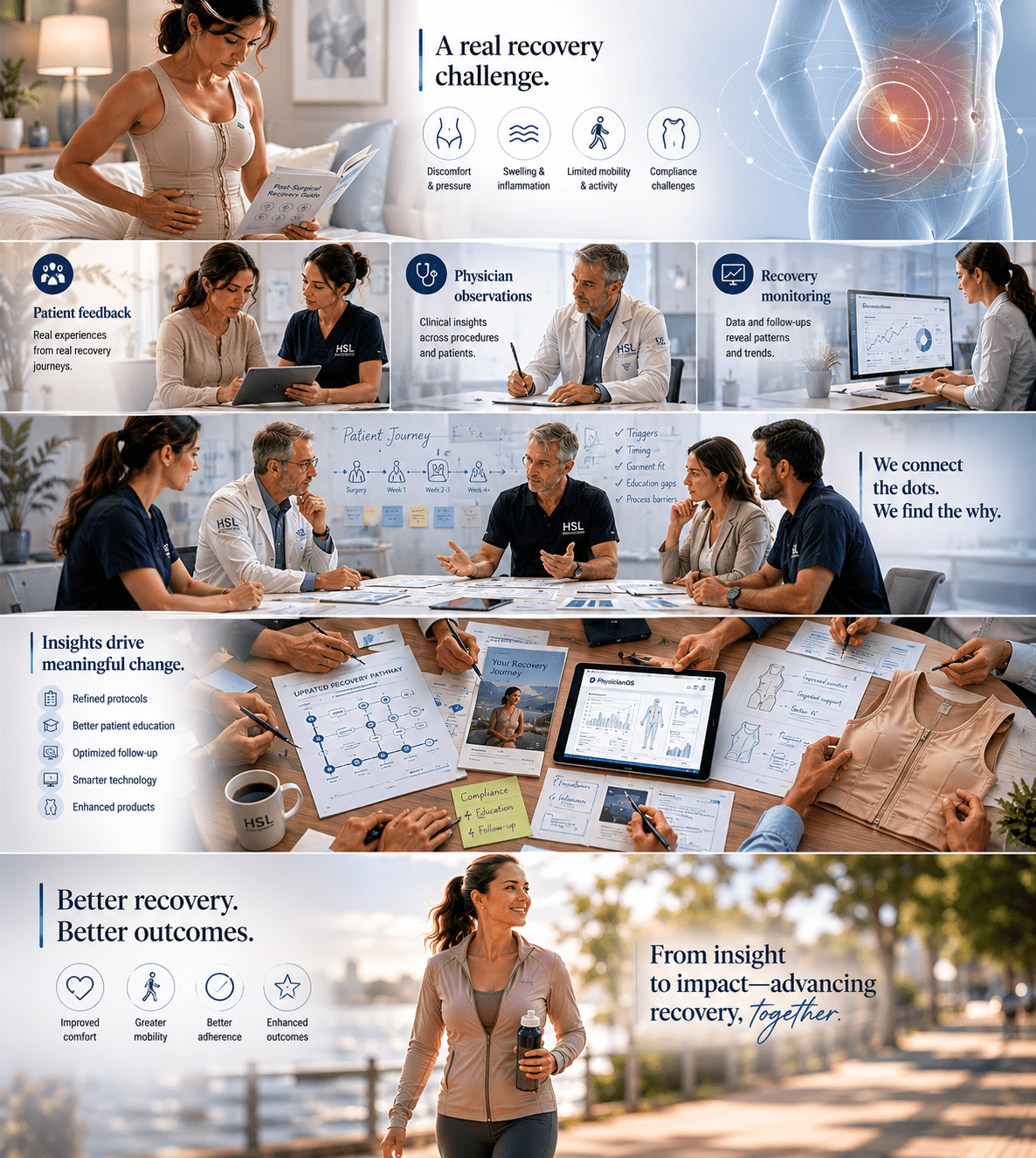
Information alone does not create improvement. The value of any observation, study, implementation experience, or recovery-related finding ultimately depends upon the ability to identify meaningful patterns, develop a deeper understanding of what those patterns may indicate, and apply those lessons in a practical manner. HSL LABS continually evaluates information derived from recovery-focused initiatives, physician observations, implementation experiences, technology-supported monitoring, educational activities, governance reviews, and other organizational learning processes to better understand the factors that influence recovery support, program effectiveness, patient engagement, and implementation success.
The insights generated through this process help inform future decisions across the HSL LABS ecosystem. Findings may contribute to refinements involving recovery protocols, educational resources, operational workflows, technology development, implementation methodologies, and product innovation. As new information becomes available and organizational experience expands, previously accepted assumptions may be reassessed, refined, or replaced. Through the continuous evaluation of observations, experiences, and emerging trends, HSL LABS seeks to transform information into understanding and understanding into meaningful action that supports ongoing improvement throughout its recovery-focused initiatives.
DEEPENING INSIGHTS
The value of any investigative effort ultimately depends upon its practical application. For this reason, HSL LABS views the acquisition of information as only one stage within a broader process of organizational learning. Equally important is the ability to interpret observations, identify meaningful patterns, draw useful conclusions, and translate those conclusions into actions that improve programs, protocols, technologies, educational initiatives, operational systems, and products.
The Company’s efforts to deepen insights begin with the evaluation of information generated through studies, physician observations, implementation experiences, technology-supported monitoring, committee reviews, Internal Executive Briefings, patient engagement activities, and other organizational learning mechanisms. Individually, these sources may provide isolated observations. Collectively, they may reveal recurring trends, emerging opportunities, operational challenges, or previously unrecognized relationships that warrant closer examination.
Particular attention is directed toward identifying patterns that may have practical significance. For example, observations regarding recovery progression, patient adherence, communication effectiveness, protocol utilization, workflow integration, educational engagement, or technology usage may provide insight into factors that influence implementation success and overall program performance. Such findings may guide future refinements and developmental priorities.
Insights derived through these activities frequently influence protocol evolution. Recommendations regarding sequencing, timing, educational support, patient engagement strategies, workflow processes, monitoring approaches, or implementation methodologies may be evaluated and incorporated into future protocol revisions. In this manner, recovery frameworks remain responsive to both experience and emerging knowledge.
Technology development similarly benefits from the insight-generation process. Observations regarding system usage, reporting requirements, workflow efficiency, communication preferences, compliance monitoring, and user interactions may contribute to enhancements involving PhysicianOS™, physician dashboards, patient portals, and related infrastructure. The objective is to ensure that technology continues to evolve in response to real-world needs rather than theoretical assumptions.
Educational initiatives are also informed by accumulated insights. Information regarding recurring patient questions, communication barriers, physician information needs, implementation challenges, and training opportunities may guide the development of new educational materials, professional resources, patient communications, and support tools designed to improve understanding and engagement.
The process additionally influences product development activities. Insights derived from physician observations, implementation experiences, recovery trends, and identified unmet needs may contribute to the refinement of existing products or the identification of entirely new product categories. In this respect, knowledge gained through investigation serves as an important driver of future innovation.
An important characteristic of the Company’s approach is that insights are rarely viewed as final conclusions. As new information becomes available and organizational experience expands, previously accepted assumptions may be revisited, modified, refined, or replaced. This ongoing process of reassessment helps support continuous improvement while reducing reliance upon static models or fixed viewpoints.
The Company also recognizes that meaningful insights often emerge at the intersection of multiple disciplines. Clinical observations, technology usage patterns, operational experiences, educational outcomes, patient engagement activities, and governance reviews may collectively reveal opportunities that would not be apparent when examined in isolation. Accordingly, HSL LABS emphasizes the integration of diverse sources of information when evaluating future initiatives and strategic priorities.
Ultimately, deepening insights is the process through which information becomes understanding and understanding becomes action. By systematically applying lessons learned through observation, investigation, evaluation, and experience, HSL LABS seeks to strengthen decision-making, improve organizational effectiveness, and continuously refine the programs, protocols, technologies, educational initiatives, operational systems, and products that comprise its recovery-focused ecosystem.