

Protecting Information. Preserving Trust.
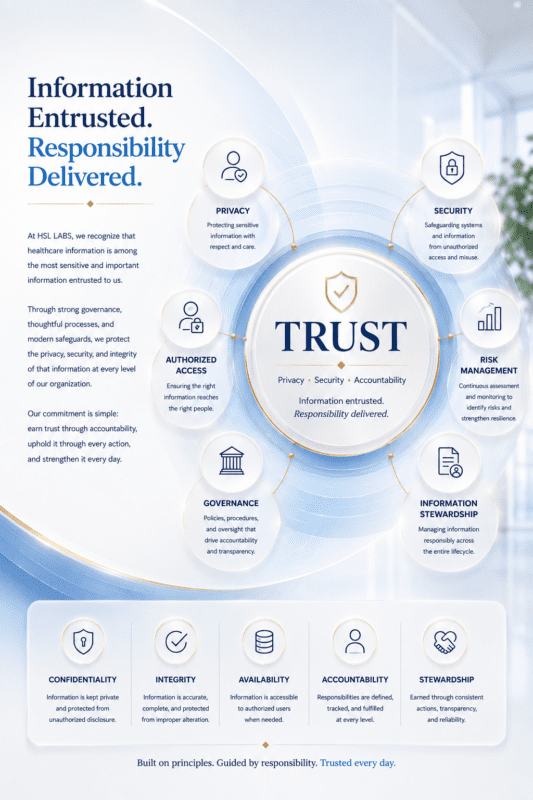
The responsible management of healthcare-related information requires more than technology alone. It requires a comprehensive framework of policies, procedures, safeguards, oversight, and accountability designed to protect the confidentiality, integrity, and availability of sensitive information. At HSL LABS, privacy, security, and information stewardship are viewed as essential organizational responsibilities that support the trust placed in the Company by physicians, participating practices, patients, and other stakeholders. As technologies, programs, reporting systems, and operational infrastructures continue to evolve, information protection remains an important consideration throughout the organization.
Our approach recognizes that effective compliance is achieved through the integration of administrative, physical, and technical safeguards working together. Access controls, authentication requirements, role-based permissions, audit capabilities, documentation management, workforce responsibilities, risk-management activities, and ongoing oversight all contribute to a broader framework designed to support responsible information management. These measures help establish clear expectations regarding how healthcare-related information is accessed, managed, protected, and utilized within approved operational environments.
Privacy and security are not static objectives. Regulatory requirements, cybersecurity risks, healthcare technologies, and operational practices continue to evolve over time, requiring continuous assessment and improvement. Through governance processes, contractual protections, information-security practices, workforce awareness, and ongoing evaluation of systems and procedures, HSL LABS seeks to support compliance with applicable privacy and security requirements while maintaining a strong commitment to responsible information stewardship and organizational accountability.
Protecting Information. Preserving Trust.
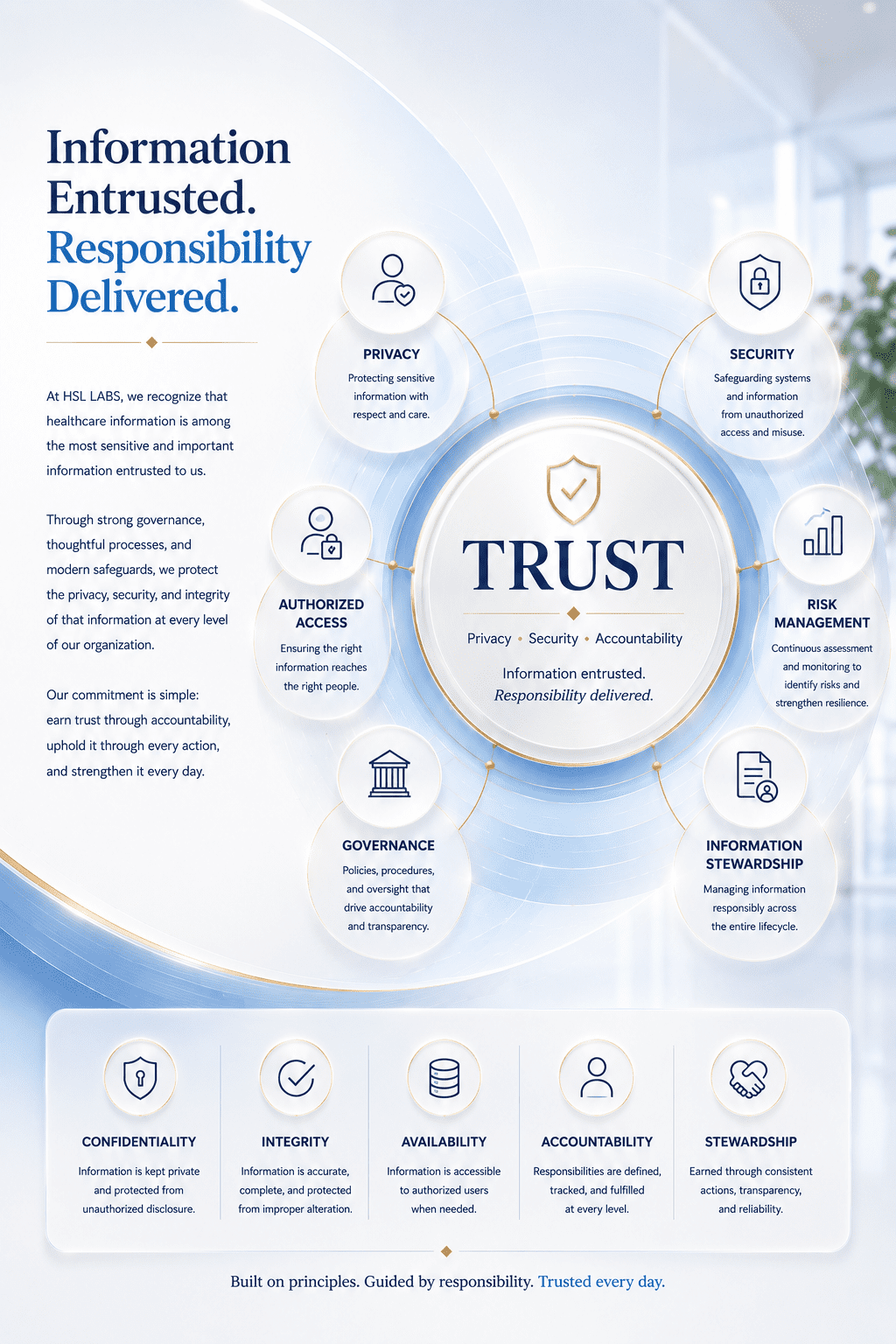
The responsible management of healthcare-related information requires more than technology alone. It requires a comprehensive framework of policies, procedures, safeguards, oversight, and accountability designed to protect the confidentiality, integrity, and availability of sensitive information. At HSL LABS, privacy, security, and information stewardship are viewed as essential organizational responsibilities that support the trust placed in the Company by physicians, participating practices, patients, and other stakeholders. As technologies, programs, reporting systems, and operational infrastructures continue to evolve, information protection remains an important consideration throughout the organization.
Our approach recognizes that effective compliance is achieved through the integration of administrative, physical, and technical safeguards working together. Access controls, authentication requirements, role-based permissions, audit capabilities, documentation management, workforce responsibilities, risk-management activities, and ongoing oversight all contribute to a broader framework designed to support responsible information management. These measures help establish clear expectations regarding how healthcare-related information is accessed, managed, protected, and utilized within approved operational environments.
Privacy and security are not static objectives. Regulatory requirements, cybersecurity risks, healthcare technologies, and operational practices continue to evolve over time, requiring continuous assessment and improvement. Through governance processes, contractual protections, information-security practices, workforce awareness, and ongoing evaluation of systems and procedures, HSL LABS seeks to support compliance with applicable privacy and security requirements while maintaining a strong commitment to responsible information stewardship and organizational accountability.
HIPAA AND HITECH COMPLIANCE
HSL LABS recognizes the importance of privacy, security, and responsible information stewardship within healthcare-related environments. As the Company develops technologies, programs, reporting systems, educational initiatives, physician-participation frameworks, and operational infrastructures that may interact with healthcare organizations and healthcare information, it remains committed to supporting compliance with applicable privacy and security requirements established under federal law.
Particular attention is directed toward the requirements and principles associated with the Health Insurance Portability and Accountability Act of 1996 (HIPAA) and the Health Information Technology for Economic and Clinical Health Act (HITECH). Together, these statutes provide important legal and operational frameworks governing the protection, use, disclosure, transmission, storage, and management of Protected Health Information (PHI) and related healthcare data.
The Company recognizes that HIPAA compliance extends beyond technology alone. Effective compliance requires the integration of administrative safeguards, physical safeguards, technical safeguards, workforce training, documentation controls, risk-management activities, access-management procedures, incident-response protocols, and ongoing oversight. Accordingly, HSL LABS seeks to incorporate these considerations into relevant operational, technological, and organizational activities.
Where appropriate and applicable, organizational policies and procedures may address issues relating to information access, user authentication, role-based permissions, audit controls, information integrity, transmission security, documentation management, workforce responsibilities, and the responsible handling of healthcare-related information. These measures are intended to support the confidentiality, integrity, and availability of information entrusted to approved systems and authorized participants.
The Company also recognizes the importance of contractual compliance frameworks. In circumstances where organizational activities involve interactions with healthcare providers, participating physician practices, surgical facilities, or other healthcare organizations, Business Associate Agreements (BAAs) and related contractual arrangements may be utilized to establish responsibilities regarding the management and protection of Protected Health Information. Such agreements help define permitted uses, disclosure limitations, security obligations, breach-notification requirements, and other compliance-related responsibilities.
HITECH introduced additional requirements and expectations relating to healthcare information security, breach notification, electronic information management, accountability, and enforcement. HSL LABS recognizes the importance of these provisions and seeks to incorporate appropriate awareness of HITECH requirements into relevant organizational planning, technology development, information-management activities, and operational procedures.
Within technology environments such as PhysicianOS™, the Physician Dashboard, the Patient Portal, reporting systems, and related infrastructure, information-security considerations are integrated into system administration and operational design. Access controls, authentication requirements, audit capabilities, permission structures, activity monitoring, and other administrative and technical measures may be utilized to support responsible information management and reduce the risk of unauthorized access, disclosure, alteration, or misuse.
The Company additionally recognizes the importance of risk assessment and continuous evaluation. Healthcare privacy and security requirements continue to evolve as technologies, regulatory expectations, cybersecurity threats, and operational environments change over time. Accordingly, HSL LABS periodically reviews relevant policies, procedures, contractual frameworks, operational practices, and technology controls to identify opportunities for enhancement and to maintain alignment with applicable requirements and recognized best practices.
Participation in Designated Clinical Research and Data Facility activities, physician-engagement initiatives, reporting programs, educational systems, and related organizational activities may involve additional privacy and information-governance considerations. In such circumstances, information-management practices may incorporate de-identification, anonymization, aggregation, minimum-necessary-use principles, access restrictions, documentation controls, and other safeguards designed to support responsible information stewardship.
Compliance responsibilities also extend to organizational culture and workforce conduct. Employees, contractors, consultants, advisors, participating practices, and authorized users of Company systems are expected to respect applicable privacy obligations, information-security requirements, confidentiality standards, and organizational policies governing the use and protection of healthcare-related information.
Ultimately, HSL LABS views HIPAA and HITECH compliance not merely as legal requirements, but as important components of organizational responsibility. Through the implementation of appropriate safeguards, governance processes, contractual protections, operational controls, and technology-management practices, the Company seeks to support the privacy, security, and responsible stewardship of healthcare-related information while maintaining the trust of physicians, participating practices, patients, and other stakeholders.