

Real-World Recovery Intelligence
The most valuable insights often emerge within the day-to-day realities of clinical practice. Through its Designated Clinical Research and Data Facility Program, HSL LABS works with participating surgical practices to better understand recovery experiences, implementation challenges, patient engagement patterns, educational effectiveness, technology utilization, and other factors that influence recovery-focused care. These practice-based observations help bridge the gap between theoretical assumptions and the realities physicians and patients encounter every day.
By creating a structured framework for ongoing observation, evaluation, and feedback, participating facilities contribute to a growing body of recovery intelligence that supports organizational learning and continuous improvement. Insights generated through real-world implementation environments may ultimately influence future protocols, technologies, educational initiatives, operational systems, and products, helping ensure that developmental efforts remain grounded in practical clinical experience.
Real-World Recovery Intelligence
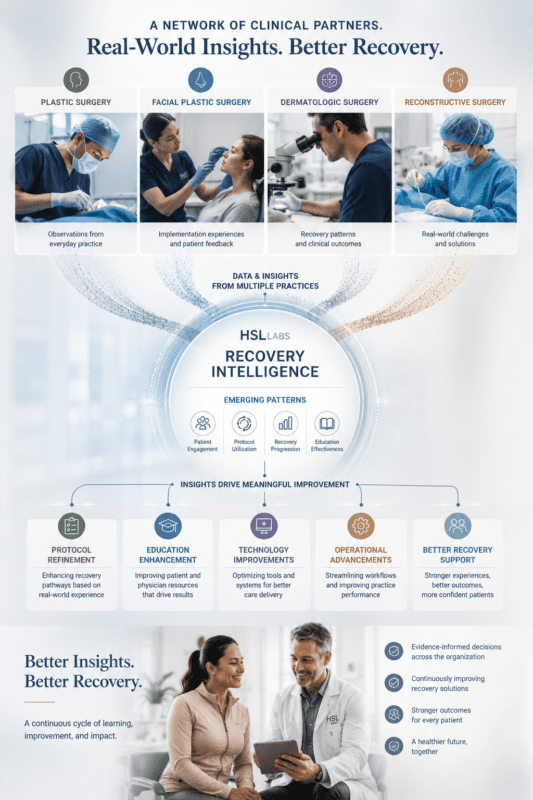
The most valuable insights often emerge within the day-to-day realities of clinical practice. Through its Designated Clinical Research and Data Facility Program, HSL LABS works with participating surgical practices to better understand recovery experiences, implementation challenges, patient engagement patterns, educational effectiveness, technology utilization, and other factors that influence recovery-focused care. These practice-based observations help bridge the gap between theoretical assumptions and the realities physicians and patients encounter every day.
By creating a structured framework for ongoing observation, evaluation, and feedback, participating facilities contribute to a growing body of recovery intelligence that supports organizational learning and continuous improvement. Insights generated through real-world implementation environments may ultimately influence future protocols, technologies, educational initiatives, operational systems, and products, helping ensure that developmental efforts remain grounded in practical clinical experience.
DESIGNATED RESEARCH AND DATA FACILITIES
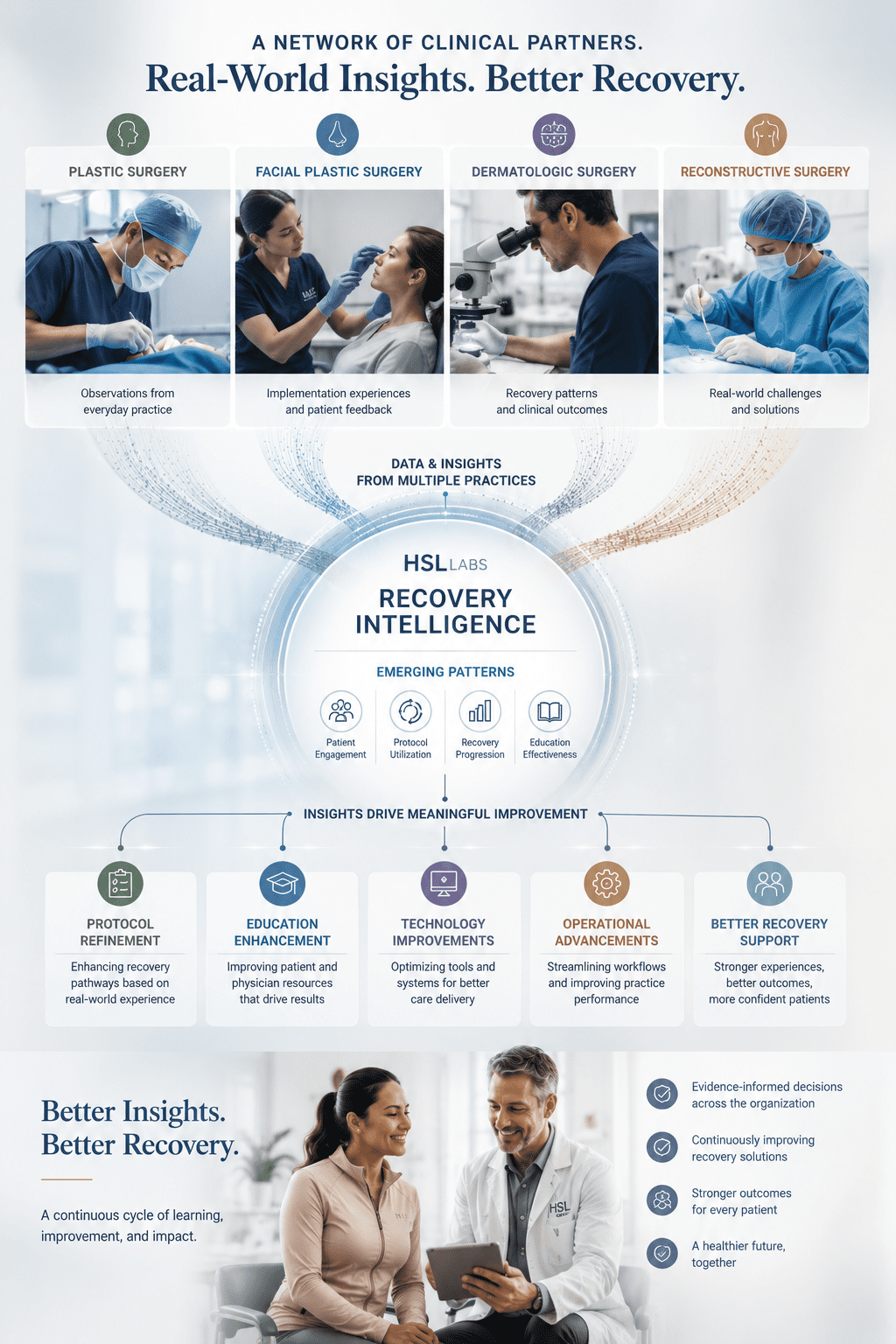
The HSL LABS Designated Clinical Research and Data Facility Program is intended to establish a network of participating surgical practices that contribute to the ongoing evaluation, refinement, and advancement of recovery-focused programs, protocols, technologies, educational initiatives, operational systems, and products. The program was created to provide a structured mechanism through which real-world recovery observations and implementation experiences can be incorporated into the Company’s broader organizational learning and decision-making processes.
Participation is generally limited to qualified surgical and procedural practices formally accepted into the program. These practices may include plastic surgery, reconstructive surgery, facial plastic surgery, cosmetic surgery, oculoplastic surgery, dermatologic surgery, and other physician-directed procedural environments approved by HSL LABS. Participating facilities are selected based upon factors that may include procedural volume, physician engagement, operational capabilities, reporting capacity, commitment to program participation, and alignment with Company objectives.
The program is based upon a straightforward principle: physicians and surgical practices routinely observe recovery-related events, patient behaviors, implementation challenges, procedural trends, communication issues, and outcome-related patterns that may not be readily apparent through traditional product development activities or isolated evaluations. When collected and evaluated systematically, these observations may contribute meaningfully to organizational learning and future developmental efforts.
Designated facilities may participate in a variety of information-gathering activities involving recovery progression, protocol utilization, patient engagement, educational effectiveness, technology implementation, workflow integration, communication practices, and other approved areas of evaluation. Depending upon the nature of a particular initiative, participating practices may contribute observational information, implementation feedback, utilization metrics, physician assessments, operational observations, and other forms of structured reporting.
To promote consistency across participating sites, HSL LABS may establish standardized reporting methodologies, documentation formats, observational criteria, review procedures, and data submission requirements. These measures are intended to improve comparability among participating facilities while supporting the integrity and usefulness of information generated through the program.
An important objective of the program is the identification of recurring patterns that may not be apparent within a single practice or procedural setting. When observations from multiple participating facilities are evaluated collectively, broader trends involving recovery experiences, protocol implementation, patient engagement, educational utilization, technology adoption, workflow performance, and other operational factors may become more readily identifiable. These findings may ultimately influence future organizational priorities and developmental initiatives.
Information generated through designated facilities may be introduced into the Internal Executive Briefing (IEB) System for further evaluation and discussion. Depending upon the subject matter, observations and findings may subsequently be reviewed by the Clinical Advisory Council, relevant committees, peer review participants, executive leadership, technology teams, protocol development personnel, educational initiative planners, or product development groups. This creates a formal pathway through which practice-level observations can contribute to organization-wide decision-making.
The program also serves an important role in protocol governance. Participating physicians and staff members frequently encounter opportunities to improve implementation processes, communication methodologies, patient engagement strategies, recovery-support measures, and procedural-specific recovery frameworks. These observations may lead to recommendations for protocol refinement, procedural adaptation, educational enhancement, or operational modification. Through the Designated Clinical Research and Data Facility Program, such recommendations can be evaluated within a structured organizational framework rather than remaining isolated within individual practices.
Technology evaluation represents another important function of participating facilities. PhysicianOS™, physician dashboards, patient portals, communication systems, reporting tools, workflow applications, and other technological resources may be assessed within actual practice environments. Feedback generated through day-to-day utilization helps identify opportunities for improvement, functionality enhancements, workflow optimization, reporting modifications, and future system development.
The program additionally supports the evaluation of patient education initiatives and professional training resources. Participating facilities may provide observations regarding patient comprehension, information utilization, communication effectiveness, staff training needs, implementation challenges, and other factors relevant to educational program development. These findings help inform future educational priorities and content refinement efforts.
To support responsible information management, participating facilities are expected to operate in accordance with applicable privacy requirements, confidentiality standards, contractual obligations, and organizational policies established by HSL LABS. Where appropriate, information may be aggregated, anonymized, de-identified, or otherwise managed through approved procedures designed to protect patient privacy and support regulatory compliance. Participating practices may also enter into Business Associate Agreements and other formal arrangements when required.
Unlike isolated studies or one-time evaluations, the Designated Clinical Research and Data Facility Program is intended to function as a continuous organizational learning system. As participating practices contribute observations and implementation experiences over time, HSL LABS develops an expanding body of practical knowledge derived from real-world surgical recovery environments. This information helps inform future decisions involving programs, protocols, technologies, educational initiatives, operational systems, and products.
Ultimately, the Designated Clinical Research and Data Facility Program serves as a bridge between clinical practice and organizational development. By creating a structured framework through which participating surgical practices can contribute observations, experience, and expertise, the program helps ensure that future Company initiatives remain informed by the realities of patient care, procedural recovery, physician participation, and day-to-day clinical operations.