

EDUCATION
HSL LABS recognizes that meaningful advancement in any scientific or clinical discipline depends upon the continual expansion, refinement, and responsible dissemination of knowledge. Accordingly, education serves as an important component of the Company’s broader commitment to advancing understanding within the fields of post-procedural recovery, healing science, patient engagement, and recovery-focused innovation.
The Company supports educational initiatives designed to promote professional development, encourage informed discussion, facilitate knowledge sharing, and foster greater awareness of emerging concepts, methodologies, technologies, and recovery-support strategies. These efforts are intended to serve physicians, healthcare professionals, organizational participants, and other stakeholders seeking to deepen their understanding of recovery-related principles and practices.
In addition to supporting educational resources and learning opportunities, HSL LABS seeks to encourage thoughtful inquiry and the exchange of ideas through scholarly activities, structured evaluation processes, and the exploration of emerging scientific and operational concepts. The Company believes that continuous learning plays an essential role in driving innovation, strengthening professional competence, and improving the quality of future solutions.
As recovery science continues to evolve, HSL LABS remains committed to fostering a culture of education, intellectual curiosity, and professional growth. Through its educational initiatives, the Company seeks to contribute to a more informed, knowledgeable, and capable community of individuals dedicated to advancing recovery-focused care and innovation.
EDUCATION
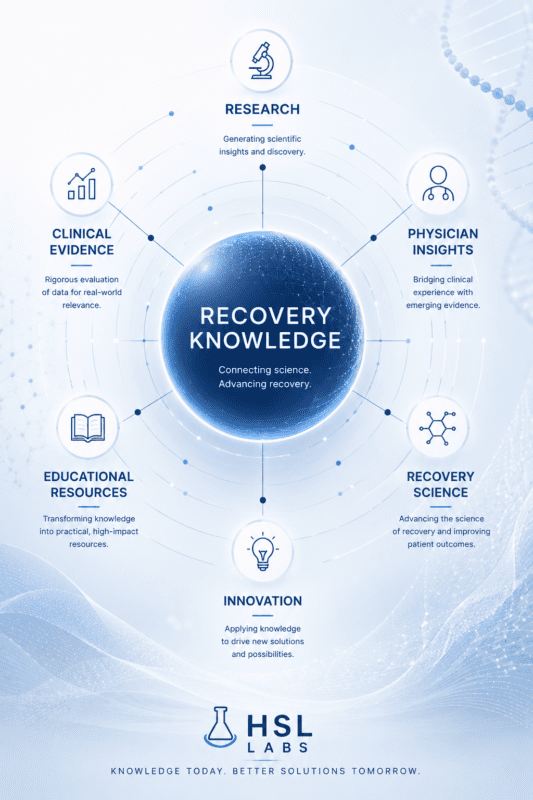
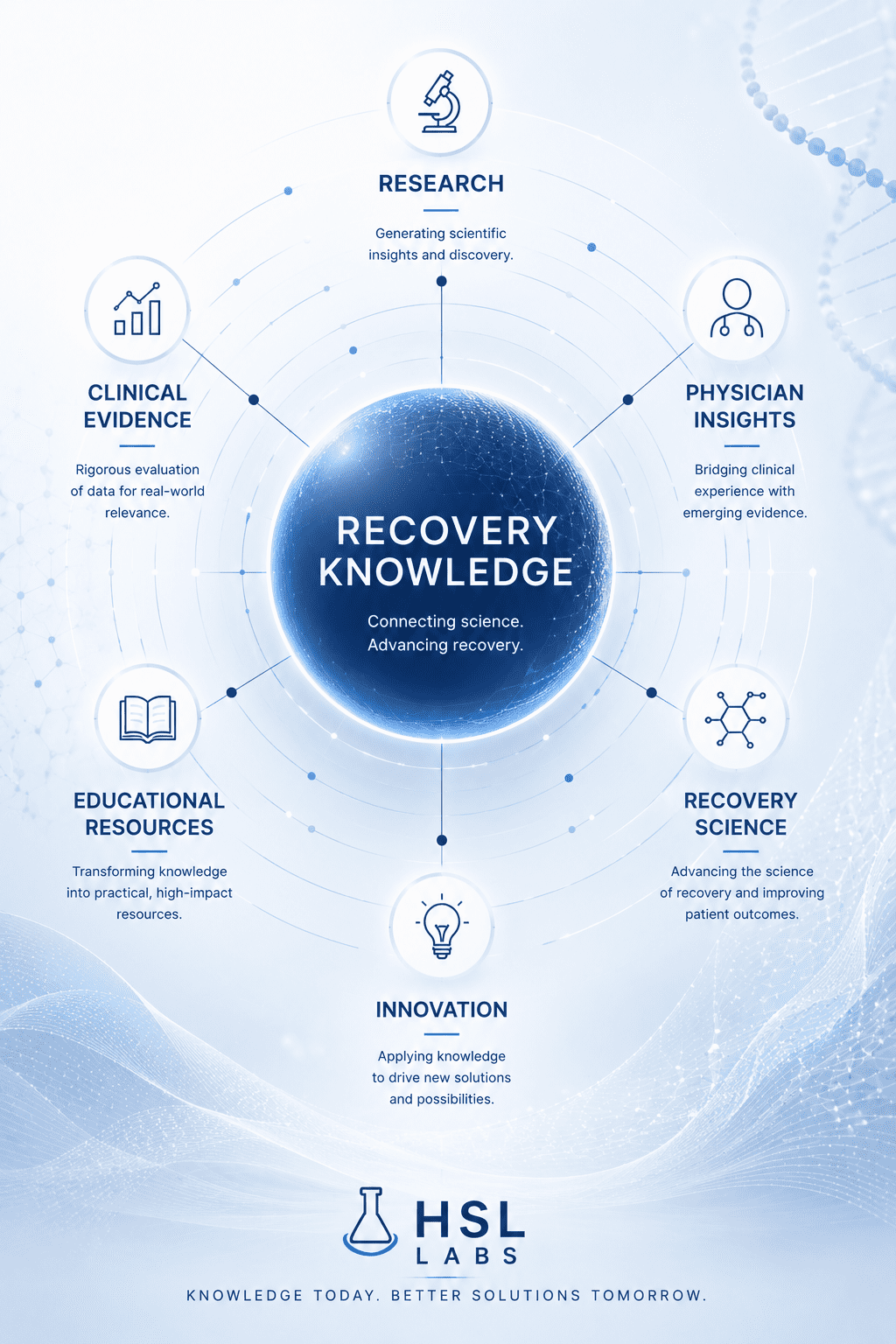
HSL LABS recognizes that meaningful advancement in any scientific or clinical discipline depends upon the continual expansion, refinement, and responsible dissemination of knowledge. Accordingly, education serves as an important component of the Company’s broader commitment to advancing understanding within the fields of post-procedural recovery, healing science, patient engagement, and recovery-focused innovation.
The Company supports educational initiatives designed to promote professional development, encourage informed discussion, facilitate knowledge sharing, and foster greater awareness of emerging concepts, methodologies, technologies, and recovery-support strategies. These efforts are intended to serve physicians, healthcare professionals, organizational participants, and other stakeholders seeking to deepen their understanding of recovery-related principles and practices.
In addition to supporting educational resources and learning opportunities, HSL LABS seeks to encourage thoughtful inquiry and the exchange of ideas through scholarly activities, structured evaluation processes, and the exploration of emerging scientific and operational concepts. The Company believes that continuous learning plays an essential role in driving innovation, strengthening professional competence, and improving the quality of future solutions.
As recovery science continues to evolve, HSL LABS remains committed to fostering a culture of education, intellectual curiosity, and professional growth. Through its educational initiatives, the Company seeks to contribute to a more informed, knowledgeable, and capable community of individuals dedicated to advancing recovery-focused care and innovation.
Building Knowledge. Strengthening Capability.
Meaningful progress requires more than innovation alone. It requires knowledgeable people, informed decision-making, and a commitment to continuous learning. At HSL LABS, education and professional development are viewed as long-term organizational investments that help strengthen the expertise, judgment, and capabilities of physicians, participating practices, advisors, staff members, and organizational leadership. By fostering an environment where learning is encouraged and knowledge is continuously expanded, the Company seeks to support the ongoing advancement of its recovery-focused mission.
The healthcare environment continues to evolve through new technologies, recovery methodologies, procedural techniques, patient expectations, operational practices, and scientific developments. Organizations that invest in learning are better positioned to adapt, evaluate new opportunities, and make informed decisions in response to changing conditions. HSL LABS therefore promotes educational initiatives designed to provide practical knowledge, support professional growth, and encourage the exchange of ideas across clinical, operational, technological, and organizational disciplines.
Education within HSL LABS extends beyond the delivery of information. The Company recognizes that valuable knowledge is often gained through experience, collaboration, and real-world implementation. By encouraging multidisciplinary learning, knowledge sharing, professional development, and continuous refinement, HSL LABS seeks to strengthen the collective expertise of its ecosystem while supporting the ongoing improvement of programs, technologies, operational systems, educational initiatives, and recovery-focused care.
Building Knowledge. Strengthening Capability.
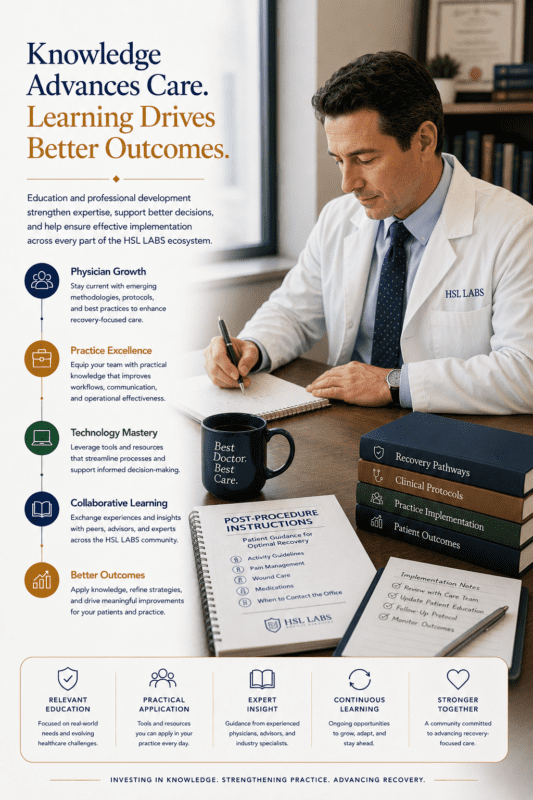
Meaningful progress requires more than innovation alone. It requires knowledgeable people, informed decision-making, and a commitment to continuous learning. At HSL LABS, education and professional development are viewed as long-term organizational investments that help strengthen the expertise, judgment, and capabilities of physicians, participating practices, advisors, staff members, and organizational leadership. By fostering an environment where learning is encouraged and knowledge is continuously expanded, the Company seeks to support the ongoing advancement of its recovery-focused mission.
The healthcare environment continues to evolve through new technologies, recovery methodologies, procedural techniques, patient expectations, operational practices, and scientific developments. Organizations that invest in learning are better positioned to adapt, evaluate new opportunities, and make informed decisions in response to changing conditions. HSL LABS therefore promotes educational initiatives designed to provide practical knowledge, support professional growth, and encourage the exchange of ideas across clinical, operational, technological, and organizational disciplines.
Education within HSL LABS extends beyond the delivery of information. The Company recognizes that valuable knowledge is often gained through experience, collaboration, and real-world implementation. By encouraging multidisciplinary learning, knowledge sharing, professional development, and continuous refinement, HSL LABS seeks to strengthen the collective expertise of its ecosystem while supporting the ongoing improvement of programs, technologies, operational systems, educational initiatives, and recovery-focused care.
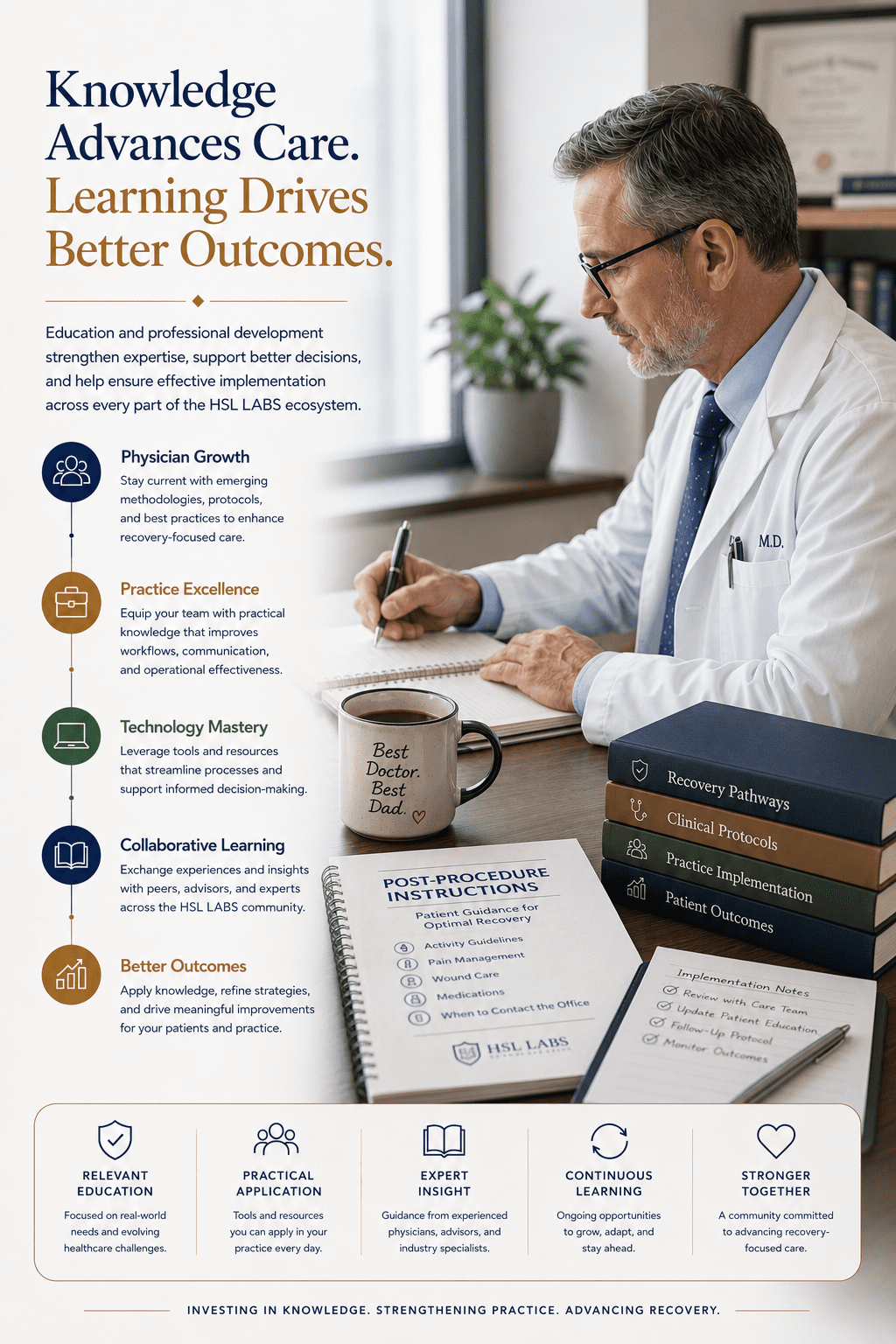
INVESTING IN EDUCATION AND PROFESSIONAL DEVELOPMENT
HSL LABS recognizes that the quality of any organization is influenced by the quality of the knowledge, judgment, skills, and expertise possessed by the individuals who participate in its activities. For this reason, the Company views education and professional development as long-term organizational investments rather than isolated training exercises or occasional informational initiatives.
The healthcare environment continues to evolve rapidly. New technologies, procedural techniques, recovery methodologies, patient expectations, regulatory requirements, operational practices, and scientific findings emerge continuously. Organizations that fail to invest in ongoing learning risk becoming disconnected from the realities of contemporary healthcare. HSL LABS therefore seeks to promote a culture in which learning, professional growth, and continuous development are regarded as essential organizational responsibilities.
Educational initiatives may be directed toward multiple audiences within the HSL LABS ecosystem, including participating physicians, practice administrators, clinical staff, advisors, committee members, technology personnel, operational personnel, and organizational leadership. While educational needs may differ among these groups, the underlying objective remains consistent: ensuring that participants have access to relevant knowledge and resources capable of supporting informed decision-making and effective participation.
For physicians, professional development activities may focus on emerging recovery-support methodologies, protocol implementation considerations, patient engagement strategies, procedural trends, technology utilization, operational insights, educational resources, and other topics relevant to recovery-focused care. The Company believes that physician participation is strengthened when healthcare professionals have opportunities to exchange knowledge, evaluate new ideas, and remain informed regarding evolving developments within the field.
Practice administrators and support personnel also play important roles in successful program implementation. Educational initiatives may therefore address workflow management, operational procedures, patient communications, reporting activities, technology utilization, documentation standards, implementation methodologies, and other practical subjects that contribute to organizational effectiveness within participating practices.
The Company similarly recognizes the importance of leadership development and organizational learning. Executive personnel, advisors, committee participants, and other contributors may benefit from educational activities addressing governance processes, quality assurance practices, technology developments, privacy considerations, operational planning, strategic decision-making, and emerging opportunities relevant to the Company’s long-term objectives.
Education within HSL LABS is not limited to the delivery of information. Equally important is the exchange of experience. Physicians, participating practices, advisory participants, technology specialists, and operational personnel frequently possess practical knowledge derived from real-world implementation activities. Structured opportunities to share these experiences help strengthen organizational learning while supporting the continuous refinement of programs, protocols, technologies, educational initiatives, and operational systems.
Professional development efforts may be supported through educational publications, training resources, advisory discussions, committee activities, PhysicianOS™ resources, webinars, presentations, briefing materials, implementation guides, case-based discussions, and other approved educational formats. The specific delivery method is less important than the objective: providing participants with practical knowledge that can be applied within real-world healthcare and operational environments.
The Company also recognizes the value of multidisciplinary learning. Recovery-focused care often involves clinical, operational, technological, educational, and organizational considerations that intersect in meaningful ways. Educational initiatives that encourage cross-functional understanding may help participants better appreciate how individual activities contribute to broader organizational objectives and patient-support efforts.
Importantly, HSL LABS views professional development as an ongoing process rather than a finite destination. New information, emerging technologies, implementation experiences, governance activities, physician observations, and organizational learning initiatives continually create opportunities for further growth and refinement. As a result, educational efforts are expected to evolve alongside the Company’s programs, technologies, operational systems, and strategic priorities.
Ultimately, investing in education and professional development reflects a broader organizational belief: sustained excellence requires sustained learning. By supporting the continued growth of physicians, participating practices, advisors, staff members, and organizational leaders, HSL LABS seeks to strengthen the expertise, capabilities, and collective knowledge that contribute to the advancement of its recovery-focused mission.
Advancing Knowledge Through Publication
The advancement of healthcare depends not only upon innovation and implementation, but also upon the thoughtful exchange of knowledge. HSL LABS recognizes that meaningful progress is strengthened when observations, experiences, methodologies, and emerging ideas are documented, evaluated, discussed, and shared within the professional community. Through its support of scholarly publication, the Company seeks to contribute to an environment where knowledge can be preserved, refined, and made accessible to those working to improve recovery-focused care and patient outcomes.
Professional publications have long served as an important mechanism for advancing understanding across healthcare disciplines. While traditional research remains valuable, meaningful insights may also emerge from physician experiences, protocol development, implementation activities, patient engagement strategies, operational methodologies, educational initiatives, technology applications, and organizational learning efforts. By encouraging the development and dissemination of professionally relevant content, HSL LABS seeks to support ongoing dialogue and the continuous expansion of practical knowledge.
The Company views scholarly publication as an educational and professional undertaking rather than a promotional activity. Publications provide opportunities to preserve institutional knowledge, encourage intellectual discipline, support professional collaboration, and create lasting resources that may benefit physicians, participating practices, researchers, advisors, and healthcare organizations. Through these efforts, HSL LABS seeks to contribute to a culture of learning, inquiry, and professional engagement that supports the continued evolution of recovery-focused medicine.
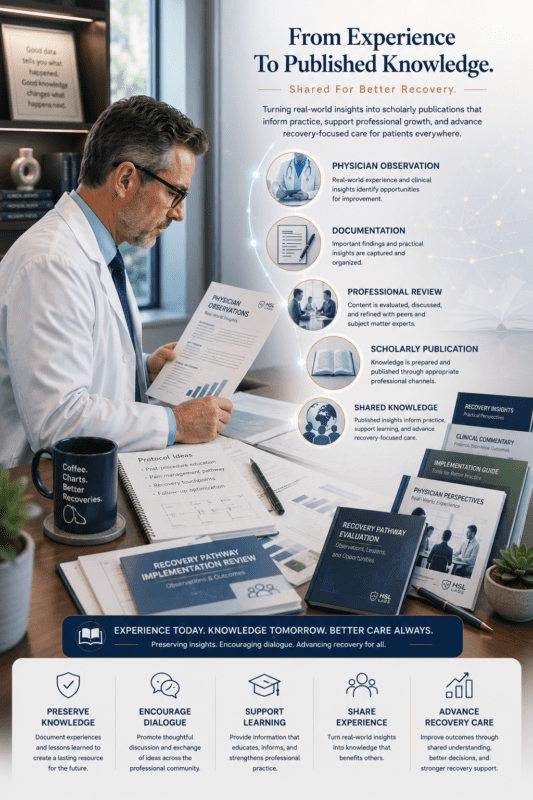
Advancing Knowledge Through Publication
The advancement of healthcare depends not only upon innovation and implementation, but also upon the thoughtful exchange of knowledge. HSL LABS recognizes that meaningful progress is strengthened when observations, experiences, methodologies, and emerging ideas are documented, evaluated, discussed, and shared within the professional community. Through its support of scholarly publication, the Company seeks to contribute to an environment where knowledge can be preserved, refined, and made accessible to those working to improve recovery-focused care and patient outcomes.
Professional publications have long served as an important mechanism for advancing understanding across healthcare disciplines. While traditional research remains valuable, meaningful insights may also emerge from physician experiences, protocol development, implementation activities, patient engagement strategies, operational methodologies, educational initiatives, technology applications, and organizational learning efforts. By encouraging the development and dissemination of professionally relevant content, HSL LABS seeks to support ongoing dialogue and the continuous expansion of practical knowledge.
The Company views scholarly publication as an educational and professional undertaking rather than a promotional activity. Publications provide opportunities to preserve institutional knowledge, encourage intellectual discipline, support professional collaboration, and create lasting resources that may benefit physicians, participating practices, researchers, advisors, and healthcare organizations. Through these efforts, HSL LABS seeks to contribute to a culture of learning, inquiry, and professional engagement that supports the continued evolution of recovery-focused medicine.
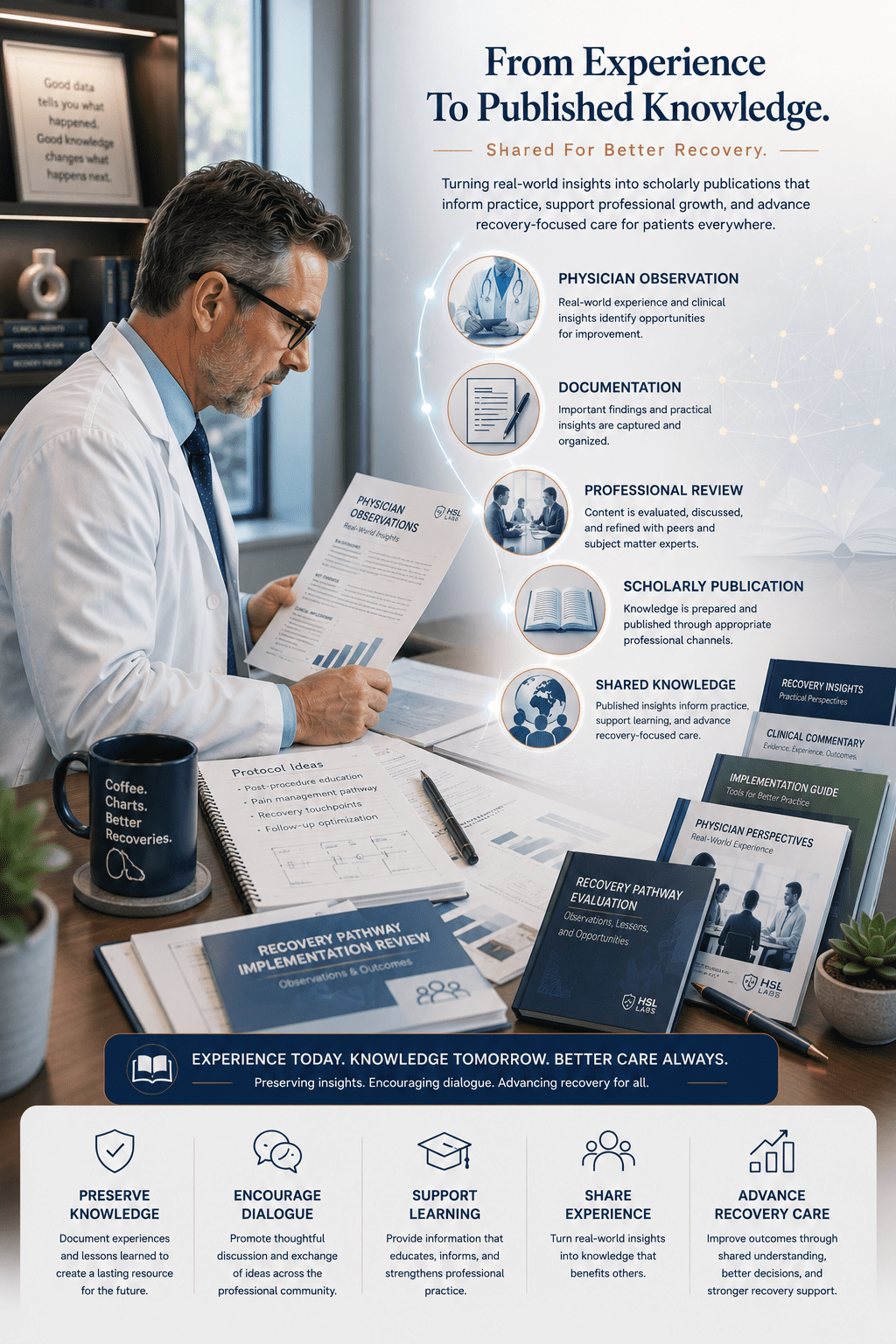
SPONSORING SCHOLARLY PUBLICATION
HSL LABS believes that meaningful advancement within healthcare depends upon the systematic exchange of knowledge. While programs, protocols, technologies, educational initiatives, and products may contribute to practical improvements in patient care and recovery support, the long-term advancement of any discipline also requires the publication, evaluation, discussion, and preservation of professional knowledge.
For this reason, the Company supports the concept of scholarly publication as an important component of its broader commitment to education, organizational learning, physician participation, and recovery-focused innovation.
The healthcare community has historically relied upon professional publications to document observations, communicate findings, share methodologies, evaluate emerging concepts, encourage professional discourse, and create permanent records of evolving knowledge. HSL LABS recognizes the importance of these functions and seeks to contribute to a culture in which ideas are examined, documented, challenged, refined, and shared through appropriate scholarly channels.
The Company’s interest in scholarly publication extends beyond traditional research studies alone. Valuable contributions may also emerge from physician observations, protocol-development experiences, implementation evaluations, educational initiatives, operational methodologies, technology applications, patient-engagement strategies, recovery-support programs, governance frameworks, and other areas that may provide useful insight to healthcare professionals and participating practices.
As organizational capabilities expand, HSL LABS intends to encourage the development of publications that address topics relevant to recovery-focused care and procedural medicine. Potential subject areas may include post-procedural recovery methodologies, patient education, protocol design, physician engagement strategies, recovery-support technologies, operational implementation models, observational findings, workflow integration, organizational learning systems, and other topics that contribute to professional understanding.
The Company also recognizes the importance of physician authorship and professional collaboration. Practicing physicians frequently possess valuable experience and practical knowledge derived from real-world patient care environments. HSL LABS therefore supports opportunities for physicians, advisors, researchers, and other qualified contributors to participate in the preparation, review, discussion, and dissemination of scholarly content relevant to the Company’s areas of interest.
An important objective of scholarly publication is the preservation of institutional knowledge. Healthcare organizations often accumulate significant practical experience over time, yet valuable observations and lessons may remain confined to individual practices or isolated professional interactions. Publication creates a mechanism through which such information can be documented, organized, preserved, and made accessible for future evaluation and discussion.
The Company additionally recognizes that scholarly publication contributes to accountability and intellectual discipline. The process of preparing information for publication often requires authors to clarify assumptions, organize evidence, articulate methodologies, identify limitations, and subject conclusions to review and professional scrutiny. These activities frequently strengthen the quality of the underlying work itself while promoting thoughtful evaluation and constructive discussion.
Future publication initiatives may involve white papers, technical reports, educational monographs, clinical commentaries, implementation guides, observational summaries, conference materials, collaborative publications, physician-authored articles, and other professional resources intended to support knowledge dissemination and professional development. The specific format may vary depending upon the subject matter, audience, and objectives of the publication.
The Company also anticipates opportunities to support broader professional dialogue through publication-related activities involving advisory participants, Clinical Advisory Council members, Designated Clinical Research and Data Facilities, educational contributors, and other qualified professionals. These collaborative efforts may help encourage the exchange of ideas while contributing to the ongoing development of recovery-focused knowledge.
Importantly, HSL LABS views scholarly publication not as a marketing activity, but as an educational and professional undertaking. The objective is not merely to promote organizational initiatives, but to contribute thoughtfully to discussions involving recovery, procedural medicine, patient support, healthcare operations, technology utilization, and other subjects relevant to the healthcare professionals and organizations the Company serves.
Ultimately, sponsoring scholarly publication reflects a broader organizational commitment to learning, inquiry, documentation, and professional engagement. By supporting the development and dissemination of thoughtful, well-prepared, and professionally relevant content, HSL LABS seeks to contribute to the continued growth of knowledge within the evolving field of recovery-focused care.
Turning Questions Into Discovery
Progress often begins with a simple question. Whether identifying opportunities to improve recovery outcomes, evaluating implementation strategies, assessing patient engagement approaches, exploring technology utilization, or examining real-world clinical observations, meaningful advancement depends upon the ability to investigate important questions in a structured and disciplined manner. HSL LABS views study design as the foundation upon which reliable learning, informed decision-making, and recovery-focused innovation are built.
Effective studies do not begin with data collection alone. They begin with clearly defined objectives, thoughtful planning, physician participation, practical evaluation criteria, and methodologies designed to generate useful information. By establishing structured pathways for investigation, HSL LABS seeks to ensure that observational efforts remain focused, relevant, and capable of producing insights that can support better programs, stronger protocols, enhanced technologies, improved educational initiatives, and more informed organizational decisions.
The Company believes that study design should balance scientific discipline with practical applicability. Investigative efforts are most valuable when they remain connected to the realities of patient care, physician workflows, operational implementation, and recovery-focused outcomes. Through physician involvement, governance oversight, standardized methodologies, and structured review processes, HSL LABS seeks to transform observations, questions, and emerging opportunities into meaningful organizational knowledge that can help guide future innovation and continuous improvement.
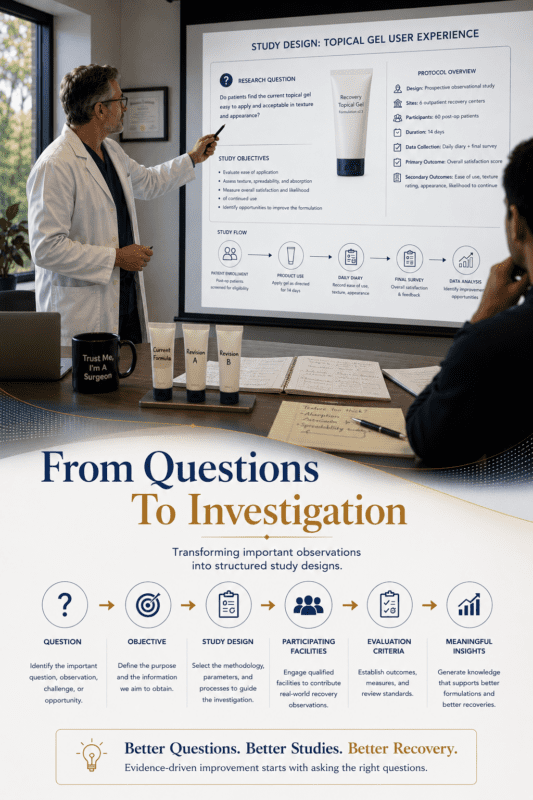
Turning Questions Into Discovery
Progress often begins with a simple question. Whether identifying opportunities to improve recovery outcomes, evaluating implementation strategies, assessing patient engagement approaches, exploring technology utilization, or examining real-world clinical observations, meaningful advancement depends upon the ability to investigate important questions in a structured and disciplined manner. HSL LABS views study design as the foundation upon which reliable learning, informed decision-making, and recovery-focused innovation are built.
Effective studies do not begin with data collection alone. They begin with clearly defined objectives, thoughtful planning, physician participation, practical evaluation criteria, and methodologies designed to generate useful information. By establishing structured pathways for investigation, HSL LABS seeks to ensure that observational efforts remain focused, relevant, and capable of producing insights that can support better programs, stronger protocols, enhanced technologies, improved educational initiatives, and more informed organizational decisions.
The Company believes that study design should balance scientific discipline with practical applicability. Investigative efforts are most valuable when they remain connected to the realities of patient care, physician workflows, operational implementation, and recovery-focused outcomes. Through physician involvement, governance oversight, standardized methodologies, and structured review processes, HSL LABS seeks to transform observations, questions, and emerging opportunities into meaningful organizational knowledge that can help guide future innovation and continuous improvement.
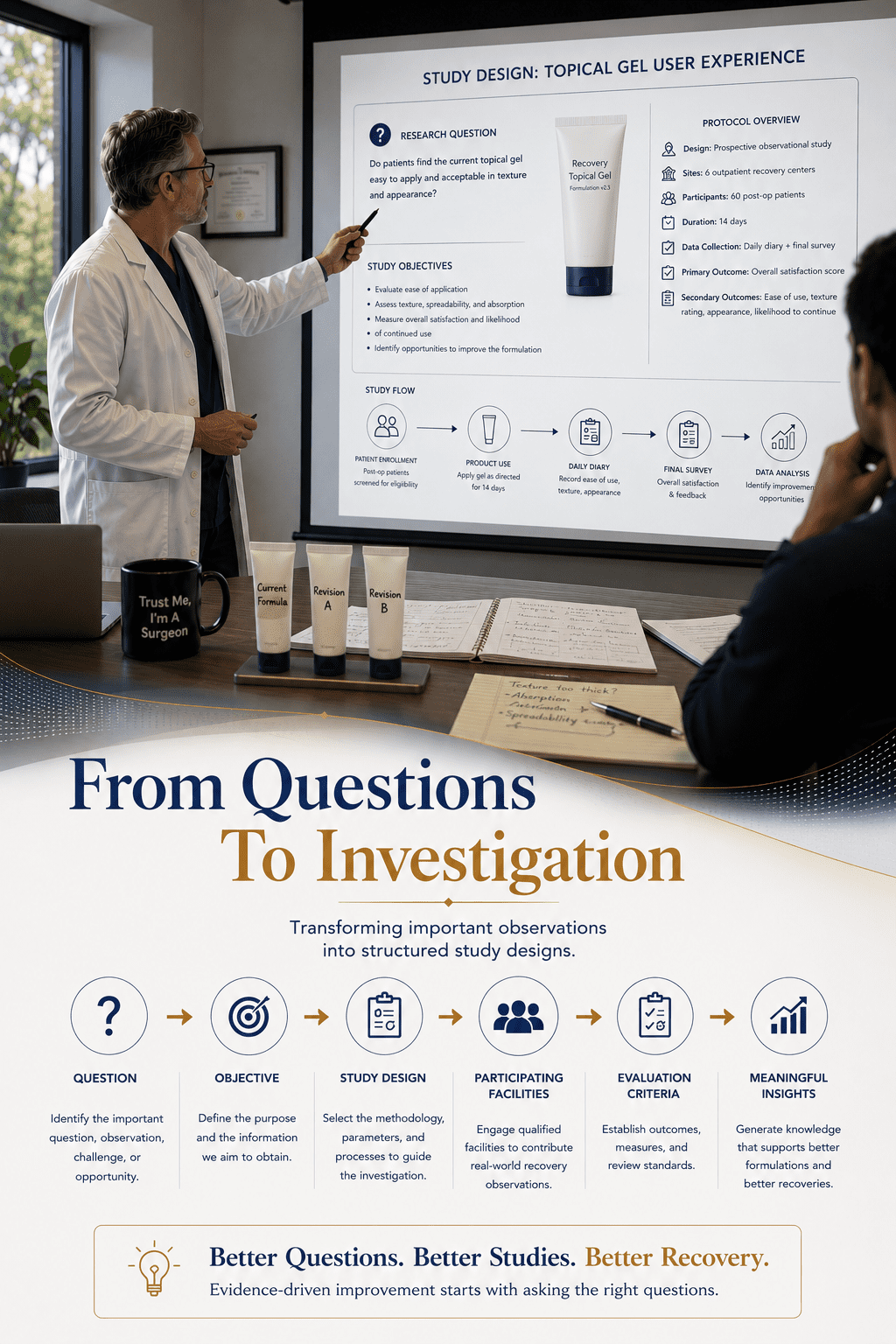
DESIGNING STUDIES
HSL LABS views study design as a structured process through which important questions are transformed into organized investigative activities. Whether the objective is to evaluate recovery-support methodologies, assess protocol implementation, examine patient-engagement strategies, explore technology utilization, or investigate emerging recovery-related observations, the quality of a study often depends upon the quality of its design.
The Company’s approach begins with the identification of a clearly defined question, observation, challenge, opportunity, or area of uncertainty. These may originate from participating physicians, Designated Clinical Research and Data Facilities, Clinical Advisory Council members, Internal Executive Briefing discussions, Committee Review activities, peer review observations, technology evaluations, educational initiatives, operational experiences, or other organizational learning mechanisms.
Once a topic has been identified, the first objective is typically to determine whether the question warrants formal investigation. Factors that may influence this determination include potential relevance to recovery-focused care, physician interest, operational significance, implementation feasibility, availability of observational information, organizational priorities, and the potential value of the resulting findings.
When a study opportunity is approved for further development, investigators may begin defining objectives, evaluation criteria, information requirements, reporting methodologies, participating facilities, observational parameters, review procedures, and anticipated outcomes. The Company seeks to establish clear goals at the outset of the design process to help ensure that investigative activities remain focused and purposeful.
Participating Designated Clinical Research and Data Facilities may play an important role in many study initiatives. Because these facilities operate within real-world surgical and procedural environments, they may contribute observations, implementation experiences, recovery-related information, operational feedback, educational assessments, technology-utilization data, and other approved forms of reporting. Their participation helps ensure that investigative efforts remain connected to practical clinical realities rather than relying exclusively upon theoretical assumptions.
Study designs may vary depending upon the nature of the question being examined. In some cases, observational methodologies may be appropriate. In others, comparative evaluations, implementation studies, workflow analyses, educational assessments, technology-utilization reviews, patient-engagement evaluations, or longitudinal monitoring activities may provide the most useful information. The selected methodology is expected to reflect the objectives of the study and the nature of the information being sought.
Physician participation is considered an important component of the design process. Physicians frequently contribute practical insight regarding procedural considerations, recovery timelines, patient behaviors, implementation realities, reporting feasibility, and clinically relevant endpoints. These perspectives help improve the relevance and practicality of investigative efforts while supporting study designs that are more likely to generate useful information.
Technology resources may also contribute to study design activities. PhysicianOS™, Physician Dashboards, reporting systems, and other approved technology platforms may assist with information collection, documentation management, reporting standardization, workflow coordination, longitudinal tracking, and other administrative functions associated with approved investigative activities.
The Company places significant emphasis on consistency and documentation. Study protocols, reporting requirements, observational criteria, information-collection procedures, review methodologies, and evaluation frameworks may be documented before implementation to promote reliability, comparability, and organizational accountability throughout the investigative process.
Once a study design has been developed, it may be subjected to review through established governance mechanisms. Depending upon the nature of the initiative, this review may involve the Internal Executive Briefing System, Committee Review activities, Clinical Advisory Council participation, peer review processes, executive evaluation, or other organizational pathways intended to strengthen the quality and credibility of the proposed study.
Importantly, HSL LABS does not view study design as a purely academic exercise. The ultimate objective is to generate information that may contribute to better programs, stronger protocols, more effective educational initiatives, enhanced technologies, improved operational systems, and more informed organizational decision-making. Accordingly, practical applicability remains an important consideration throughout the design process.
As organizational capabilities continue to expand, HSL LABS expects study-design activities to play an increasingly important role in supporting physician-informed innovation, organizational learning, technology development, protocol refinement, educational advancement, and recovery-focused research initiatives. Through disciplined study design, the Company seeks to create a structured pathway through which important questions can be investigated, evaluated, and translated into meaningful organizational knowledge.
Ultimately, designing studies is the process through which curiosity becomes investigation, observation becomes methodology, and questions become opportunities for learning. By applying structure, discipline, physician participation, and operational oversight to the design process, HSL LABS seeks to strengthen the quality, relevance, and usefulness of the information that informs its future direction.
Recognizing Commitment. Advancing Excellence.
Professional standards are strengthened when education, experience, competency, and accountability work together. As post-procedure recovery continues to evolve as an important area of healthcare focus, certification programs help establish meaningful benchmarks that recognize individuals who have demonstrated specialized knowledge, professional engagement, and a commitment to supporting better recovery experiences. Certification provides a structured pathway through which physicians, specialists, and healthcare personnel can distinguish themselves through ongoing learning, professional participation, and adherence to recognized standards of excellence.
HSL LABS is proud to support the certification initiatives of the Post-Procedure Research Institute (PPRI) as a Founding Sponsor. These programs are designed to help promote consistency, encourage continuing education, recognize professional achievement, and strengthen the development of recovery-focused care. By creating objective standards for participation, competency, and professional growth, certification programs help foster a culture of accountability while encouraging the advancement of recovery science and implementation practices.
Professional certification represents more than the successful completion of coursework or examinations. It reflects a commitment to lifelong learning, ethical conduct, patient support, professional development, and continuous improvement. Through physician certification, specialist credentialing, educational initiatives, and ongoing professional engagement, these programs help build a growing community of professionals dedicated to improving recovery outcomes, enhancing patient experiences, and advancing the standards of post-procedural care.

Recognizing Commitment. Advancing Excellence.
Professional standards are strengthened when education, experience, competency, and accountability work together. As post-procedure recovery continues to evolve as an important area of healthcare focus, certification programs help establish meaningful benchmarks that recognize individuals who have demonstrated specialized knowledge, professional engagement, and a commitment to supporting better recovery experiences. Certification provides a structured pathway through which physicians, specialists, and healthcare personnel can distinguish themselves through ongoing learning, professional participation, and adherence to recognized standards of excellence.
HSL LABS is proud to support the certification initiatives of the Post-Procedure Research Institute (PPRI) as a Founding Sponsor. These programs are designed to help promote consistency, encourage continuing education, recognize professional achievement, and strengthen the development of recovery-focused care. By creating objective standards for participation, competency, and professional growth, certification programs help foster a culture of accountability while encouraging the advancement of recovery science and implementation practices.
Professional certification represents more than the successful completion of coursework or examinations. It reflects a commitment to lifelong learning, ethical conduct, patient support, professional development, and continuous improvement. Through physician certification, specialist credentialing, educational initiatives, and ongoing professional engagement, these programs help build a growing community of professionals dedicated to improving recovery outcomes, enhancing patient experiences, and advancing the standards of post-procedural care.
PROFESSIONAL CERTIFICATIONS
HSL LABS believes that meaningful professional standards require more than education alone. Knowledge must be demonstrated, competency must be validated, and professional conduct must be maintained over time. For this reason, HSL LABS proudly supports the certification programs of the Post-Procedure Research Institute, Inc. (PPRI), for which HSL LABS serves as a Founding Sponsor.
The certification programs established by PPRI are intended to recognize physicians, specialists, and key healthcare personnel who have demonstrated a commitment to advancing the science, practice, and professional standards of post-procedure recovery. These certifications help establish objective benchmarks for education, participation, professional engagement, and adherence to recognized recovery-focused principles.
As recovery science continues to emerge as an increasingly important component of procedural medicine, credentialing programs provide an important mechanism through which healthcare professionals may distinguish themselves through specialized training, ongoing education, professional participation, and demonstrated commitment to patient recovery and healing.
CERTIFIED PHYSICIAN/SPECIALIST
The Certified Physician/Specialist designation is awarded by PPRI to physicians who satisfy the Institute’s established qualification standards and who maintain good standing within the program.
To qualify, physicians must generally maintain an active and unrestricted medical license, remain in good standing with applicable regulatory and professional organizations, demonstrate meaningful clinical involvement in post-procedural recovery, and actively participate in educational, research, protocol-development, or other Institute-sponsored initiatives. Certified physicians are also expected to adhere to applicable PPRI standards, guidelines, ethical principles, and recovery-focused best practices.
The certification recognizes physicians who not only perform cosmetic, reconstructive, procedural, or surgical interventions, but who also demonstrate a commitment to advancing the understanding and implementation of post-procedure recovery principles designed to support healing, optimize outcomes, and improve the patient experience.
Certification is subject to periodic review and renewal by PPRI and reflects ongoing participation in activities that contribute to the advancement of the field.
CERTIFIED POST-PROCEDURE RECOVERY SPECIALIST
The Certified Post-Procedure Recovery Specialist designation is awarded to qualified healthcare professionals who successfully complete the educational and competency requirements established by PPRI.
Certification requires completion of a rigorous course of study sponsored by the Institute, including an extensive educational curriculum and successful completion of a comprehensive examination demonstrating proficiency in the principles of post-procedure recovery. Certified specialists are also required to satisfy continuing education requirements established by PPRI in order to maintain their designation.
Eligible participants may include licensed healthcare professionals such as registered nurses, nurse practitioners, physician assistants, surgical technicians, and other qualified personnel employed by physician practices that are certified and in good standing with PPRI.
Certified Post-Procedure Recovery Specialists are expected to possess a working knowledge of recovery-support methodologies, patient education, recovery management principles, protocol implementation, patient engagement strategies, and other important components of the post-procedural recovery process. They also agree to uphold PPRI standards relating to patient safety, ethical conduct, professional responsibility, and clinical integrity.
ADVANCING PROFESSIONAL STANDARDS
HSL LABS believes that certification programs play an important role in establishing professional standards within emerging disciplines. By recognizing demonstrated knowledge, encouraging continuing education, promoting accountability, and supporting professional development, certification programs help strengthen both individual competency and the broader recovery-support community.
The Company is proud to support the educational, testing, certification, and professional-development initiatives of PPRI and its efforts to advance post-procedure recovery as a recognized area of professional focus. Through these programs, physicians, specialists, and key healthcare personnel are provided with meaningful opportunities to demonstrate expertise, expand their knowledge, and contribute to the continued advancement of recovery-focused care.
Ultimately, professional certification represents more than the completion of a course of study. It reflects a commitment to learning, professional growth, patient support, ethical conduct, and the pursuit of excellence in post-procedure recovery. Through its support of PPRI certification programs, HSL LABS seeks to help foster a community of professionals dedicated to improving recovery experiences and optimizing patient outcomes.
Building Centers of Recovery Excellence
Advancing post-procedure recovery requires more than the efforts of individual physicians. Meaningful progress is strengthened when physician practices, surgical facilities, recovery-focused organizations, and healthcare teams actively participate in education, research, protocol development, technology evaluation, and organizational learning. Clinical designation programs are intended to recognize organizations that demonstrate a commitment to these broader efforts and contribute to the continued advancement of recovery-focused care.
Unlike professional certifications, which acknowledge the achievements and qualifications of individual healthcare professionals, clinical designations recognize institutional engagement and organizational participation. Designated facilities serve as important environments where recovery methodologies can be observed, evaluated, refined, and strengthened through real-world implementation. Their contributions help bridge the gap between theoretical concepts and practical clinical experience, ensuring that future initiatives remain grounded in physician-directed care and everyday patient realities.
Participating facilities also play an important role in fostering collaboration across the recovery ecosystem. Through educational initiatives, observational programs, protocol assessments, advisory activities, technology evaluations, and professional engagement opportunities, designated organizations contribute to a growing body of knowledge that benefits physicians, healthcare professionals, patients, and participating practices alike. By supporting continuous learning and organizational improvement, these facilities help strengthen the foundation upon which future recovery innovations, standards, and educational programs are built.
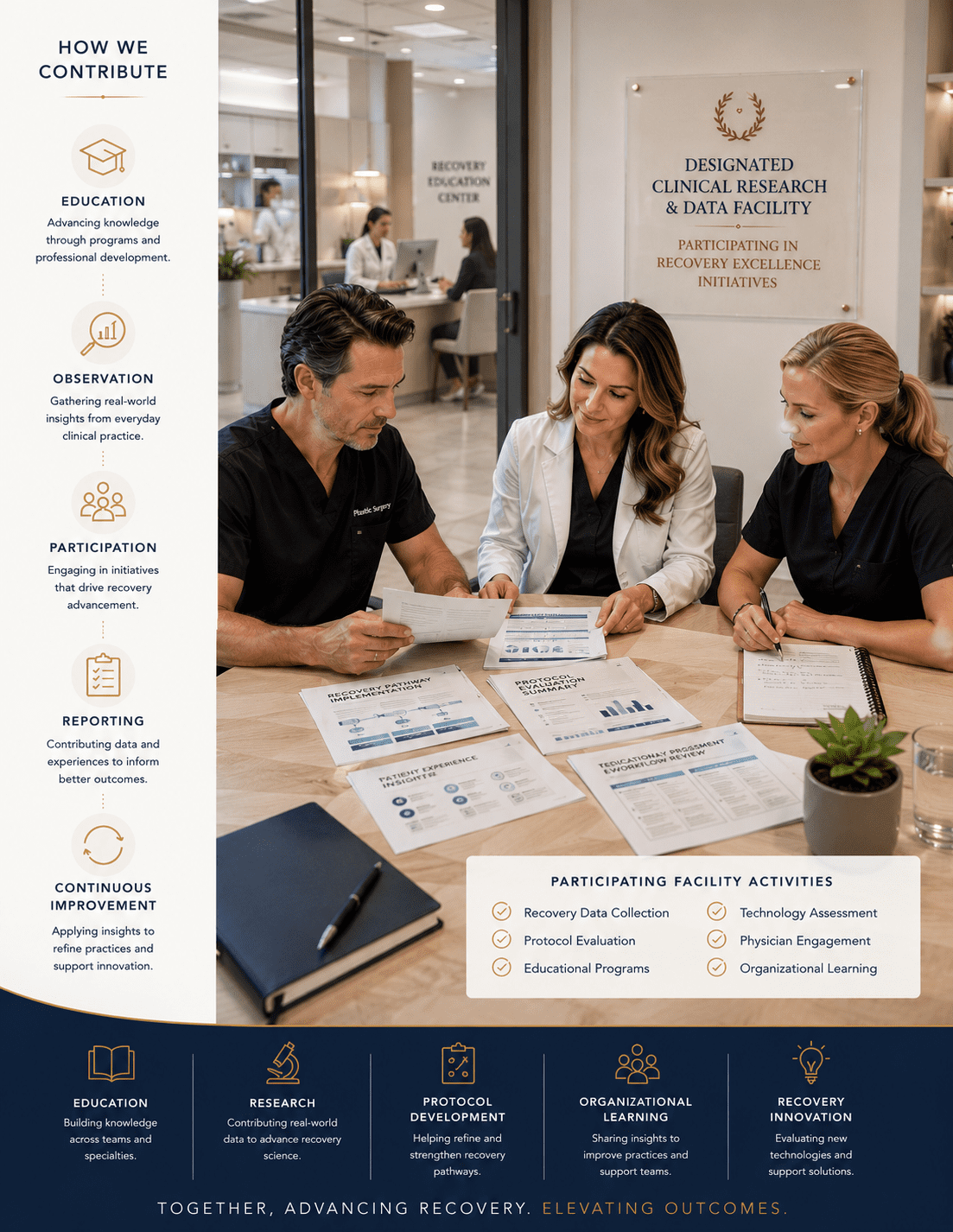
Building Centers of Recovery Excellence
Advancing post-procedure recovery requires more than the efforts of individual physicians. Meaningful progress is strengthened when physician practices, surgical facilities, recovery-focused organizations, and healthcare teams actively participate in education, research, protocol development, technology evaluation, and organizational learning. Clinical designation programs are intended to recognize organizations that demonstrate a commitment to these broader efforts and contribute to the continued advancement of recovery-focused care.
Unlike professional certifications, which acknowledge the achievements and qualifications of individual healthcare professionals, clinical designations recognize institutional engagement and organizational participation. Designated facilities serve as important environments where recovery methodologies can be observed, evaluated, refined, and strengthened through real-world implementation. Their contributions help bridge the gap between theoretical concepts and practical clinical experience, ensuring that future initiatives remain grounded in physician-directed care and everyday patient realities.
Participating facilities also play an important role in fostering collaboration across the recovery ecosystem. Through educational initiatives, observational programs, protocol assessments, advisory activities, technology evaluations, and professional engagement opportunities, designated organizations contribute to a growing body of knowledge that benefits physicians, healthcare professionals, patients, and participating practices alike. By supporting continuous learning and organizational improvement, these facilities help strengthen the foundation upon which future recovery innovations, standards, and educational programs are built.
CLINICAL DESIGNATIONS
HSL LABS believes that advancing the science and practice of post-procedure recovery requires more than individual professional achievement. It also requires the active participation of physician practices, surgical facilities, recovery-focused clinical environments, and other organizations committed to supporting education, research, innovation, protocol development, and organizational learning.
For this reason, HSL LABS supports the development of clinical designation programs intended to recognize participating practices and facilities that demonstrate meaningful engagement in recovery-focused initiatives and contribute to the advancement of post-procedural recovery as an emerging area of professional focus.
Unlike professional certifications, which recognize the qualifications and accomplishments of individual physicians and healthcare professionals, clinical designations recognize organizational participation, institutional commitment, and ongoing contributions to recovery-related activities.
Designated organizations may participate in a variety of educational, research, observational, technology-evaluation, protocol-development, and organizational-learning initiatives. Such participation helps strengthen the connection between real-world clinical practice and the ongoing development of programs, protocols, technologies, educational resources, and recovery-support methodologies.
One important example is the Designated Clinical Research and Data Facility Program. Participating facilities within this program may contribute observational information, implementation experiences, recovery-related data, protocol assessments, workflow observations, educational evaluations, and other approved forms of reporting that support organizational learning and future development efforts.
These facilities play an important role in helping HSL LABS better understand recovery experiences across diverse procedural categories and clinical environments. By contributing information derived from actual patient-care settings, participating facilities help ensure that future organizational initiatives remain informed by practical experience and physician-directed clinical realities.
Clinical designations may also recognize participation in educational initiatives, physician-development programs, advisory activities, protocol evaluations, technology assessments, professional discussions, and other organizational efforts intended to advance the field of post-procedure recovery.
Designation standards may include factors such as physician participation, professional certifications, educational engagement, protocol utilization, reporting activities, organizational cooperation, ethical conduct, commitment to patient-centered recovery principles, and ongoing involvement in approved initiatives. Specific designation criteria may vary according to the nature and objectives of a particular program.
The Company believes that designated facilities can serve as valuable centers of learning, collaboration, and professional engagement. Through their participation, these organizations contribute to the exchange of knowledge, the evaluation of emerging methodologies, the refinement of recovery-support practices, and the continued development of educational and professional standards.
Clinical designations may additionally provide opportunities for greater collaboration among participating physicians, healthcare professionals, researchers, educators, advisors, and organizational leaders. These relationships help foster the exchange of ideas while creating structured pathways through which observations, experiences, and recommendations may contribute to broader organizational initiatives.
Importantly, designation is not intended to represent endorsement of a particular physician, treatment, procedure, or clinical outcome. Rather, it reflects participation in defined educational, research, observational, and organizational activities associated with the advancement of post-procedure recovery and healing.
As HSL LABS and its affiliated initiatives continue to evolve, clinical designation programs are expected to play an increasingly important role in supporting physician engagement, organizational learning, educational advancement, protocol development, and recovery-focused innovation.
Ultimately, clinical designations recognize organizations that choose to contribute to something larger than their own individual practice activities. By participating in research, education, professional development, protocol refinement, and organizational learning initiatives, designated facilities help strengthen the collective knowledge base that supports the continued advancement of post-procedure recovery.
Building Meaningful Professional Standards
Professional certifications derive their value from the quality of the education, competency standards, and evaluation processes that support them. Meaningful credentialing programs require more than coursework alone—they depend upon carefully developed learning frameworks, relevant subject matter, practical competency expectations, and objective assessment methodologies designed to evaluate real-world understanding. By supporting the development of rigorous educational and examination standards, organizations help strengthen the credibility and long-term value of professional certification programs.
The advancement of post-procedure recovery as a professional discipline requires contributions from physicians, educators, researchers, clinical facilities, subject matter experts, and organizational leaders. Educational content and competency frameworks are most effective when they reflect practical clinical experience and implementation realities rather than theoretical concepts alone. Through collaboration among qualified contributors, certification programs can remain aligned with the evolving needs of physicians, healthcare professionals, and recovery-focused clinical environments.
Equally important is the integrity of the certification process itself. While educational contributors may assist in curriculum development, examination content, and competency design, independent administration and credentialing oversight help preserve objectivity and professional credibility. This balance between collaborative content development and independent certification administration supports accountability, promotes confidence in certification outcomes, and helps ensure that professional standards continue to evolve alongside advances in recovery-focused care.

Building Meaningful Professional Standards
Professional certifications derive their value from the quality of the education, competency standards, and evaluation processes that support them. Meaningful credentialing programs require more than coursework alone—they depend upon carefully developed learning frameworks, relevant subject matter, practical competency expectations, and objective assessment methodologies designed to evaluate real-world understanding. By supporting the development of rigorous educational and examination standards, organizations help strengthen the credibility and long-term value of professional certification programs.
The advancement of post-procedure recovery as a professional discipline requires contributions from physicians, educators, researchers, clinical facilities, subject matter experts, and organizational leaders. Educational content and competency frameworks are most effective when they reflect practical clinical experience and implementation realities rather than theoretical concepts alone. Through collaboration among qualified contributors, certification programs can remain aligned with the evolving needs of physicians, healthcare professionals, and recovery-focused clinical environments.
Equally important is the integrity of the certification process itself. While educational contributors may assist in curriculum development, examination content, and competency design, independent administration and credentialing oversight help preserve objectivity and professional credibility. This balance between collaborative content development and independent certification administration supports accountability, promotes confidence in certification outcomes, and helps ensure that professional standards continue to evolve alongside advances in recovery-focused care.
TEST DESIGN AND ADMINISTRATION
HSL LABS recognizes that meaningful professional certifications require more than educational materials alone. Effective credentialing programs depend upon carefully developed curricula, clearly defined competency standards, objective evaluation methodologies, and professionally administered examinations capable of assessing knowledge in a fair, consistent, and reliable manner.
As a Founding Sponsor of the Post-Procedure Research Institute (PPRI), HSL LABS actively supports the development of educational and certification initiatives intended to advance professional standards within the emerging field of post-procedure recovery. This support extends beyond sponsorship activities and includes meaningful participation in the development of educational content, competency frameworks, examination subject matter, and professional learning resources.
A substantial portion of the educational materials utilized within PPRI-sponsored certification programs may originate through the collaborative efforts of HSL LABS, participating physicians, Clinical Advisory Council members, Designated Clinical Research and Data Facilities, subject matter experts, educators, and other qualified contributors. These individuals provide practical knowledge, clinical observations, implementation experiences, recovery-related expertise, and professional perspectives that help shape educational content relevant to real-world recovery environments.
The educational-development process is intended to ensure that learning materials remain grounded in actual clinical experience rather than theoretical concepts alone. Recovery-support methodologies, patient-engagement principles, protocol implementation considerations, communication practices, workflow realities, educational strategies, and emerging developments within the field may all contribute to the development of course content and instructional materials.
HSL LABS and participating physician contributors may also assist in the development of examination subject matter and competency-assessment frameworks. Examination topics are intended to reflect the educational objectives of certification programs and may evaluate knowledge relating to post-procedure recovery principles, patient support methodologies, implementation practices, educational concepts, professional responsibilities, ethical considerations, and other relevant areas of competency.
Particular emphasis is placed on the development of examinations that assess practical understanding rather than simple memorization. The objective is to evaluate whether candidates possess a meaningful working knowledge of the principles, methodologies, and professional responsibilities associated with post-procedure recovery support.
The Company believes that examination development benefits significantly from physician participation. Physicians actively engaged in procedural medicine and recovery-focused initiatives frequently possess practical insights regarding the knowledge, skills, and competencies necessary for successful implementation within clinical environments. Their participation helps strengthen the relevance and applicability of educational and examination content.
Importantly, while HSL LABS and participating physicians may contribute to curriculum development, educational-content creation, and examination design activities, the administration of certification examinations and the issuance of professional certifications remain the responsibility of PPRI. This distinction helps preserve the integrity, objectivity, and independence of the certification process.
PPRI is responsible for establishing certification requirements, administering examinations, evaluating candidate performance, determining certification eligibility, maintaining certification records, issuing certificates, and overseeing ongoing certification activities. This separation of responsibilities supports appropriate governance while helping ensure that certification decisions remain within the authority of the credentialing organization.
The Company additionally supports periodic review and refinement of educational materials and examination content. As recovery science evolves, new information emerges, and implementation experience accumulates, opportunities may arise to update educational resources, revise competency standards, expand subject matter coverage, and improve evaluation methodologies. Ongoing review activities help ensure that certification programs remain relevant and professionally meaningful.
The collaborative relationship among HSL LABS, participating physicians, educational contributors, and PPRI creates a framework through which educational content, professional standards, and competency assessments may continue to evolve alongside the field itself. This model encourages both innovation and accountability while promoting the development of rigorous and practical certification programs.
Ultimately, test design and administration represent important components of a broader commitment to professional excellence. Through the development of high-quality educational materials, thoughtful competency frameworks, meaningful examination content, and independent certification administration, HSL LABS and PPRI seek to support the continued advancement of post-procedure recovery education and professional development.