


Turning Questions Into Discovery
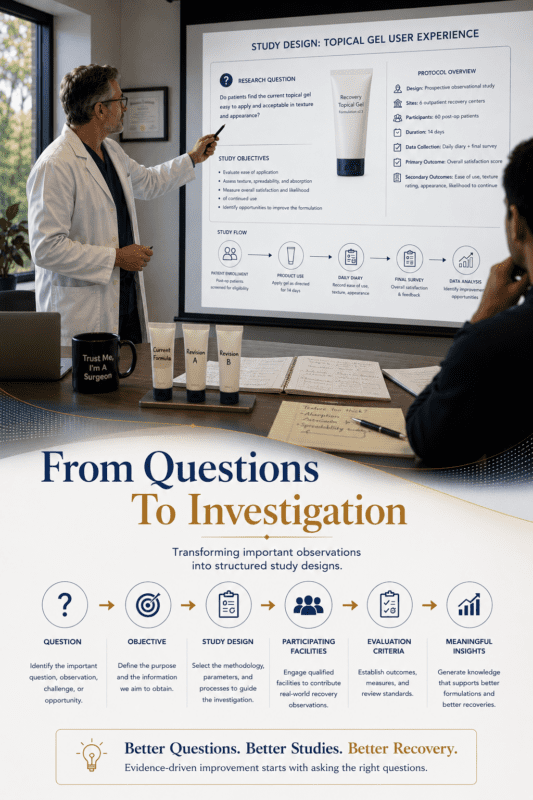
Progress often begins with a simple question. Whether identifying opportunities to improve recovery outcomes, evaluating implementation strategies, assessing patient engagement approaches, exploring technology utilization, or examining real-world clinical observations, meaningful advancement depends upon the ability to investigate important questions in a structured and disciplined manner. HSL LABS views study design as the foundation upon which reliable learning, informed decision-making, and recovery-focused innovation are built.
Effective studies do not begin with data collection alone. They begin with clearly defined objectives, thoughtful planning, physician participation, practical evaluation criteria, and methodologies designed to generate useful information. By establishing structured pathways for investigation, HSL LABS seeks to ensure that observational efforts remain focused, relevant, and capable of producing insights that can support better programs, stronger protocols, enhanced technologies, improved educational initiatives, and more informed organizational decisions.
The Company believes that study design should balance scientific discipline with practical applicability. Investigative efforts are most valuable when they remain connected to the realities of patient care, physician workflows, operational implementation, and recovery-focused outcomes. Through physician involvement, governance oversight, standardized methodologies, and structured review processes, HSL LABS seeks to transform observations, questions, and emerging opportunities into meaningful organizational knowledge that can help guide future innovation and continuous improvement.
Turning Questions Into Discovery
Progress often begins with a simple question. Whether identifying opportunities to improve recovery outcomes, evaluating implementation strategies, assessing patient engagement approaches, exploring technology utilization, or examining real-world clinical observations, meaningful advancement depends upon the ability to investigate important questions in a structured and disciplined manner. HSL LABS views study design as the foundation upon which reliable learning, informed decision-making, and recovery-focused innovation are built.
Effective studies do not begin with data collection alone. They begin with clearly defined objectives, thoughtful planning, physician participation, practical evaluation criteria, and methodologies designed to generate useful information. By establishing structured pathways for investigation, HSL LABS seeks to ensure that observational efforts remain focused, relevant, and capable of producing insights that can support better programs, stronger protocols, enhanced technologies, improved educational initiatives, and more informed organizational decisions.
The Company believes that study design should balance scientific discipline with practical applicability. Investigative efforts are most valuable when they remain connected to the realities of patient care, physician workflows, operational implementation, and recovery-focused outcomes. Through physician involvement, governance oversight, standardized methodologies, and structured review processes, HSL LABS seeks to transform observations, questions, and emerging opportunities into meaningful organizational knowledge that can help guide future innovation and continuous improvement.
DESIGNING STUDIES
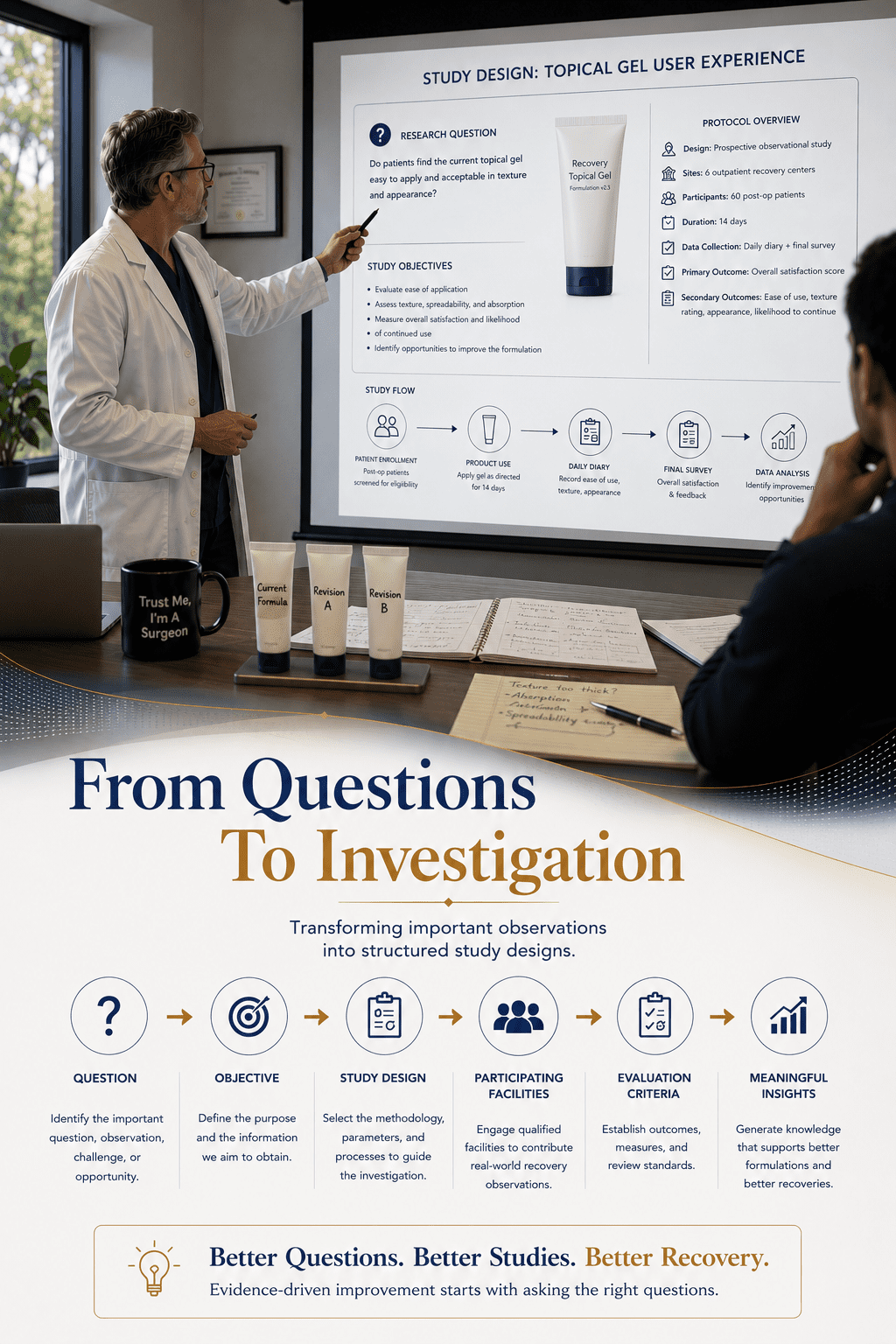
HSL LABS views study design as a structured process through which important questions are transformed into organized investigative activities. Whether the objective is to evaluate recovery-support methodologies, assess protocol implementation, examine patient-engagement strategies, explore technology utilization, or investigate emerging recovery-related observations, the quality of a study often depends upon the quality of its design.
The Company’s approach begins with the identification of a clearly defined question, observation, challenge, opportunity, or area of uncertainty. These may originate from participating physicians, Designated Clinical Research and Data Facilities, Clinical Advisory Council members, Internal Executive Briefing discussions, Committee Review activities, peer review observations, technology evaluations, educational initiatives, operational experiences, or other organizational learning mechanisms.
Once a topic has been identified, the first objective is typically to determine whether the question warrants formal investigation. Factors that may influence this determination include potential relevance to recovery-focused care, physician interest, operational significance, implementation feasibility, availability of observational information, organizational priorities, and the potential value of the resulting findings.
When a study opportunity is approved for further development, investigators may begin defining objectives, evaluation criteria, information requirements, reporting methodologies, participating facilities, observational parameters, review procedures, and anticipated outcomes. The Company seeks to establish clear goals at the outset of the design process to help ensure that investigative activities remain focused and purposeful.
Participating Designated Clinical Research and Data Facilities may play an important role in many study initiatives. Because these facilities operate within real-world surgical and procedural environments, they may contribute observations, implementation experiences, recovery-related information, operational feedback, educational assessments, technology-utilization data, and other approved forms of reporting. Their participation helps ensure that investigative efforts remain connected to practical clinical realities rather than relying exclusively upon theoretical assumptions.
Study designs may vary depending upon the nature of the question being examined. In some cases, observational methodologies may be appropriate. In others, comparative evaluations, implementation studies, workflow analyses, educational assessments, technology-utilization reviews, patient-engagement evaluations, or longitudinal monitoring activities may provide the most useful information. The selected methodology is expected to reflect the objectives of the study and the nature of the information being sought.
Physician participation is considered an important component of the design process. Physicians frequently contribute practical insight regarding procedural considerations, recovery timelines, patient behaviors, implementation realities, reporting feasibility, and clinically relevant endpoints. These perspectives help improve the relevance and practicality of investigative efforts while supporting study designs that are more likely to generate useful information.
Technology resources may also contribute to study design activities. PhysicianOS™, Physician Dashboards, reporting systems, and other approved technology platforms may assist with information collection, documentation management, reporting standardization, workflow coordination, longitudinal tracking, and other administrative functions associated with approved investigative activities.
The Company places significant emphasis on consistency and documentation. Study protocols, reporting requirements, observational criteria, information-collection procedures, review methodologies, and evaluation frameworks may be documented before implementation to promote reliability, comparability, and organizational accountability throughout the investigative process.
Once a study design has been developed, it may be subjected to review through established governance mechanisms. Depending upon the nature of the initiative, this review may involve the Internal Executive Briefing System, Committee Review activities, Clinical Advisory Council participation, peer review processes, executive evaluation, or other organizational pathways intended to strengthen the quality and credibility of the proposed study.
Importantly, HSL LABS does not view study design as a purely academic exercise. The ultimate objective is to generate information that may contribute to better programs, stronger protocols, more effective educational initiatives, enhanced technologies, improved operational systems, and more informed organizational decision-making. Accordingly, practical applicability remains an important consideration throughout the design process.
As organizational capabilities continue to expand, HSL LABS expects study-design activities to play an increasingly important role in supporting physician-informed innovation, organizational learning, technology development, protocol refinement, educational advancement, and recovery-focused research initiatives. Through disciplined study design, the Company seeks to create a structured pathway through which important questions can be investigated, evaluated, and translated into meaningful organizational knowledge.
Ultimately, designing studies is the process through which curiosity becomes investigation, observation becomes methodology, and questions become opportunities for learning. By applying structure, discipline, physician participation, and operational oversight to the design process, HSL LABS seeks to strengthen the quality, relevance, and usefulness of the information that informs its future direction.