

Recovery Visibility & Practice Oversight
Managing recovery often requires physicians and staff to coordinate information across patient communications, recovery activities, educational engagement, follow-up requirements, and operational workflows. As recovery progresses over days, weeks, and months, maintaining visibility into patient status and practice activities can become increasingly complex. The Physician Dashboard was designed to provide a centralized view of recovery-related information, helping practices maintain greater awareness of patient progress, participation, and recovery-support activities throughout the recovery journey.
By bringing recovery monitoring, patient engagement oversight, operational reporting, protocol management, communications, and practice-level insights into a single environment, the Physician Dashboard helps support more informed decision-making and improved workflow efficiency. The goal is not simply to provide access to information, but to help physicians and their teams identify opportunities for patient support, maintain greater visibility throughout recovery, and deliver a more organized, consistent, and connected recovery experience for both patients and practice staff.
Recovery Visibility & Practice Oversight
Managing recovery often requires physicians and staff to coordinate information across patient communications, recovery activities, educational engagement, follow-up requirements, and operational workflows. As recovery progresses over days, weeks, and months, maintaining visibility into patient status and practice activities can become increasingly complex. The Physician Dashboard was designed to provide a centralized view of recovery-related information, helping practices maintain greater awareness of patient progress, participation, and recovery-support activities throughout the recovery journey.
By bringing recovery monitoring, patient engagement oversight, operational reporting, protocol management, communications, and practice-level insights into a single environment, the Physician Dashboard helps support more informed decision-making and improved workflow efficiency. The goal is not simply to provide access to information, but to help physicians and their teams identify opportunities for patient support, maintain greater visibility throughout recovery, and deliver a more organized, consistent, and connected recovery experience for both patients and practice staff.
PHYSICIAN DASHBOARD
The Physician Dashboard serves as the primary operational interface through which participating physicians and authorized practice personnel interact with PhysicianOS™. Designed specifically for procedural practices participating in HSL LABS programs and initiatives, the dashboard provides centralized access to patient recovery information, protocol management tools, reporting resources, educational materials, communications, practice analytics, and administrative functions within a single integrated environment.
The dashboard was developed to address a common challenge within modern healthcare operations: the fragmentation of information across multiple systems, documents, communications channels, and administrative processes. By consolidating relevant recovery-related information and operational resources into a unified interface, the Physician Dashboard seeks to improve visibility, coordination, efficiency, and decision-making throughout the patient recovery lifecycle.
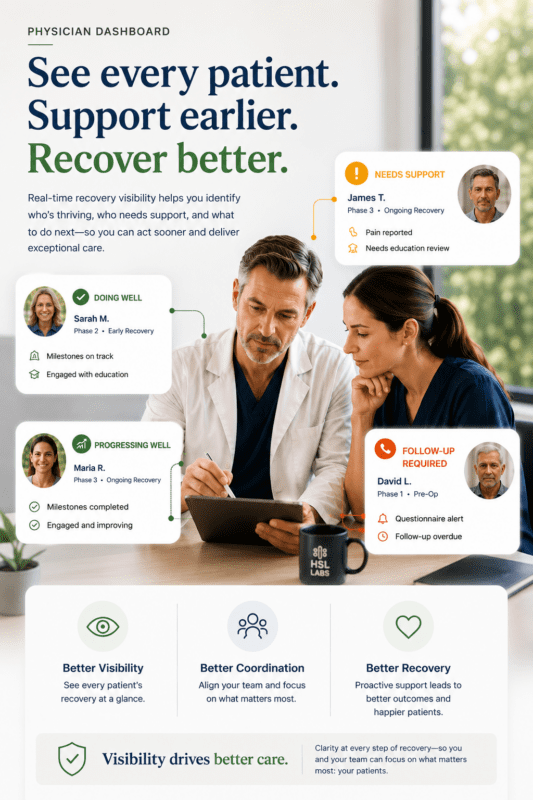
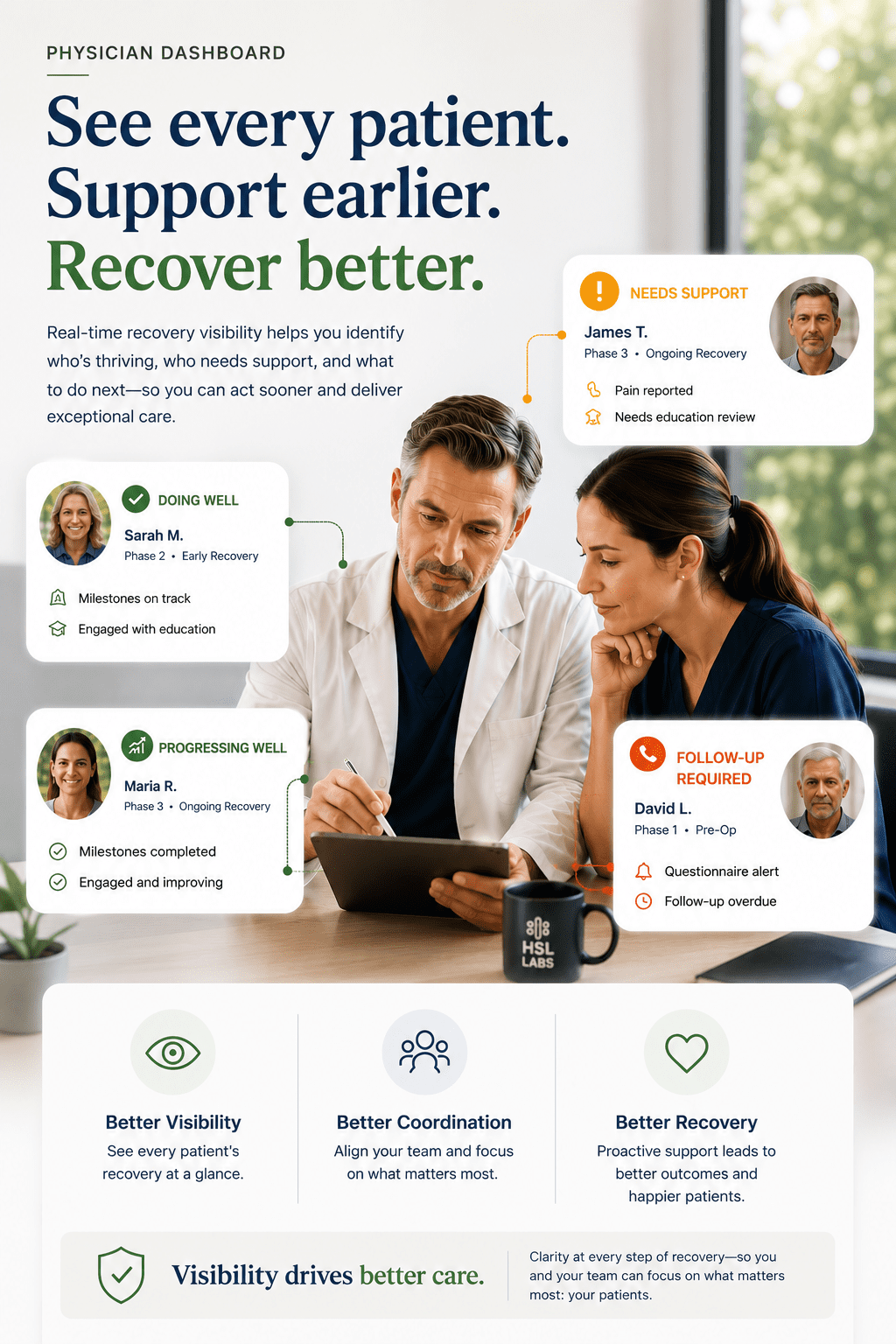
One of the dashboard’s primary functions is recovery monitoring. Participating physicians and authorized staff members may access information regarding enrolled patients, recovery-phase status, protocol participation, educational engagement, milestone completion, reporting activity, and other approved recovery-related indicators. This capability allows practices to maintain a more organized view of recovery activities while facilitating appropriate follow-up and patient support efforts.
The dashboard also supports protocol administration and implementation management. Physicians and staff may review protocol assignments, recovery-phase transitions, implementation guidance, protocol revisions, procedural-specific recommendations, educational materials, and related documentation. This helps ensure that practices are working from current information while reducing administrative complexity associated with protocol management.
Patient engagement oversight represents another important component of the system. The dashboard may provide visibility into patient participation activities, educational resource utilization, communication interactions, reporting compliance, follow-up requirements, and other engagement metrics. These tools help practices identify opportunities for additional patient support while encouraging continuity throughout the recovery process.
In addition to patient-specific functions, the dashboard provides practice-level operational reporting capabilities. Participating practices may access information regarding program utilization, enrollment activity, protocol implementation trends, reporting completion rates, patient participation metrics, educational engagement statistics, workflow performance indicators, and other operational measures relevant to practice participation within HSL LABS initiatives.
The Physician Dashboard is also intended to support quality management and performance evaluation activities. Practices may review implementation patterns, identify recurring operational challenges, evaluate recovery-support workflows, monitor participation consistency, and assess various aspects of program utilization. These capabilities assist physicians and staff in maintaining awareness of operational performance while identifying opportunities for improvement.
Communication management is integrated throughout the dashboard environment. Physicians and designated personnel may receive organizational announcements, protocol updates, Clinical Advisory Council communications, educational releases, technology notifications, implementation guidance, and other relevant information through a centralized communications framework. This helps reduce reliance upon fragmented communication channels while ensuring that important information remains accessible and documented.
The dashboard additionally serves as an access point for administrative and governance-related functions. Authorized users may review Internal Executive Briefing materials, committee communications, peer review activities, policy updates, training resources, compliance documentation, and other organizational information relevant to their roles and responsibilities. These capabilities help support transparency, accountability, and informed participation throughout the HSL LABS ecosystem.
A significant advantage of the Physician Dashboard is its ability to aggregate information from multiple operational activities into a single management environment. Rather than requiring physicians and staff to navigate separate systems for patient engagement, protocol management, reporting, communications, education, and administrative functions, the dashboard provides a consolidated view of relevant information and resources. This integration supports more efficient workflow management and reduces administrative burden within participating practices.
The dashboard is also designed to support longitudinal analysis and practice-level trend evaluation. Over time, participating physicians may be able to review historical participation data, recovery-support activities, educational utilization patterns, reporting trends, operational performance metrics, and other aggregated information that may assist in evaluating practice engagement and implementation effectiveness.
As PhysicianOS™ continues to evolve, the Physician Dashboard is expected to expand through the addition of enhanced reporting tools, workflow management capabilities, predictive analytics, communication resources, patient engagement features, and other functionality designed to support participating physicians and their practices. Future development priorities will continue to be informed by physician feedback, operational experience, technology evaluations, and recommendations emerging through the Company’s governance and review processes.
Ultimately, the Physician Dashboard functions as the operational command center for participating practices. By integrating recovery management, protocol administration, patient engagement oversight, reporting capabilities, communications, analytics, and administrative resources into a single environment, the dashboard helps physicians and their teams manage participation activities more efficiently while supporting informed decision-making throughout the recovery process.